

If you believe the Street, “buy the dip” has become scripture.
We talked extensively this week about the Fed doing everything it can to preserve its optionality going forward. That was readily apparent on Friday when Yellen and vice Chair Fischer adopted seemingly contradictory lines.
Optionality or no optionality, it’s starting to feel like we’re on a preset course - despite Yellen’s explicit assertions to the contrary. With each passing FOMC meeting it becomes ever more apparent that there’s no way out. That’s the inherent risk in throwing the kitchen sink at a problem. If the kitchen sink doesn’t work, then you’ve got nothing left. If the problem subsequently worsens, well, then you’re really stuck.
It’s all just a matter of counter cyclical breathing room. What’s becoming quite clear as we plunge ever deeper into the Keynesian rabbit hole is that zero really is the “lower bound.” These policies have literally stopped working altogether. In fact, as we’ve shown on any number of occasions, they’re starting to act counterintuitively (e.g. pushing FX higher instead of lower in Japan) as market participants effectively test policy makers in whom they’ve lost faith. It’s traders calling central bankers’ collective bluff.
Still, they (policy makers) control the cost of money, like it or not. And that means we’ve got a veritable tug-of-war unfolding and a perverse one at that. You’d think it would be policy makers trying to guard against bubbles and investors trying to drive assets to ever higher levels. But it almost feels like it’s the other way around. This has gone beyond looking for a “healthy correction.” We’re now in some kind of Krugman netherworld wherein a crash and a return to some semblance of creative destruction is the only thing that can ultimately right the ship.
But don’t hold your breath. As noted above, the powers that be are all-in on this one. It’s going to be really hard to explain why negative interest rates were a good idea if this whole thing crashes and burns. If you do something counterintuitive (like charge lenders for the privilege of lending) then you’d better make sure it works out. Otherwise, history will not be kind to you. And so, this charade will persist in perpetuity until it finally collapses on itself. In other words, the bubbles will keep getting bigger - until they don’t. Everyone now realizes this. Just ask Deutsche Bank, who was out Friday with the following rather disconcerting commentary:
“Various Fed officials have also raised the issue of financial stability in the context of the reach for yield and riskier products to make up for low rates. This is part of financial repression. The logic might be that once the Fed has normalized, elements of that reach for yield and risk would be unwound and this could lead to disruptive financial market volatility. We can illustrate this aspect of financial repression in terms of the equity market. In the post crisis world, all assets seem closely correlated to breakevens and real rates but with varying betas. We note that the equity market recently looks very expensive even to these rates through the shift in the beta on inflation expectations – so despite low inflation expectations, equities have done even better than otherwise warranted by low real rates. This shows up as a fall in the equity risk premium and defines well the hunt for yield in a repressive financial regime. We can also illustrate the extent to which this is unprecedented with the historical performance of the equity market. Decomposing equity returns into earnings growth, changes in P/E and changes in the risk premium shows that the bulk of equity performance is best captured by the shunt lower in equity risk premium.”
“We are inclined to expect persistent financial repression with low real rates at least until as and when the US economy slows enough to provoke a reactionary fiscal response. If we are right, in the meantime the Fed may flatten their dot plot to the market; the market can mildly bear steepen itself to the Fed’s dots. The case for a more dramatic steepening would be limited and in turn the case for a sharp retracement of risk assets also limited. We suspect the Fed’s insistence to raise again will therefore allow bouts of market price adjustment that are contained – whether intentional or not, this will placate those who are worried about the hunt for yield and market complacency. Buy the repression on dips.”
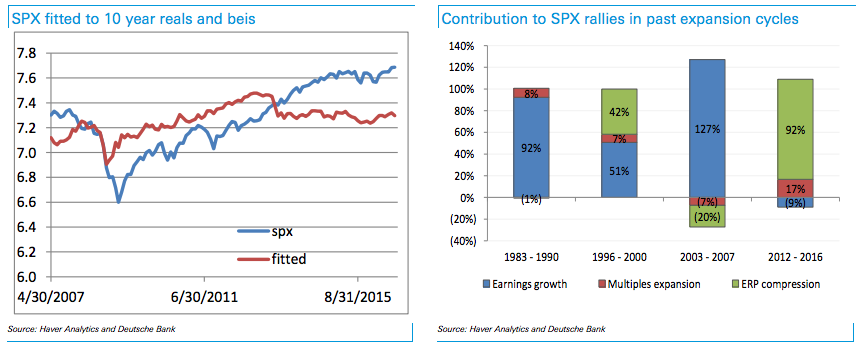
(Charts: Deutsche Bank)
There you go folks. “Buy the dip” is no longer a joke. It’s become a Street-sanctioned investment strategy.
Welcome to the Twilight Zone.