


Hey trader,
Shopify roared out of the gate this morning, up almost 10% on earnings.
As I write this, the stock has given up all its gains and then some.
But would you believe I saw this coming from a mile away?
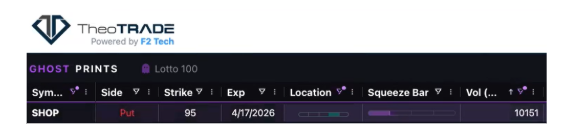
Yes, the Ghost Prints Surveillance Console tipped me off when it flagged a block trade of +10,000 put contracts near the open.
Most traders never realize they’re in a gap and trap until it’s too late.
You can change all that.
Today, I’m going to show you how I used the Ghost Prints Surveillance Console to predict the gap failure BEFORE it happened.
And better yet, I’ll give you a framework to turn this into a trade setup.
The Gap That Didn't Hold
Shopify reported before the open and gapped up to nearly $140.
The initial headlines focused on AI opportunity. But Q4 net income actually declined year over year, and the market started digesting that reality fast.
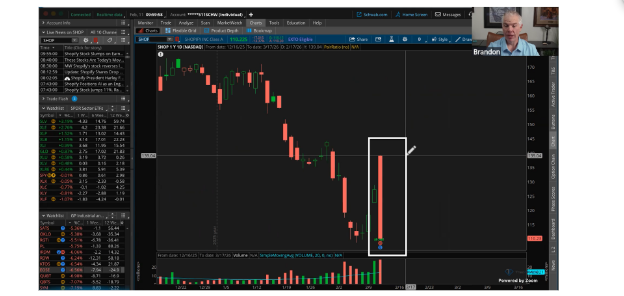
After the initial spike, SHOP ground sideways between $122 and $124 for about an hour. Then it broke lower and kept going.
The daily candle tells the story. A massive bearish engulfing pattern on huge volume, completely swallowing the overnight gap.
The initial reaction was positive. The sustained reaction was the opposite.
What 10,148 Contracts Tell You
At 9:48 AM, a single block trade hit the Ghost Prints Console. Someone bought 10,148 put contracts on the SHOP April expiration at the $105 strike.
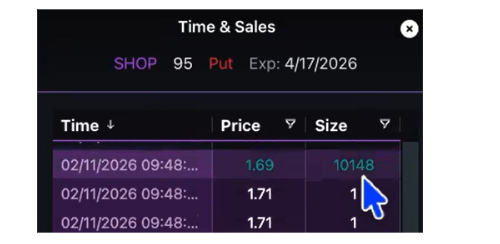
The open interest was just 667 contracts heading into the session. This trade was entirely new positioning.
The puts filled at the ask price, which confirms aggressive buying rather than passive selling. And the option time and sales showed no roll condition attached to this trade.
This was not someone closing out an old position or restructuring an existing trade. This was 10,148 new contracts opened in a single print at a strike 15% below where the stock was trading.
The Delta Shift Already Happening
At the time of the trade, the $105 puts carried a delta of just 10. The immediate hedging impact was minimal because the strike sat so far out of the money.
But SHOP has already dropped to around $110. That same $105 put now carries a delta of 23.
The delta has more than doubled in a single session. If SHOP continues drifting toward $105, that delta keeps climbing.
At $105 it approaches 50. Below $105, market makers start shorting stock aggressively to hedge.
The original trade targeted $95. That is the level where this position reaches its full impact, and the gamma squeeze mechanics take over as delta forces accelerating hedge activity from market makers.
The Entry Signal Hiding in the First 30 Minutes
The Ghost Prints Console tells you where institutional money is positioned. The question is when to enter.
One approach is the Opening Range Breakout. Take the first 30 minutes of trading and identify the high and low of that range.
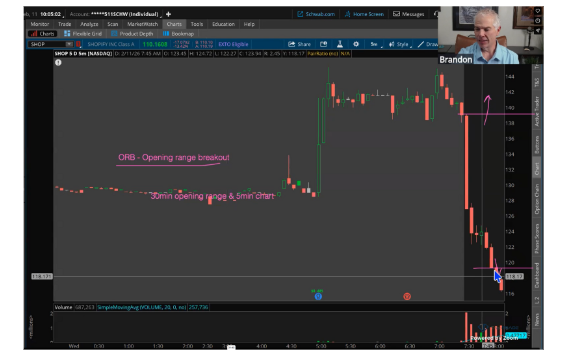
On a 5-minute chart, the first bar to close outside that range provides the entry. SHOP's opening range low sat at $119.
The first 5-minute bar to close below that range triggered the entry at $116.34. From that level, the stock dropped to $110 for a 6% move captured with a clear, rules-based trigger.
The ORB does not have to produce an intraday trade. It can serve as the entry for a swing position targeting the $95 level over the next several weeks.
The Volatility Factor
Post-earnings implied volatility was still elevated during the session. The front week expiration showed 111% IV with just two days remaining.
The next week sat at 74%. Both readings are well above normal for SHOP.
But 65 days out at the April expiration, IV stabilized around 60-64%. That level should settle further as the earnings reaction gets absorbed, making end-of-day entries more favorable than chasing the morning move.
The Trade Structure
A $110/$105 put vertical in the March 21 expiration captures the move toward the $95 target with defined risk.
The spread prices around $2.35 to $2.45 as a debit. The skew provides a slight edge since the put being bought carries lower implied volatility (63.3%) than the put being sold (63.7%).
Maximum risk is the debit paid. The $95 target does not need to be reached for this trade to profit.
If SHOP drops toward $105, the spread could return 50% on the debit.
With 60% implied volatility on a $110 stock, it does not take much to push through $105. But the current narrow volatility environment means taking profits earlier may be prudent rather than waiting for the full gamma squeeze to develop.
Why This Setup Matters
Earnings gaps that fail create powerful reversals because they trap the most traders on the wrong side.
The crowd bought the gap. Now they are holding losing positions and waiting for a bounce that may not come.
Every bounce attempt becomes a selling opportunity for trapped longs.
Meanwhile, 10,148 new put contracts sit at $105 with increasing delta as the stock approaches that level. The institutional position gains influence with each dollar lower.
The combination of trapped longs and mechanical hedge selling creates a feedback loop that someone positioned for this morning.
The Ghost Prints Console caught this trade in real time. The block size, the ask-side fill, and the absence of a roll condition all confirmed this was new, aggressive bearish positioning during what appeared to be a bullish earnings event.
That is the difference between reading headlines and reading institutional flow.
See exactly how Ghost Prints reveals institutional positioning before the crowd catches on.
Brandon Chapman, CMT
Creator of Ghost Prints