
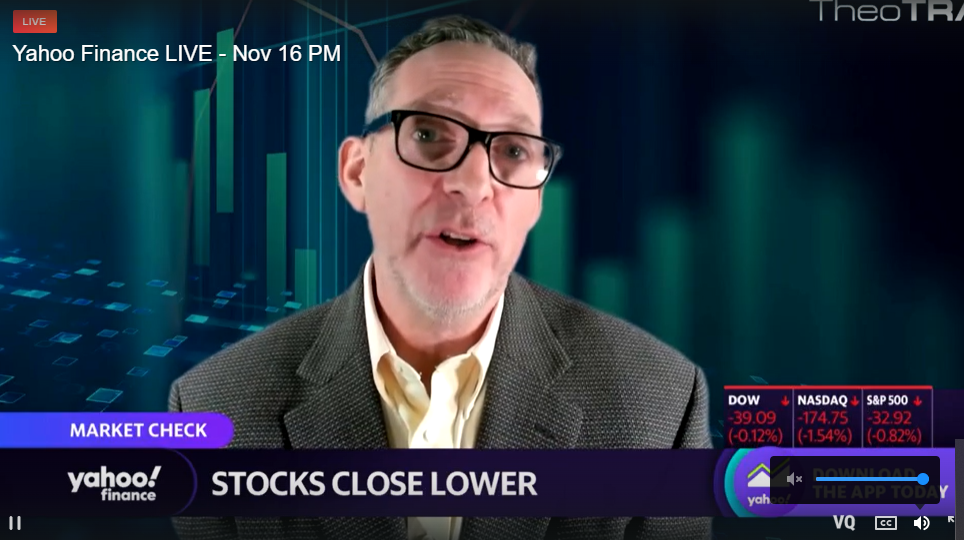
TheoTrade Chief Market Technician, Professor Jeff Bierman, CMT was a featured guest on “The Closing Bell,” on Yahoo Finance Live. Professor Bierman talks about the 15% rally in the market in the past month, and why he expects a short-term pull back. Overall, he expects a bull sentiment to the end of the year, and then trouble ahead into 2023 when the impact of inflation hits.
Professor Bierman also discusses the pressures and opportunities in the semiconductor sector See the full video here. See an excerpt of Bierman’s comments below.
Professor Jeff Bierman, Chief Market Technician, TheoTrade, on “The Closing Bell,” Yahoo Finance Live, 11/16/2022. Check out Jeff Bierman’s TheoTrade Master Class.
SEANA SMITH:
Jeff, the market's taking a bit of a breather today coming off of a couple of days of pretty solid gains, a lot of that driven by the CPI and PPI reports that we've gotten over the last several trading days. What's your takeaway?
JEFF BIERMAN:
We've rallied about a month ago, from 3,500 to about 4,000. That's about 15%. That's like a yearly gain in a month, so you've got to take that into consideration.
You also have to take into consideration that not only did Target sort of shot the Achilles heel of the market today in terms of retail, but you have to put into that mix the fact that, once again, Micron warned, and that lit a selling pressure fire onto semiconductors. So when you lose the participation of semiconductors and technology-- that's 15% to 20% of the market—that’s going to pullback in the market for the day.
Apart from that, the market is just short-term overbought. So I call this any excuse to pull back the market, at least for 24 hours. I don't think it's going to last that much longer. I think the market will regain its form maybe in a week or two and start its march towards the end of the year as the window dressing starts to take over.
SEANA SMITH:
Jeff, you mentioned that you expect a march higher market towards the end of the year after we get over some volatility here in the short term. I guess, here we are today, the S&P still below 4,000, where do you see us by year-end?
JEFF BIERMAN:
Well, about three or four weeks ago when I was around 3,500, 3,600, I had another interview, and I said about 4,100 to 4,125. That's the next major resistance level in the market, about 4,200. But when you get into that fourth quarter window dressing, like, race to the top, money managers are going to start to add winners to their portfolio and subtract losers. And this particular quarter has actually worked out to script. I mean, you couldn't draw it better like it was a Shakespearean play.
You bottom out in mid-October, which is exactly what you want. Then you can start a march up into the last 2 and 1/2 months into the end of the year. And the strength really coming from semiconductors, which got ridiculously cheap on that 10-year basis. And then you had strength from a lot of other collateral sectors.
But the one thing that stands out to me is, is that there's still a bifurcation in the market, meaning that a lot of traders are treating value as growth and treating growth as value. And until they kind of reconnect that bifurcation or disconnect, the market itself probably won't move that much higher. But you also have to take into consideration and something else and that is the bonds were up today. They were up on a day where the equities are down. That's very unusual because usually they correlate together.
So when you see that type of bearish divergence, it's a little bit of a signal saying, hey, a lot of people like tempering their enthusiasm maybe about the fourth quarter retail sales. But at the same time, they're seeing a competitive edge in buying 4% yields over trying to buy the S&P, which barely offers you about 1.64%. So you're starting to see the bond buying not as a function necessarily of maybe we've topped ticked as inflation, but more or less as a competitive yield to the stock market.
SEANA SMITH:
Jeff, how have you been looking at earnings because so far third quarter, it's been OK, but we know the bar was set very low. In terms of revisions or outlook for the current quarter, and then looking all the way out into 2023, do you think some of those expectations have further to fall?
JEFF BIERMAN:
Yeah, actually, I do. As a matter of fact, when you actually look at the four jumbo 75 basis point hikes, you're not seeing it now. It takes normally between 9 to 10 months to trickle down. So what the market's starting to tell you is, hey, we think that interest rates and inflation, that the ratcheting up, the parabolic move, is coming to an end.
But it's a double-edged sword because while the interest rates are starting to come down, what's already been baked into the economy is about 300 basis points, four times 75, that eventually is going to wear down a lot of these large-cap international companies. So I do expect growth to moderate. I do expect sales to moderate.
I don't expect it to fall off a cliff, but it's going to start to weigh on the market because the credit markets themselves, they're not at risk now, but once things start to slow down, then you're going to start to see people start to bandy about recession because the technical definition of recession is two quarters of negative GDP growth. We may not actually hit negative GDP growth, but we could still be in a recession just because companies' margins have been compressed so much by the rise in interest rates.
So I'm going to-- I think by February of 2023, you're really going to start to see the impact of interest rates impact a lot of these large-cap tech companies, and their growth is going to moderate. But I don't think it's going to fall off a cliff, by any means.