

Ok, so next week is obviously critical.
We’ve got the FOMC and the BoJ and as we’ve tried to emphasize, the BoJ may actually be more critical than the Fed. The Fed has plenty of reasons to go “full-Brainard” as it were and forestall a second rate hike. They’ve got a weak non-manufacturing ISM number to play on, a slightly disappointing August NFP number and, more recently, soft retail sales to cite.
Hiking risks driving up the dollar, driving up the cost of FX hedging long-end exposure for foreign buyers, and thus risks triggering a rather nasty VaR shock in US paper. That, in turn, could spillover into EM and risk upsetting this rather delicate situation:
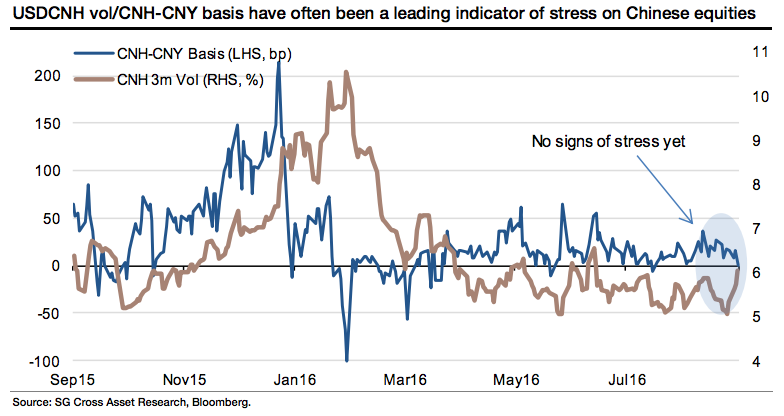
(Chart: SocGen)
The BoJ is in a different position. They’ve just about run out of counter cyclical breathing room. They’re buying some JPY6 trillion in ETFs, they’re monetizing every JGB they can get their hands on, and they’re already in NIRP. So now, the market expects they may unleash something to ease the pressure on Japanese banks (i.e. they may try to steepen the curve). Here’s how Deutsche Bank describes the situation:
“It is likely that resistance to further steepening could persist unless we hear from the Fed (e.g. relent and bullish steepening) or BoJ (changes in the long end buying with bearish steepnening).”
Well, we’re not entirely sure why one or both of those two outcomes aren’t likely. And indeed, Deutsche Bank doesn’t seem to be so sure either. Consider this (from the same note):
“The policy mix in place over the last 5 years has consisted of tighter fiscal and regulatory policies compensated by a very aggressive monetary policy. This policy mix was initially effective and depressed term premia from both a macro and flow perspective. However, as the current policy mix is reaching its limits the odds of a rebalancing are increasing. This supports a strategic bias towards higher term premia.”
“Despite the recent steepening, the market is still broadly pricing a continuation of the existing regime. For instance the Fed's own measure of the term premium remains at historical lows excluding the last two months (see graph below). Similarly more macro measure of the term premium such as our adjusted bond risk premium (traditional bond risk premium adjusted for the inflation skew, i.e. the relative tail risk of high inflation vs. low inflation, as well as for QE flows) remains depressed even after assuming an extension of global QE (see graph below).”
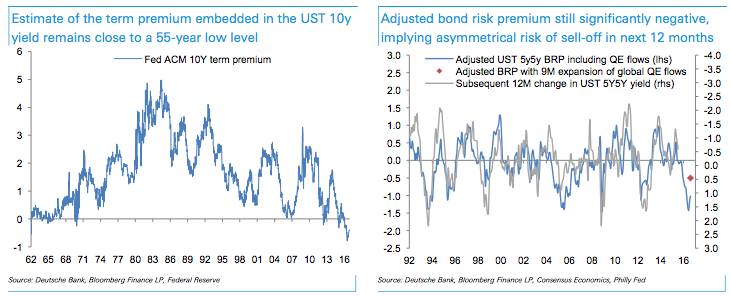
(Charts: Deutsche Bank)
In other words: who knows?
What we do know is that this entire global regime has become so interconnected that any lack of coordination risks throwing the global financial universe completely out of balance. It’s not just that cross-asset correlations are rising (thus jeopardizing the viability of strats like risk-parity), it’s that the “butterfly” in the “butterfly effect” analogy has become something akin to Mothra.
That is, one seemingly inconsequential decision that two decades ago would have been barely reported on and most certainly deemed esoteric, now has the effect to trigger a series of consequences that are almost impossible to predict unless you have the ability to think at least three steps ahead.
The problem, of course, is that the people making the decisions clearly have not demonstrated any such clairvoyance…
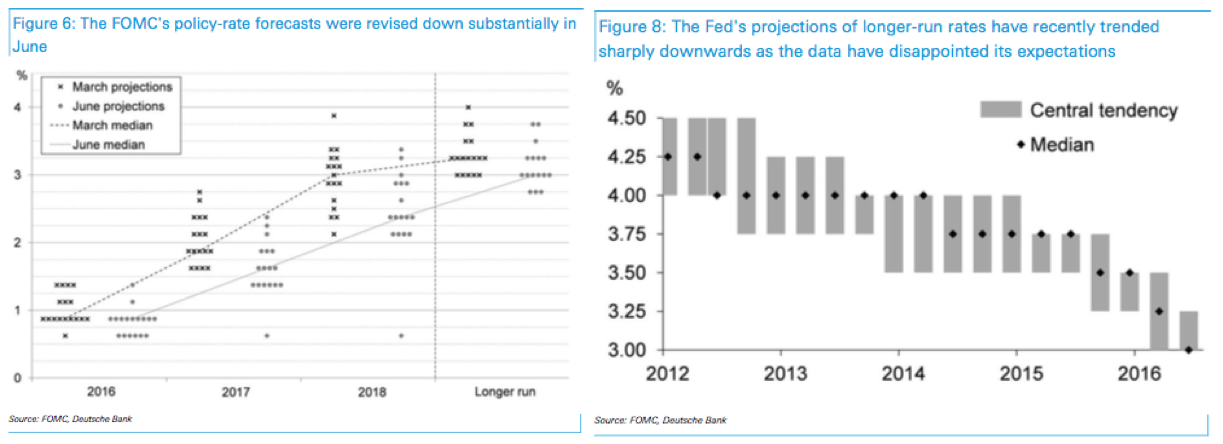 (Charts: Deutsche Bank)