President Trump Initiates $100 Billion More In Tariffs
The stock market had a good Thursday as the S&P 500 was up 0.69% and the Dow was up 241 points which is equivalent to 0.99%. Unfortunately, after the close, President Trump instructed the U.S. Trade Representative to consider $100 billion in additional tariffs. This sent stock futures down. The Chinese state media claimed Trump’s $100 billion in tariffs were a ridiculous attempt at intimidation. This is clearly game theory at work. It is a game of chicken. Whichever side crumbles and gives in will be at the mercy of the winner who will dominate the negotiations in the next trade deal.
In the stock market’s perspective, these heightened tariffs are bad news if they are enacted. However, the higher they get, the less likely they will go through. I wouldn’t sell stocks based on these actions because I don’t think they will go through. The stock market actually plays a factor in these negotiations because if stocks fall, it pressures both sides to fold. I think it pressures Trump more because he started this battle, but he didn’t give in after stocks fell last time. It would be unfortunate if stocks need to crash hard to end this trade battle.
Game Of Chicken With China
Let’s go through the steps that got us to this point now that we know this is a game of chicken. The first step was Trump’s initial tariffs on steel and aluminum; then came his tariffs on China which were higher than the administration’s initial internal proposal to the President. His tariffs on steel and aluminum applied to all countries, but then he opened up the floor for negotiations. This showed the Chinese he’s willing to negotiate a deal if they fold in this game of chicken. The story of how he asked the tariffs to be raised from what officials initially proposed show he is serious. First China initiated a small tariff to try to check America. When it realized Trump wasn’t backing down, China raised them. Trump probably knew China was going to issue tariffs in response to America, so he already had his decision made up that he was going to raise them further.
The two aspects that help a player win the game of chicken are that their threats are credible and that they are dedicated to going through with the action even if it hurts them. One way to do this is to convince your opponent that you are crazy. Obviously, the more tariffs are increased, the more it will hurt the economy. Holding the entire economy hostage is a bit crazy, so Trump has an edge. Now that Trump has reacted to the Chinese tariffs, Chinese leaders know if they raise the tariffs further, Trump will respond. That makes raising tariffs further a risky proposition. The Chinese need to decide whether losing the game or increasing the tariffs are a worse choice. If the Chinese think they can outlast President Trump, it will be a disaster for the stock market because the economies of America and China will feel the brunt of the tariffs before a deal is struck.
Quick Knee Jerk Correction Coming?
Normally, the stock market overreacts to news events. In this case a quick drop before a bounce after a deal is struck seems possible. The knee jerk reaction could be justified if market participants don’t think anything will be worked out for an elongated period. Politicians don’t have unlimited power to lose a game of chicken which is why I know negotiations will eventually occur. Any deal is a good one for the market because it means the tariff battle has ceased.
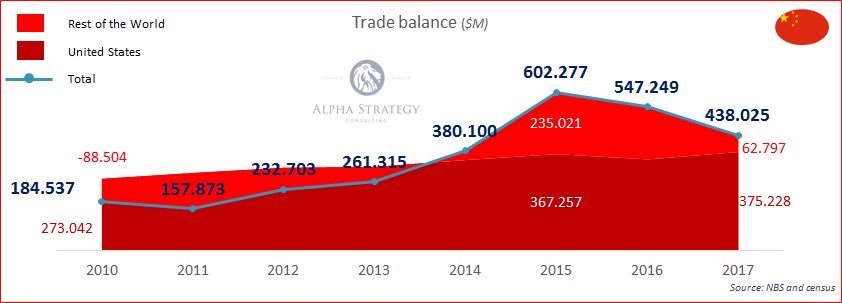
It’s clear both countries would be hurt by a trade war. There is analysis that says China would fall into a recession because the country already has overcapacity. Without the demand America provides being taken away, the inventories would explode. I’m sure the debate about which country would be hurt by a trade war more will occur with even more fervor in the next few days.
Extreme Volatility? Not Really
The first quarter had a lot of uncertainty which was translated into volatility in stocks. It’s impossible to quantify the level of uncertainty in the market because you can’t measure a what people are thinking. There are financial charts which measure political risk which are interesting, but probably not perfect because polls are imperfect. Of course, political risk isn’t the only issue the market faces. There are practically unlimited factors that can move markets. Whatever someone wants to make a trade based on instantly affects the price of the market. I don’t think 2017 was a quiet year in terms of uncertainty, but stocks were marked higher because of the improving economy and tax cuts. There wasn’t room to price in potential risk events.
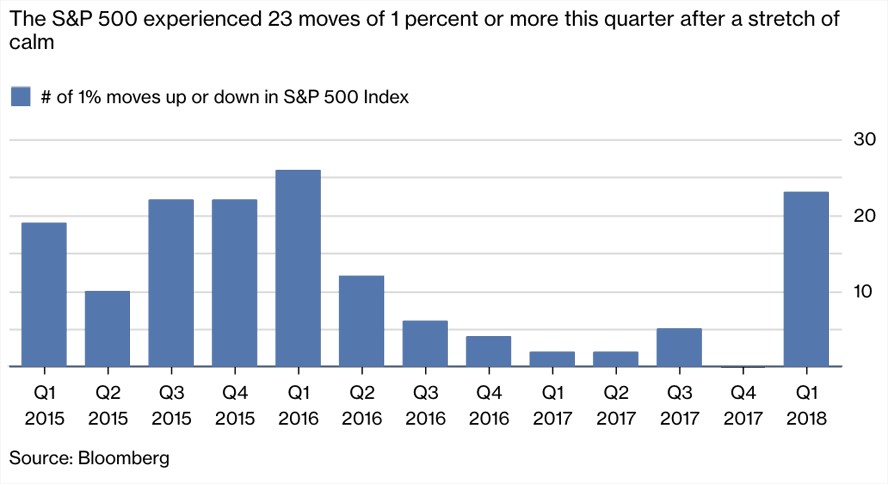
This year is more normal in the sense that the market actually reacts when negative catalysts occur such as a bad data point. The chart below shows the number of 1% up or down moves in the S&P 500 was up to the highest point since Q1 2016. The biggest risk is clearly the trade war. It’s amazing how fundamental analysis on the economy and corporate earnings gets tossed aside when headlines show more tariffs are likely. These declines give you the opportunity to buy the stocks you have in your watchlist.
Conclusion
When the 2nd phase of Chinese tariffs were announced, the market sold off after hours and then rebounded throughout the trading day. I am not sure if the market will react the same way to Trump’s latest increase in tariffs. The initial fears of a trade battle are being realized, but the hope is that there will a trade deal, so none of these tariffs are enacted. It seems like this game of chicken will increase the number of 1% moves. Usually low volatility begets lower volatility and high volatility begets higher volatility. We are clearly in a phase change in the market which means more movement will occur.