


Peter Thiel dumped his entire NVIDIA position last weekend. All of it.
His macro fund liquidated 537,742 shares worth over $100 million during the third quarter. The 13-F filing hit the wires this past weekend.
Ten days earlier, SoftBank bailed on $8.5 billion in NVIDIA holdings.
Two massive exits in two weeks from billionaire investors who built their fortunes on understanding technology before everyone else.
These are calculated moves by people with access to information and analysis you and I will never see, not retailers selling in a panic.
When the smartest money on the planet exits the same position twice in rapid succession, you need to understand what they're seeing.
Your portfolio depends on recognizing this pattern before the third, fourth, and fifth exits hit the news. By then, the damage is already done.
Let me show you exactly what this pattern means and why the next shoe is about to drop.
The Cockroach Theory Never Fails
You see one cockroach in your kitchen. You think you've got one cockroach.
You're wrong. You've got fifty.
The same principle applies to institutional exits. When two high-profile investors dump the same stock within weeks of each other, they're not alone.
They're just the first ones whose filings became public. There are more. Always more.
This is what I call the cockroach theory. The exits you see represent a fraction of the distribution happening behind the scenes.
SoftBank's $8.5 billion exit got headlines. Peter Thiel's $100 million position mattered less by dollar amount.
But the pattern is what destroys accounts. These aren't coincidental timing decisions. They're responses to the same risk assessment.
Why Billionaires Exit Good Companies
People misunderstand what these exits signal. They assume Thiel and SoftBank think NVIDIA is a bad company or that AI is dead.
That's not what's happening.
Smart money exits for two reasons only. They see no meaningful upside from current prices. Or they see significant downside risk.
Often both.
NVIDIA trades at a $3 trillion valuation. For the stock to double from here, the company needs to reach $6 trillion.
That would make it larger than the entire GDP of most countries. Possible? Maybe. Probable? The math doesn't support it.
These investors built wealth by buying assets before everyone else recognized the value. They didn't get rich chasing stocks at all-time highs.
Peter Thiel bought NVIDIA years ago when no one cared about AI chips. Now that every pension fund and retail account owns it, he's gone.
Warren Buffett teaches this principle constantly. He buys what nobody wants and sells what everyone demands. Thiel's following that exact playbook.
The Warning Signal You're Ignoring
NVIDIA isn't oversold yet. The Money Flow Index sits at 39.
That's not even close to the 20 threshold that signals genuine selling exhaustion. There's more downside coming.
The stock can fall another 20-30% before hitting legitimate oversold conditions. If it breaks below the zero line on momentum indicators, this becomes a meltdown scenario.
The algorithms will flip from defending the position to attacking it.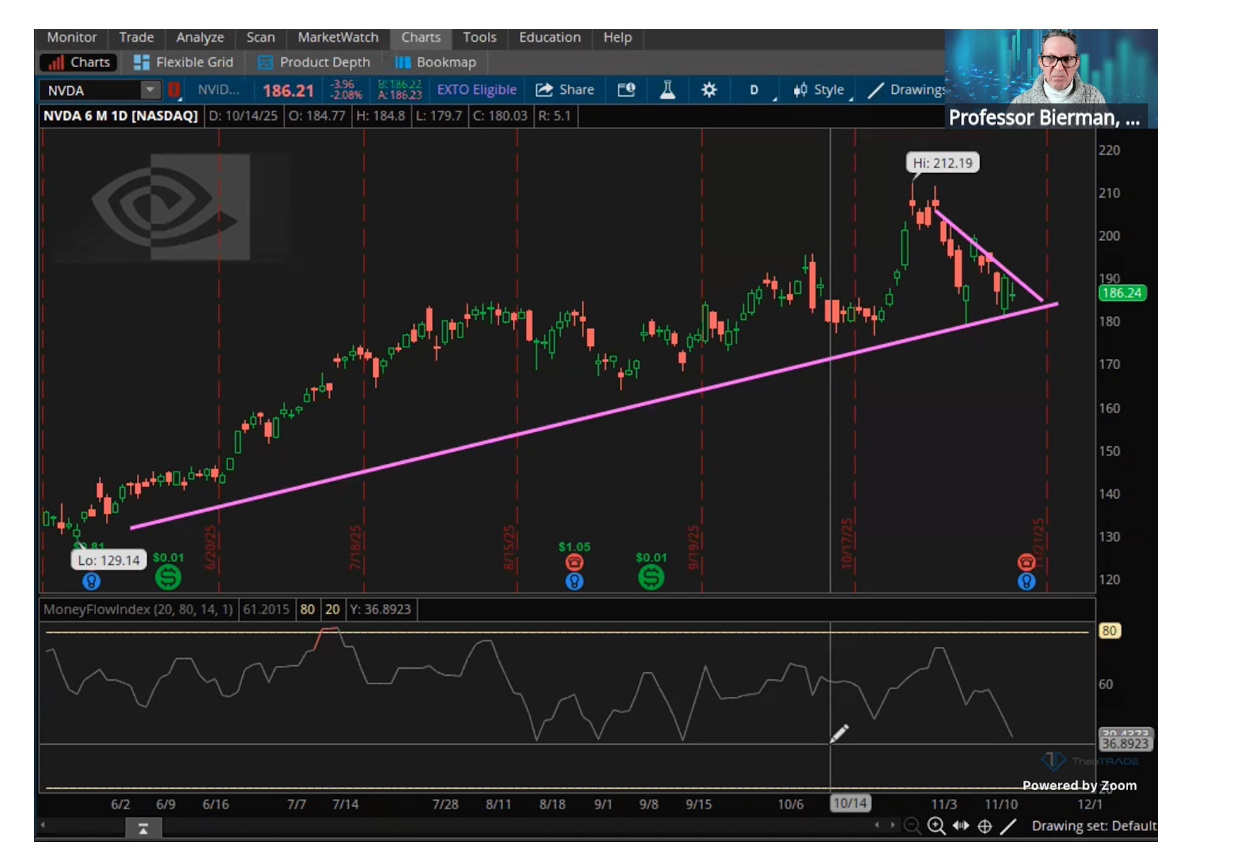
When institutions exit, they don't announce it on CNBC. They distribute quietly over weeks or months.
The 13-F filings reveal what already happened 45 days ago. By the time you read about these sales, the smart money already repositioned.
Who's next? That's the question destroying sleep for anyone still holding significant NVIDIA exposure.
The third filing will come. Then the fourth.
Each one confirms what the cockroach theory already told you. There's an army of sellers you can't see yet.
What This Means for Your Positions
I won't short NVIDIA. The gamma squeeze risk is too high.
The Genesis COG isn't built for grand slam home runs. It's built for consistent singles that compound into wealth without blowing up accounts.
But I won't own it either. Not at these levels. Not after seeing this pattern play out.
The risk-reward equation flipped completely. There's minimal upside potential and substantial downside exposure.
Every technical indicator I track says the same thing. Parabolic MACD signals aren't working.
Traditional momentum triggers failed. The only indicator giving reliable information right now is money flow.
That's showing systematic distribution.
The Genesis Cog Scanner identifies these distribution patterns before they become obvious. When institutional money flow shifts from accumulation to distribution, that's your signal to reassess risk.
Most traders wait for price confirmation. By then, they're already underwater.
The scanner reveals the warning signs when you can still exit with profits intact instead of watching gains evaporate.
Two exits don't predict the future. They reveal the present.
Smart money is systematically reducing exposure to a stock that offered explosive returns but now offers explosive risk. When billionaires who understand technology better than anyone else choose to exit, that's not a coincidence.
That's a roadmap.
The question isn't whether more exits are coming. The question is whether you'll recognize the pattern before your position turns into a forced hold at much lower prices.
Professor Jeffrey Bierman
Creator of the Genesis COG System