

One of the most important things to understand about the upcoming US election is that both candidates seem to be leaning towards adopting some manner of protectionist policies.
For Clinton, it seems to be an outgrowth of her protracted battle against Bernie Sanders whose message about lost jobs resonated among large swaths of the electorate. Here’s an (admittedly biased) excerpt from The Hill:
“Sen. Bernie Sanders has somehow transformed protectionism from an icon of America's right-wing into a ‘progressive’ panacea. He has done so with the claim that free-trade agreements have cost the jobs of many Americans, because U.S. businesses can't compete with low-wage operations abroad. This is the same argument that Smoot and Hawley made nearly 90 years ago.”
Misguided or not, that rhetoric effectively forced Hillary Clinton to adopt a similar, if toned down, message.
On the Republican side, Donald Trump has made no secret of his apparent disdain for jobs lost to China and Mexico, countries the GOP candidate effectively casts as trade villains who’ve gutted US manufacturing.
While there’s undoubtedly some truth in the message, this is a decisively dangerous time to be ramping up protectionism. The problem is twofold. First, Europe’s refugee crisis and the perception that the flood of asylum seekers fleeing the war-torn Mid-East are somehow a collective menace to the EU and its people has sparked a kind of xenophobic nationalism that’s led directly to the dismantling of Schengen and more recently to the UK electorate’s decision to leave the EU. Everyone seems to have forgotten that terrorism in the West existed long before 2015. The second issue is that the reemergence of intense nationalism comes at a time when global trade is in the doldrums.
In other words, this is not the time to start rolling back globalization. At least not if we hope to reignite the economic growth that disappeared in the wake of 2008.
But that’s exactly what’s happening. Here’s BofAML:
“Are we on the verge of reversing decades of increased globalization? Brexit has been characterized by some analysts as the first significant rejection of global economic integration, with upcoming votes in other developed markets (DM) seen as a risk for similar outcomes. In the US, neither major party presidential candidate strongly supports free trade — a substantial shift in the role Washington has played in promoting global trade integration in the post-war era. As we have noted before, the chances that the US will adopt the Trans-Pacific Partnership, a regional trade agreement, are looking increasingly remote. The campaign trail has featured calls for sizable tariffs to be imposed on certain major US trading partners. Support for free trade and open borders is waning throughout DM economies, which have traditionally been strong proponents. Polls now suggest individuals in emerging markets (EM) have a more positive view of trade.”
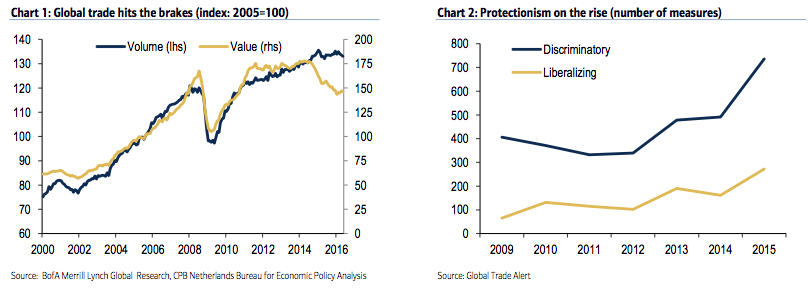
“This shift in sentiment and looming risk of great trade barriers is happening in the midst of a substantial slowdown in the volume of global trade (Chart 1). There are several possible reasons for this unprecedented slowdown, but one unappreciated factor has been the steady rise in protectionism since the Global Financial Crisis (Chart 2). This is a disturbing trend that may develop into an increasing drag on global growth should electorates demand more protectionism and mercantilist policies. This is both ironic and unfortunate: while global trade deals often appear to be zero-sum negotiations, more global trade activity is a positive-sum outcome.”
(Charts: BofAML)
And here’s what IMF Director Christine Lagarde had to say this week on the subject (via Reuters):
“When you look deep down at the economic growth prospects, at the growth potential, at the productivity, we are not getting very good signals, and we will probably be revising down our forecast for growth in 2016."
“Lagarde said she will tell G20 leaders on Sunday and Monday in Hangzhou, China that further reductions in growth potential and more obstacles to the free movement of goods, services, capital and people would hurt all of them. She said people harmed by trade and innovation need to be helped by policies to allow them to retrain and acquire new skills and job mobility.”
"This is something that all countries and all governments should be concerned and mobilized about.”
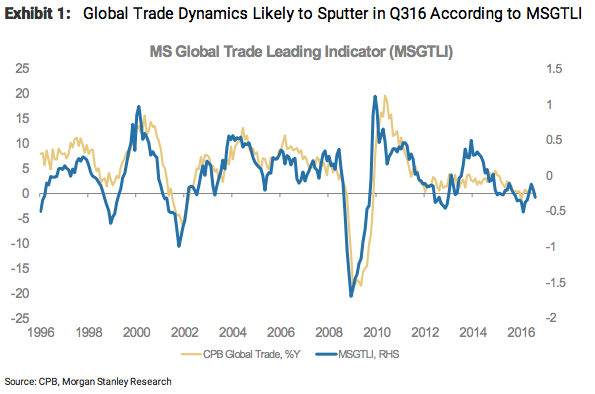
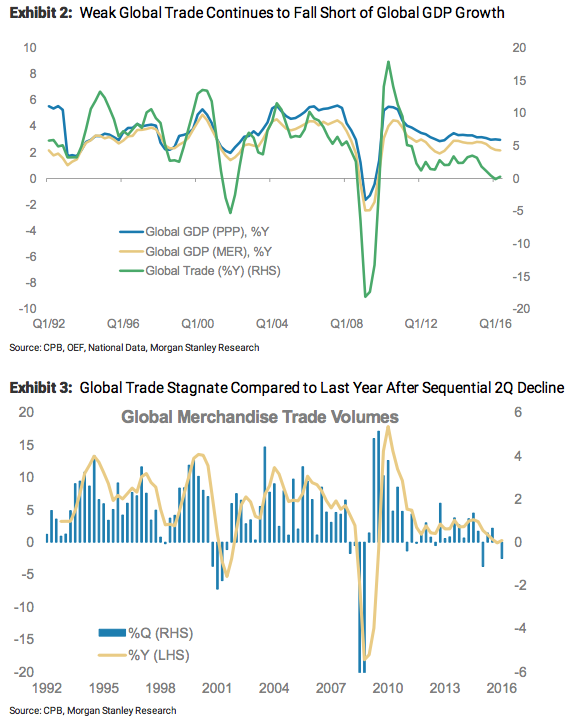
Just how bad is the problem? Well, let’s look at some visuals from Morgan Stanley:
(Charts: Morgan Stanley)
Here’s some color from the bank:
“A noticeable fall in trade-related data during August, which causes our MS Global Leading Trade Indicator (MSGTLI) to decline further, hints at sputtering global trade dynamics this autumn.”
“Having already weakened slightly in July, MSGTLI took a bigger knock in August on the back of a sharp decline in the US Manufacturing ISM, a material downgrade in German business expectations and slower USD appreciation. As a result, MSGTLI now points to a contraction in global trade in 3Q16.”
No matter what your politics, ask yourself this question: do we really want, as a society, to start moving backwards instead of forwards? Because that’s what this represents.