
And now, back to our regularly scheduled programming.
Well, not entirely, but US traders woke up Tuesday to green screens, a welcome reprieve from two days of mayhem. “Brexit” discussions still dominate the airwaves and headlines, but you can count on the dip buyers and knife catchers for what may or may not be a dead cat bounce.
European bourses were up across the board with the FTSE and CAC up more than 2.5% and the DAX tacking on nearly 2%. We’re seeing strength in all the usual risk-on places. Oil is up, USDJPY is stronger as is GBPUSD. Gold is down as is the VIX.
So are we out of the woods? Has the storm passed so quickly? Not likely. Here’s a bit of technical analysis from BofAML:
“Yesterday’s S&P 500 close below 2025 exposes 1950-1930, which is the February double bottom breakout point and downside projection given the close below 2025. The S&P 500 tested the 38.2% Fibonacci retracement of the early-February to early-June advance at 2001.96 but any bounces that meet resistance ahead of or within 2025- 2050 (prior supports at the May and mid-June lows that now act as resistance) keep the immediate risk to the downside with the 50% and 61.8% retracements at 1965.32 and 1928.69, respectively. Holding this Fibonacci zone is important for the bulls.”
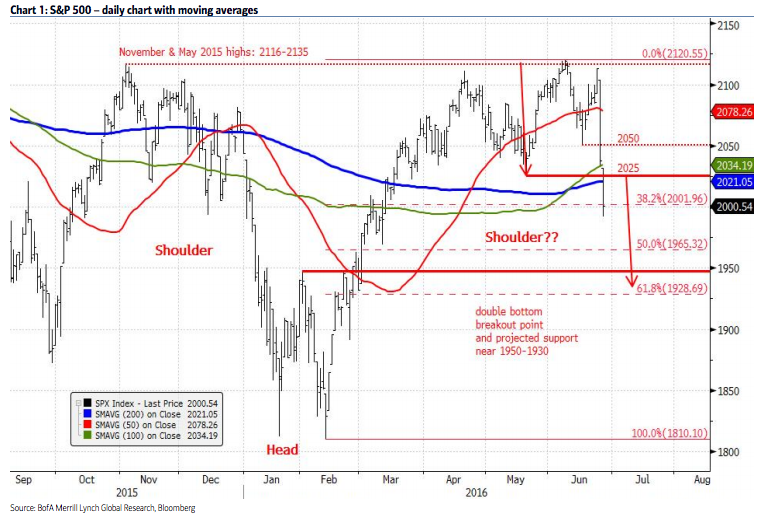
(Chart: BofAML)
In sum: exercise caution.
At this juncture it’s critical not to lose track of two important narratives that the Brexit vote has brought to the fore.
The first revolves around the extent to which European banks are teetering on the precipice. The market has been casting a wary eye at the space for a while now amid possibly reckless ECB easing and generalized solvency concerns in some names. Here’s a look at default risk for Deutsche Bank, Barclays, and also at the spread on iTraxx Sub Fin:
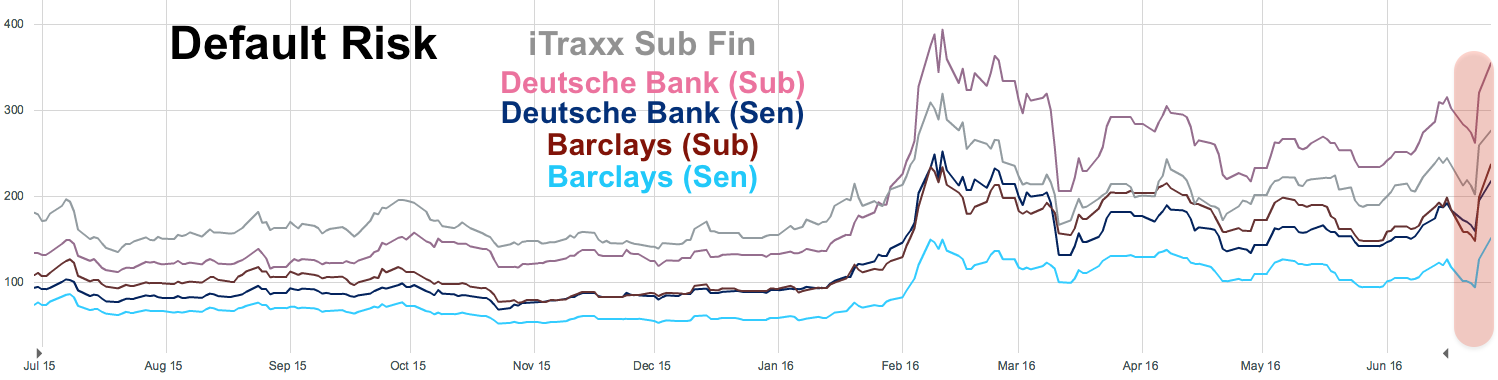
Clearly, there’s a palpable sense of angst. Also, don’t lose track of just how much pain financials have endured over the past two sessions:
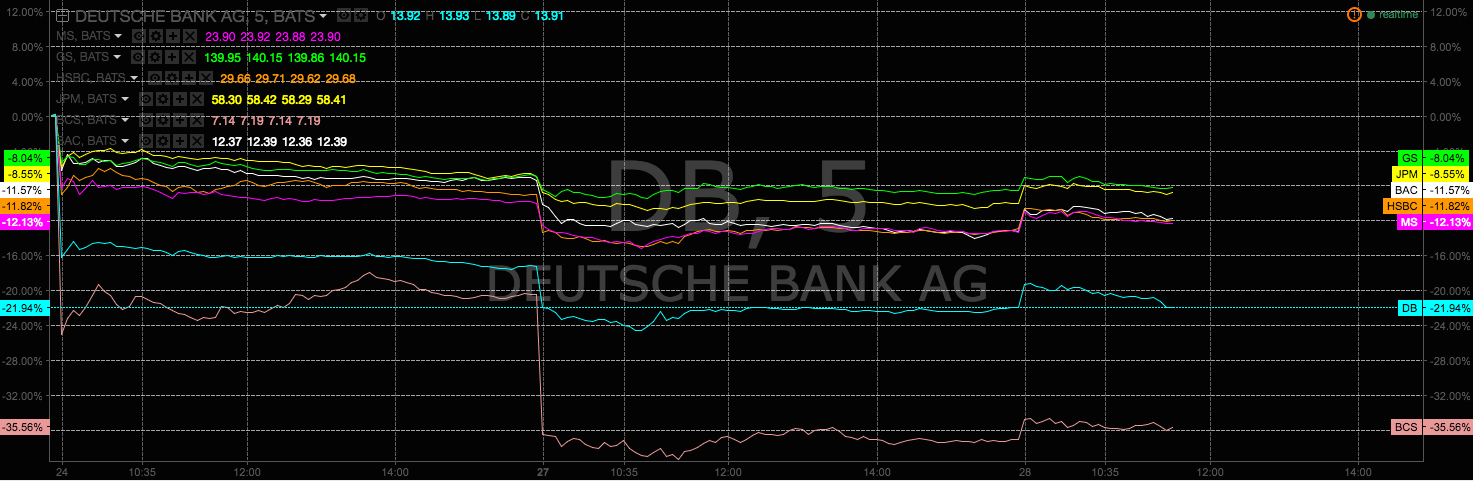
As you can see, we’re looking at steep declines across the board. Today’s gains have barely made a dent in terms of recovering levels seen just last Thursday and some European names actually closed red. Indeed, some traders are viewing this week as a kind of live fire stress test. Here’s Bloomberg’s Richard Breslow:
“Banking sector shares have been conspicuous for the hammering they’ve suffered since Friday. There is some understandable and logical rationale why this across the board knee-jerk reaction was so severe. And also that investors may want to be a lot more selective as they reconsider cause and response.”
“Last week, understandably lost in the panic, every big U.S. bank passed its Federal Reserve administered stress test. It wasn’t assured ab initio.”
“Theoretical assumptions are the only way the regulators ever want to have to evaluate the banks. But how the Fed and the banks respond to this real world strain will be a better barometer. It matters because tomorrow there will be an announcement on the approved levels for dividends and stock buybacks. In other words, lowering the amount of capital on hand to help buffer against adverse shocks.”
In other words: this is not a drill.
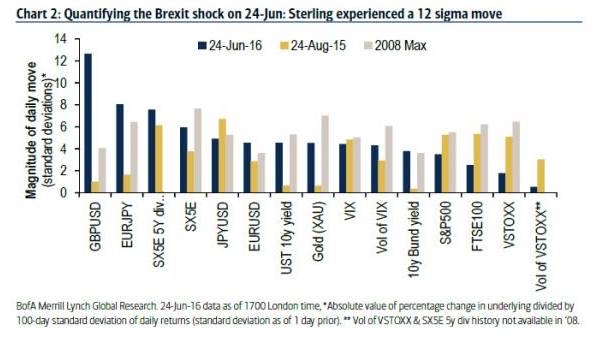
The second narrative you need to keep a close watch on is the extent to which Brexit exposed the fragility of the market’s increasingly creaky infrastructure. The more interconnected and homogenous markets become, the greater the potential for violent moves. This is exacerbated by HFTs and central bank meddling. Have a look at the response to Brexit compared to previous shocks:
(Chart: BofAML)
Pretty scary, right? You don’t necessarily want to see too many 12-sigma moves. Sure you can make a fortune if you call it ahead of time, but the very fact that it’s a 12-sigma move means you probably won’t be able to predict it. It’s kind of like what any college statistics professor will tell you about the lottery: “sure, someone is going to win, but it aint going to be you.”
This is a bad setup given the geopolitical landscape.
Lots of landmines + fragile markets = potential for “oops” scenarios. Scenarios like that which played out on Friday.
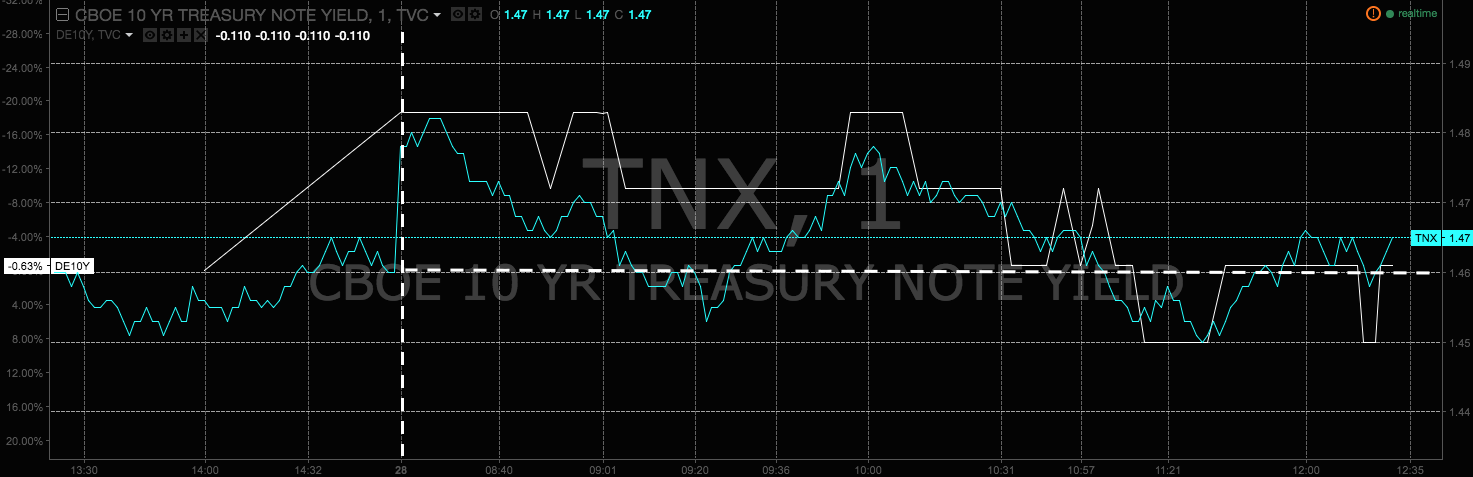
As for Tuesday’s rally, we’ll close with one final chart which should tell you everything you need to know (hint: if this rally were for real, you wouldn’t expect the yield on 10Y US Treasurys and 10Y German bunds to be just flat):