


Hey trader,
The oil futures curve is pricing in a physical shortage that the spot price is hiding from you.
Crude pulled back to $94 today. Most traders saw that and assumed the risk was fading.
The futures term structure tells a completely different story.
If you know how to read the curve, you can see whether the risk is growing or shrinking before the spot price catches up. That is the edge the futures market hands you for free.
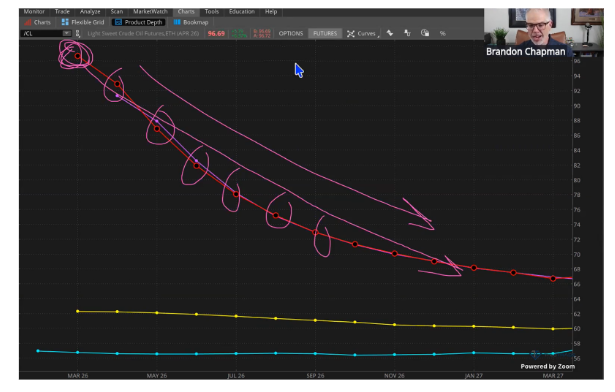
The April-to-May spread in oil futures is $4. The net cost of carry across the full curve sits at approximately $14.
Both numbers imply a shortage that has not calmed down since the Iran conflict broke out.
The Ghost Prints Surveillance Console has been tracking institutional energy flow for weeks.
The options positioning confirms what the futures curve is already telling you.
I'm going to break down how to read the oil curve, why backwardation in oil means the opposite of what it means in the VIX, and how to structure a trade in JETS that benefits when this pressure breaks.
Why Oil Backwardation Is Bullish
Oil futures are settled by physical delivery. If you sell a contract, you store the oil until delivery at places like Cushing, Oklahoma.
Storage costs money. Financing costs money.
The only offset is the lease rate. You can lease your oil to someone who needs it today and collect a credit.
When the lease rate exceeds the combined cost of storage and financing, the net cost of carry turns positive.
Spot crude is trading near $96. Far-dated futures sit near $82.
The net cost of carry is approximately $14.
Buyers are paying hefty premiums to lease oil in the here and now. That is the definition of an implied shortage.
Backwardation in oil is bullish because the pressure on future contracts is to converge upward toward the spot price over time.
The VIX is also in backwardation right now. The interpretation is completely different because VIX futures are cash-settled.
There is no storage cost, no financing cost, and no way to lease volatility. Pure expectations theory applies directly.
VIX backwardation means the market expects volatility to fall. Oil backwardation means there is a physical shortage and prices are pressured higher.
Settlement mechanics determine the interpretation.
Why High Oil Is Deflationary
I pulled up the product depth chart and compared Thursday March 5, Friday March 6, and Monday March 9.
Thursday's prices were lower across the curve. Friday steepened noticeably.
Monday held the same degree of steepness.
The April contract sits near $96. The May contract sits near $92.
A $4 gap between two consecutive months is significant in oil.
Oil peeled back from its highs to around $94 on the session. The upside risk embedded in the curve has not diminished despite the pullback.
The net cost of carry has been positive all year. It has gotten increasingly more positive since the fighting in Iran broke out.
The Fed focuses on core CPI and core PCE. Both exclude oil.
High oil prices hurt consumer spending. Companies cannot pass on the higher costs when consumers pull back.
In Q2 2008, oil peaked near $144 per barrel. The advanced GDP reading that quarter came in at 4.1%.
The economy was already falling apart underneath that number.
The Iran conflict is creating a version of the same dynamic. Oil above $100 per barrel reduces consumer spending and hurts corporate profitability.
How to Structure the Trade
Airlines sit on the other side of this equation. If oil pulls back on any progress with Iran or easing through the Strait of Hormuz, airlines benefit immediately.
JETS is the ETF that captures that exposure. Implied volatility on JETS is at the 72nd percentile.
That IV level creates a dual tailwind for a call vertical. If oil pulls back and JETS rallies, the spread gains directional value.
Elevated IV contracts at the same time, which accelerates how quickly the spread moves toward full value.
A call vertical in JETS using April expiration offers time for the situation to develop.
- Buy an at-the-money or slightly out-of-the-money call
- Sell a higher strike call to reduce cost
- Risk profile: Limited to premium paid, with defined upside capped at spread width minus cost
- Catalyst: Oil price decline from Iran de-escalation or Strait of Hormuz progress
- IV edge: 72nd percentile IV means the short call collects elevated premium, and any IV contraction accelerates spread profitability
The trade only needs one positive headline to work. Any progress in the conflict or stabilization of oil supply routes sends JETS higher while IV compresses at the same time.
The Ghost Prints Console has been flagging institutional energy flow across multiple sessions.
Most traders will look at oil pulling back to $94 and assume the worst is behind them. The $4 April-to-May spread and the $14 net cost of carry say otherwise.
Brandon Chapman, CMT
Creator of Ghost Prints