

Ok, so let’s get to a couple of things you might have heard making the rounds on Monday.
For one thing, Goldman said sell some stocks last night. The bank has “tactically” downgraded equities on a 3-month time horizon. We’d love to know what an “un”-tactical downgrade looks like. It’s the same old story, but just in case you want to hear it again, here it is straight from the horse… err.. Squid’s mouth:
“The rally in risky assets over the past few weeks has continued and broadened – the S&P 500 has made all-time highs, the VIX has fallen, bonds and ‘safe havens’ started to sell off, and cyclicals have outperformed defensives. We think a key driver of the recovery has been a combination of the light positioning into Brexit and the search for yield amid expectations of easing. n However, given equities remain expensive and earnings growth is poor, in our view equities are now just at the upper end of their ‘fat and flat’ range.”
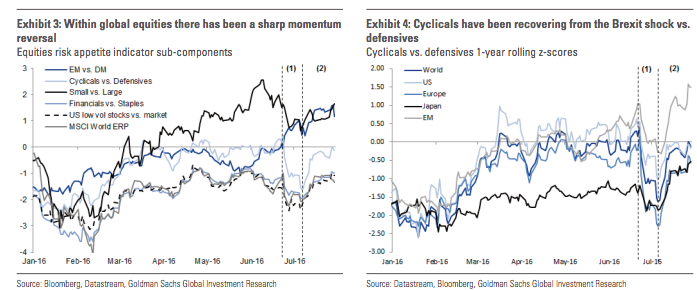
(Charts: Goldman)
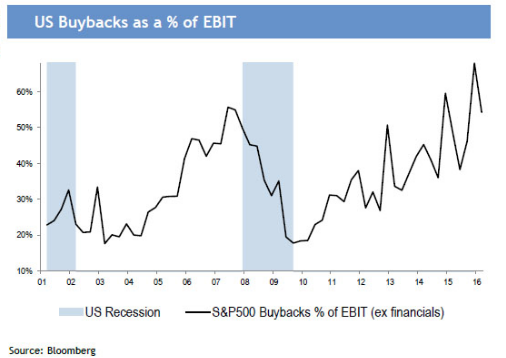
More interesting is the bank’s take on the performance of companies buying back shares. As you’re no doubt well aware, one of the key narratives underpinning this market is the extent to which equity demand emanates solely from the corporate bid (i.e. share repurchases). It’s a perverse yet elegant system: 1) central banks drive borrowing costs to zero, 2) that drives investors to take more risk, 3) corporations take advantage of that demand by issuing more debt at costs which to them look meager but to investors represent juicy yields, 4) corporations use the proceeds to buy back shares and inflate earnings, 5) stocks go up.
Now clearly, there are all kinds of holes in that. For one thing, there’s this:
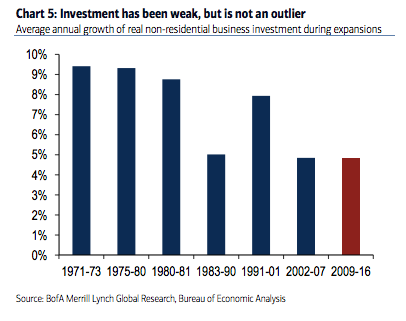
(Chart: BofAML)
To be clear, you don’t really want to be in a situation where the best thing you can say about a data point is that it’s not a negative outlier. That’s like saying “it’s bad but it’s not the worst we’ve ever seen.” Here’s BofAML:
“Persistently low business investment has been a common lament of this recovery. Despite being flush with cash for years, US corporations have taken only marginal steps to increase their productive capacity via investments in machinery/equipment, structures or intangibles such as intellectual property. Weak investment can lead to a depleted capital stock, which leaves firms ill-equipped to handle an unexpected increase in demand. Weak investment can also erode productivity — a critical issue given average annual US labor productivity growth of only 0.5% in the past five years.”
Right… and about that weak productivity:
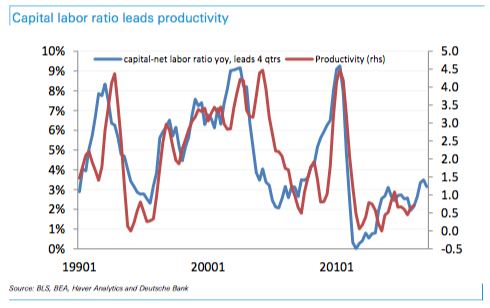
(Chart: Deutsche Bank)
We’ve heard some people ask why companies would increase their investments in productivity when the top line isn’t growing. Well, the thing about business is, you kind of have to skate ahead of the puck. If everyone gets bogged down in a financial engineering war where the entire corporate world is just seeing who can leverage their balance sheets the most in order to appease shareholders, then the economy will simply die. There’s got to be business investment. The stock certificate is meaningless if the business stops being a business and turns itself into a hedge fund that buys its own paper. It’s a vicious circle.
Anyway, it looks like investors are starting to get wind of this. Here’s Goldman:
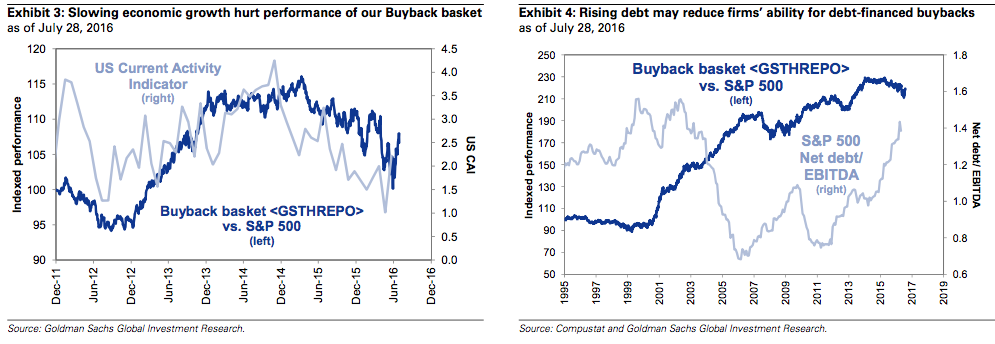
“Buyback executions have decelerated after reaching a record high in 1Q. S&P 500 share repurchases totaled $163 billion in 1Q 2016, the highest level since 3Q 2007. However, the pace of buyback executions slowed during 2Q, falling by 18% compared with the comparable year-ago quarter.”
“Returning cash to shareholders through buybacks has been an effective long-term strategy. Our Buyback basket (GSTHREPO) has a long-term track record of outperformance. Since 1995, the sector-neutral strategy has outperformed the S&P 500 by an annual average of 4 pp (14% vs 9%).”
“During periods of low growth and low interest rates, firms with the highest buybacks fail to provide investors with either the consistent yield of bond-like assets or the prospect of future growth. Between the start of 2015 and 1H 2016, our Buyback basket (GSTHREPO) lagged the market by 7pp (-7% vs. 0%) as the US Current Activity Indicator (CAI) fell to 1.0% in May 2016 from 4.2% in November 2014.”
“However, so far in 2016 investors have penalized firms that executed buybacks while rewarding firms with high dividends and high capex. Low interest rates and uncertain global growth prospects have led investors to high dividend yielding sectors such as Telecom (24% YTD) and Utilities (22%). Our sector-neutral basket of stocks with the highest capex and R&D (GSTHCAPX) has returned 12% in 2016 vs. 7% for the S&P 500. In contrast, our basket of stocks with the highest trailing four-quarter buyback yields (GSTHREPO) has lagged the S&P 500 by 280 bp YTD (5% vs. 7%).”
(Charts: Goldman)
It kind of reminds us of the title David Einhorn chose for his account of Greenlight’s long war with Allied Capital. As long as you can “fool some of the people all of the time,” the above is sustainable. That is, you can keep convincing people that earnings growth is healthy and that everything is on the up and up. But eventually this stuff starts to show up loud and clear (and yes that’s a mixed sensory metaphor) on the balance sheet - see the right pane above. That in turn leads any investor with half a brain to second guess the stock.
For what it’s worth, JPMorgan is out with a similar call. Here’s an interesting chart comparing buybacks to earnings:
(Chart: JPMorgan)
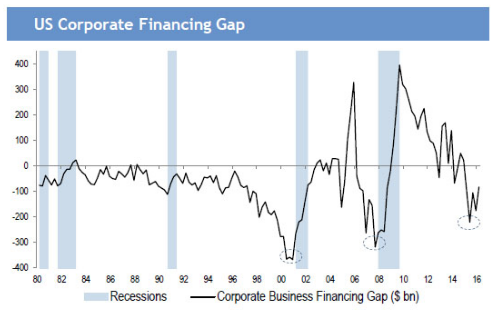
And hee’s a rather disturbing visual which basically shows that corporate America is becoming one giant shale oil driller in terms of funding gaps:
(Chart: JPMorgan)
If you think about it, it’s getting sillier and sillier by the month. Between central banks buying bonds and stocks and corporate board rooms being the only game in town when it comes to US equities, it’s not even clear what you’re look at when the numbers scroll across the screen anymore.
Furthermore, when someone like Jeffrey Gundlach tells you to “sell everything,” you’re kind of stuck. If you sell everything you’re buying cash. But what if you suspect that due to central bank largesse, they’ll be no easy transition from deflation to “healthy” inflation but rather a screaming ascent to the “height” of the Weimar Republic? In that case, one is left with the following question: “Ok Jeff, so what do we buy, beaver pelts?”