
We’ve seen some inexplicable moves in equities in the post-Trump election trading. It took a couple of days for me to realize the likely scenario which will play out over the next 4 years. To make an analogy, Trump is being put in the middle of a bank heist where the government is the robber and the bank is the people. Trump campaigned on being a champion for the people, but the stolen money has already been put into his hands. He isn’t a policy wonk, so he doesn’t know how to get out of the situation. I admire Trump’s passion to help those he campaigned for since he had nothing to gain by running for president, but he will rely on the same people to write the new laws as the ones who have been writing the old failed ones.
It’s ironic that the same people who talked about how disastrous a Trump victory are talking about how great he will be and attempting to influence his policy. Trump is considering, the CEO of JP Morgan, Jamie Dimon, for the Treasury Secretary. Trump said he wanted to drain the swamp, but there’s no drainage system in place for him to do so. It’s like a reverse spoils system where Trump appoints people to his cabinet who hated him. Because everyone hated Trump, the only way to fill out a cabinet is to pick people who despised him. Trump doesn’t have an ideological center, so the people who surround him are a mixture of people who may disagree on major issues. From a historical perspective, I consider Trump most like Andrew Jackson, who was rugged and had a populist mold. It’s ironic that Jackson was the creator of the spoils and his closest comparison Trump, may do the opposite.
If Trump actually drained the swamp, there would be an immediate crash to the system. Trump can’t alter the direction of the country because no one benefits immediately from the changes that need to take place. There needs to be spending cuts because America is bankrupt, there needs to be a debt restructuring because America is bankrupt, and the Federal Reserve needs to unwind its balance sheet to get back to a system of sound money.
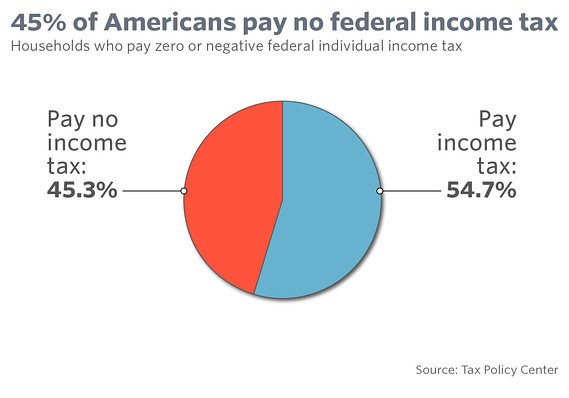
About 45% of Americans don’t pay taxes, so they will be hurt by cuts to entitlements. A debt restructuring and unwind of the Fed’s balance sheet would crush risk assets which would hurt the 55% of people who do pay taxes. The problem is this current debt binge is coming to an end, meaning prosperity has already started to decline. This is why Trump was elected in the first place; people want change. An analogy to this is a child who has a cold, but doesn’t want to take his medicine because it tastes bad. Eventually the child gets sicker, so the options are either to take the horrible medicine or perish. By electing Trump, the people thought Trump could be a game changer to this situation. He may be a game changer, but he is not a miracle worker, so the same choice still applies.
This analogy explains the convergence of the results of decisions which policymakers have in front of them. Whatever Trump does will lead to the same outcome because the deck is stacked against us. I am more curious about what his response will be to the crash than what his first 100 days will look like.
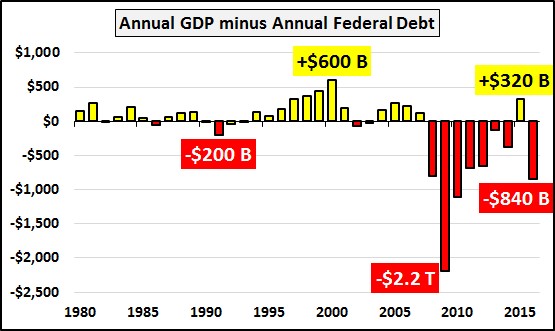
Trump plans to possibly spend $1 trillion on infrastructure. This is ironic because in the past few days the bond market lost $1 trillion as yields increased because investors want a return on this risky debt increase. The $600 billion deficit only tells part of the story. The chart below shows the difference between the debt growth and the annual GDP growth. This shows you how America is not getting a good ‘bang for its buck’ when it comes to government spending to create growth. This supports my theory on economics that government spending hurts economic activity by crowding out private investment. Each time the government tries to juice the economy with a stimulus, there are diminishing returns.
Trump is attempting to use logic when looking at fiscal spending. For those in Washington, logic is far from their mindset. Trump wants to issue long term debt (30 year treasuries) to fund his spending binge. This may have been a good strategy 10 years ago, when America’s debt was more manageable and the Fed was less involved. Now in order to issue large amounts of 30 year bonds, the Fed would have to back stop it by buying the bonds.
The chart below explains the situation I am referring to. BLICS stands for Begum, Luxembourg, Ireland, Cayman Islands, and Switzerland. From 1950 to 2000 there was a steady amount of foreign treasury buying because America was a creditor nation. America was like a millionaire who wants to borrow money to buy a $3,000 computer. When you can afford to pay the debt back, everyone wants to lend it to you. At first when the government started borrowing more money, foreign buyers were interested because of America’s past history. As they realized America could never pay the debt back and was manipulating interest rates lower through quantitative easing, they slowed their buying. In the 2015-2016 period foreigners became net sellers.
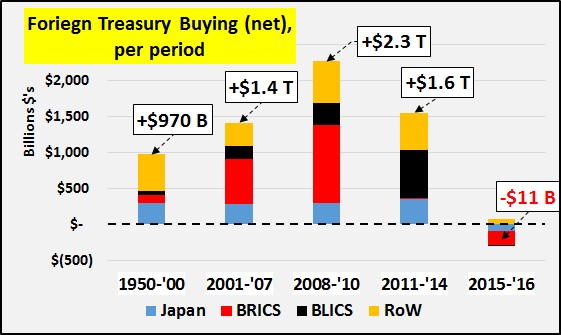
In the 2015-2016 the U.S. public has picked up the slack in terms of treasury buying because the Fed ended QE3 and foreigners stopped buying. The U.S. public cannot keep up the pace if Trump plans to issue more debt. The rate of return also needs to increase for US. investors to be willing to buy treasuries because inflation is increasing. As rates rise, the long-term borrowing plan Trump has, starts to look much worse.
Conclusion
Trump doesn’t have an ideological core which is capitalist. This means he will be swayed into pursing similar policies that have created this mess. It doesn’t matter what Trump does because the system unwind will happen either way. By showing the chart of the difference between growth and debt, I proved fiscal stimulus is tapped out. By showing the lack of foreign buyers of U.S. debt, I showed America cannot take out long term loans at low rates like Trump wants to do.