Another Solid MBA Mortgage Applications Report
In the week of September 20th, the MBA mortgage applications composite index fell 10.1% weekly after falling 0.1%. That looks pretty bad compared to the recent housing data, but keep in mind yearly growth is still solid and because the MBA data is more recent, it had to deal with the rise in rates in the first half of the month. Weekly purchase applications growth was -3% after rising 6%. However, yearly growth was still a strong 9%. If rates stay where they are now, the average mortgage rate will decline in early October.
Mortgage rates are delayed versus long term treasuries. Mortgage rates rise quicker than they fall, meaning if treasury yields rise, mortgage rates will rise with a small delay. If treasury yields fall, mortgage rates will fall, but with a longer gap. It’s no surprise the rise in rates caused refinancing activity to fall 15% weekly on top of the 4% decline in the prior week.
Rates were extremely low in late August and early September. Even though rates are low now, if they are above their recent low, refinancing will fall sharply. Rates are historically low, but refinancing isn’t historically high.
Big Burst In New Home Sales
Investors are excited to see what the Atlanta Fed Q3 GDP Nowcast shows on Friday. It will include a bunch of new positive data on housing such as the solid new home sales report on Wednesday. I expect the GDP Nowcast to show close to 2.5% Q3 GDP growth.
This is a slowdown, but there was no recession in Q3 unless the data is all revised sharply low. Just because it’s always possible for data to be revised lower, doesn’t mean we should discount all positive data. The 2008 financial crisis was very rare. Every year since then we haven’t seen very sharp negative revisions.
Specifically, in July new home sales were revised from 635,000 to 666,000. Furthermore, in August new home sales were 713,000 which beat estimates for 662,000 and the high end of the estimate range which was 685,000. This great reading, the positive revision, and the cycle high in June pushed the 3 month average to 703,000 which is a new cycle high. That’s not something you see in recessions. Decline in mortgage rates has been a boon for the housing market as you can see from the chart below.
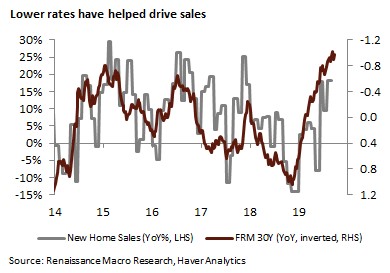
This was the highest 3 month average of new home sales since October 2007 which was right before the subprime crisis. Before you wonder if another crisis is coming, recognize that new home sales peaked in July 2005 which was over 2 years before the recession.
If the June 2019 high stays intact, this indicator doesn’t signal a recession is coming anytime soon. I haven’t called for a recession this year. I’m sticking with that. In 2018, I discussed the possibility of a recession in 2020 based on the potential yield curve inversion. However, the way it happened, i.e. the long bond yield falling below the short bond yield, nullified the recession call. I don’t expect one next year either.
There was a big increase in new home prices as monthly growth was 7.5% which put prices at $328,400. New homes are more expensive than existing homes. Yearly growth improved from a mid-single digit contraction to a 2.2% gain. Inventories tightened up just like inventories for existing homes did as buyers came off the sidelines due to the decline in rates.
Number of new homes on the market fell 1.2% to 326,000 and in relation to sales, inventories fell from 5.9 months to 5.5 months. Our housing market is quickly shifting from favoring buyers to sellers assuming the labor market stays solid. Remember, the Conference Board index showed consumer confidence in the job market waned in September.
West was the main driver of the improvement in new home sales as sales were up 16.5% monthly. South, which is the largest market, saw sales increase 6%. Smaller regions that are the Midwest and the Northeast fell from last month.
Businesses Are Less Uncertain?
It’s surprising to see the Atlanta Fed survey showing uncertainty easing with the trade war ratcheting up in the past few months. This index is much different from the Conference Board index which suggested business conditions were worsening because of the trade war. I trust businesses more than consumers, but the Atlanta Fed survey started in January 2015 which means it doesn’t have much historic data. I can’t accurately judge this release based on other tense and loose periods in financial markets.
Specifically, the uncertainty index in September fell from 97.4 to just 90.2. That’s the lowest reading since March 2019 which was 80.6. That March reading was the lowest in this index’s history. This survey is much different from the analysis which shows fiscal policy is almost the most uncertain ever.
On the other hand, the business expectations index was terrible. It looks even worse than the Conference Board survey. Expectations fell from 91.7 to 86.5. That’s the worst reading since this index started in 2015. Uncertainty isn’t the problem. Maybe it is cyclical weakness.
Expectations category lines up well with uncertainty and the overall expectations index because capex rose and sales growth fell. If you aren’t uncertain, you invest in capex. Capex index rose to 120 which is a record high. Sales growth index fell to 75.6 which is a record low. It’s quite the odd divergence. You would think it isn’t sustainable. I’ll be watching future releases to see what happens.
Conclusion
New home sales report was fantastic again and purchase applications growth was solid. If rates rise, there might be a problem. However, rising long bond yields price in higher nominal GDP growth, so it’s a catch 22. The housing market is about to have a very strong Q4.
It should have a positive impact on Q3 GDP growth. Atlanta Fed survey was odd because uncertainty wasn’t high, but firms were bearish because of declining sales. If that’s the case, cyclical weakness is a much bigger issue than the trade war.