Healthcare Reform Failed
The GOP’s healthcare reform ended up being a bust. It’s all about game theory. As I said, the House could decide to simply pass the “skinny bill” without doing a conference like many of the moderates and some of the conservatives wanted. For Paul Ryan and Mitch McConnell, it was a matter of convincing the GOP senators that they would do a conference. It’s a tough sell because once the senator supports the bill he/she is powerless. In the case of this game, John McCain wasn’t sold on the idea that the bill would go to conference and be improved, so he voted it down, killing the bill. He was the only senator who changed his/her vote from the motion to proceed with the debate.
Now with the healthcare bill ending in failure, the GOP can either decide to move on to tax reform or try another last hail Mary pass. Leadership only needs to figure out a way to appeal to John McCain without losing any conservatives. If John McCain decides the only way he will support the plan is if it gets Democratic support, then it will be almost impossible to get anything done because conservatives are so far from agreeing with progressives on anything. The Democrats are defending 25 senate seats and the GOP is only defending 8 which makes the Democrats more vulnerable in the next election. The GOP might decide to wait it out and hopefully win a few more seats to get something done on healthcare.
At this point, the healthcare plan looks done for now as tax reform gets to be in center stage in September when the Congress comes back from vacation. The hope for the market is that tax reform can get combined with the debt ceiling raise. That would be a double win as the risk would be eliminated that the government would stop paying its bills and the tax cuts would help consumer spending going into the all-important holiday shopping season. Whenever the tax plan is enacted, the corporations will start pouring money from overseas and enacting big buybacks. This will lift stocks as buybacks remain the top funder of this bull market.
Economy
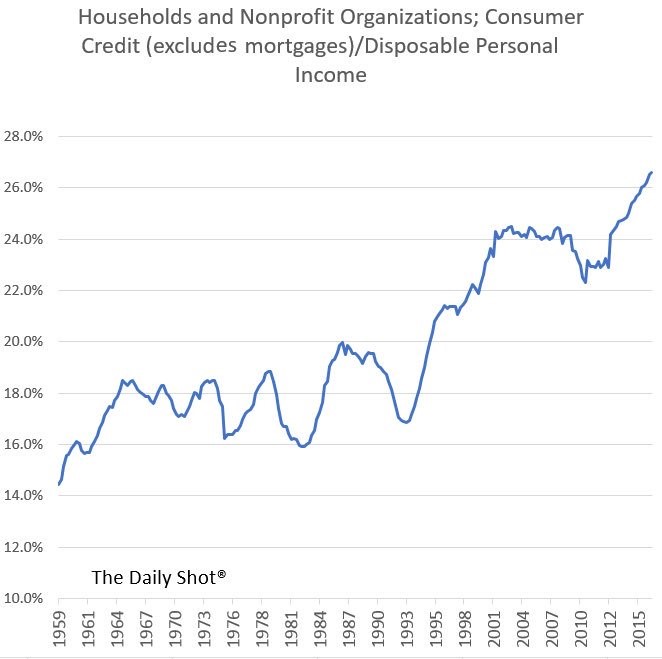
The chart below shows the household debt relative to disposable personal income excluding mortgage debt. It’s tough to determine whether the current situation is better or worse than 2007. In total debt, the consumer has much less debt because mortgages are the biggest purchase that people make, by far. Unless you’re starting a business by putting money on credit cards, there’s not a way to have that much consumer debt. On the other hand, I would argue that mortgage debt is the best kind of debt because it’s attached to a house/land which usually goes up overtime. We saw the worst-case scenario in the early 2000s where housing prices fell, but that’s not the norm. Even when a house loses value, it’s still doing better than the other stuff purchased on credit cards as they lose value immediately. A car depreciates over a few years and loses value as soon as you drive it out of the lot. A student loan has no collateral value.
I think we’ve moved too far in the wrong direction, increasing opportunities to buy houses now that many have left the market. It’s like how technology stocks have been a great buy for years after the 2000 bust as they rallied in the face of the skepticism in the marketplace that another bust was coming. This line of thinking, where mortgage debt is the best kind of consumer debt, makes the chart below disconcerting because the non-mortgage debt is the highest ever. When the labor market rolls over, credit card loans, auto loans, and student loans are going to look like housing did in 2008. There must be a limit to the debt relative to disposable income. In a recession, the disposable income goes down, which could spike the ratio even higher.
Margin Debt
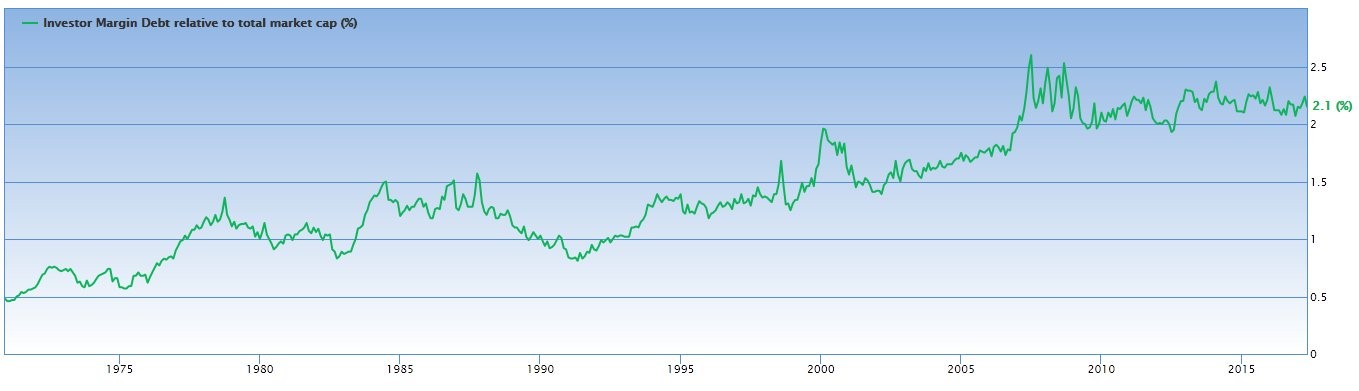
There is a vast misconception promoted by stock market bears that the margin debt is the highest ever which means there is the most speculation in stocks ever. They try to scare investors, but the reality is that if you don’t adjust for the size of the market, you are being foolish. The chart below makes an adjustment by comparing the margin debt to the total market cap which makes sense. The margin debt is lower than it was in 2007-2010, but it’s much higher than it was in the past few decades.
Trading has changed so much since the 1970s with the advent of the internet. It’s much easier for anyone to check stock prices quickly and use margin accounts wisely. It’s not tough to check your stocks when you’re out or at work because it’s all on your phone. The biggest reason for the secular increase in margin usage is the decline of interest rates making it cheaper to borrow money. That’s not an issue that inspires panic like the bearish traders want. It would be interesting to see the effect a decline in margin trading would have if interest rates went up. We will never find out because stocks would fall if interest rates went up regardless of what happens to margin debt because there would be more competition for stocks.
Conclusion
The Senate failed to pass healthcare reform. Some speculate that McCain wanted to mess with Trump and the Senate leadership, but it’s not about personal grievances. Game theory said that McCain needed proof that there would be a House-Senate conference. Without a guarantee, he couldn’t vote for a bill he hated as he risked it passing. That would make him look foolish. It’s quite embarrassing to pass a bill that you said yourself was bad.
The consumer debt level looks low because mortgage debt is low, but the nasty consumer loans which have no collateral are now more prevalent than ever, making the situation riskier than it seems. Finally, as far as margin debt goes, it’s not a big risk to the market. Many bears try to make everything seem like a bubble, but the speculation simply isn’t that high in terms of margin debt.
1 Comment
Scott Baker
August 1, 2017Is market pricing ignoring the fact that Congress and the Senate have only 12 working days to raise the debt ceiling? Sept 29th is the last day the US Government can pay its debts unless the ceiling is lifted.
The House is already on vacation until September and the Senate has no plan. This could be a trigger for a downward movement in the market.
Scott