

Ok, so we pretty much covered everything worth mentioning regarding Monday’s session earlier.
OPEC chatter notwithstanding, there’s really no good reason to do anything ahead of the Fed and the BoJ unless you think you have a pretty good read on the tone Yellen will strike in the presser and on what Kuroda intends to do as far as steepening the yield curve.
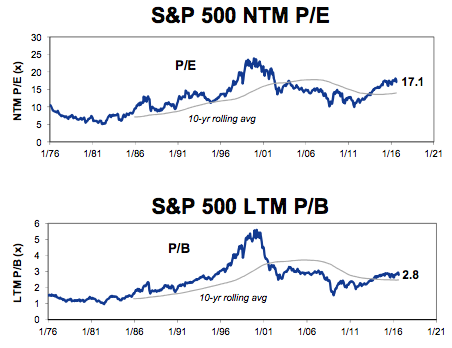
We’ve talked quite a bit about bonds of late and why the only reason to be in stocks is that some $12 trillion in high quality fixed income guarantees a loss if held to maturity and will only be profitable if central banks continue to play the “fool” in the “greater fool” theory of investing (and you sell into it). Here’s an updated look at valuations on equities:
(Charts: Goldman)
So clearly, we’re overextended on both a PE and a price/book basis. Speaking of PB, consider the following interesting commentary from Goldman:
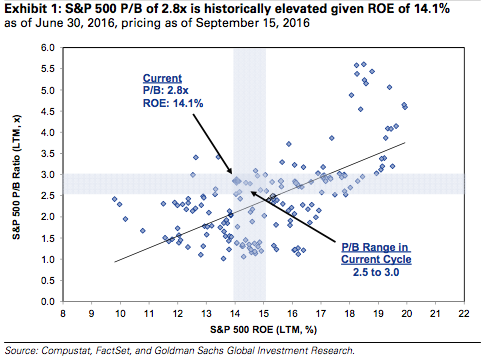
“S&P 500 also appears expensive in price/book (P/B) terms given the current level of return on equity (ROE). The historical relationship between ROE and P/B shows investors typically penalize falling profitability with lower valuation. Despite the steady decline in S&P 500 index-level ROE to 14.1%, aggregate S&P 500 P/B has actually expanded to 2.8x, above the 40-year average of 2.5x. Based on history, an index-level ROE of 14% implies a P/B of 2.1x, suggesting index downside of 25%.”
(Chart: Goldman)
Right, so just a 25% correction - that’s all.
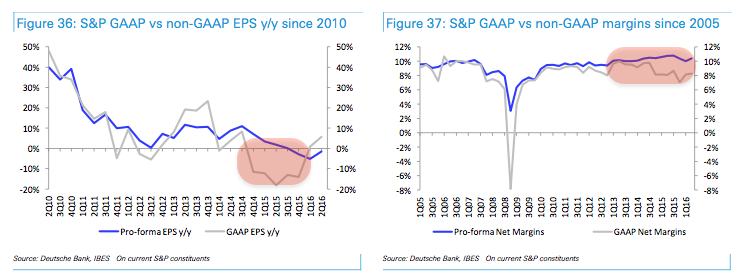
Perhaps more interesting (to us anyway) is a granular look at GAAP versus non-GAAP earnings - something we’ve discussed in these pages before.
To be sure, there are legitimate reasons to deviate from GAAP. If it can be shown that using non-GAAP numbers legitimately improves investors’ understanding of a 10Q, then by all means. But if all you’re doing is “faking it to make it,” so to speak, then you’re essentially lying to investors.
Let’s look at some numbers, shall we? Here’s a look at GAAP versus non-GAAP earnings and margins going back six and 11 years respectively:
(Charts: Deutsche Bank)
Clearly, the divergence between “reality” and “fantasy” is growing. Here’s Deutsche Bank playing defense:
“S&P 2Q16 reporting is now complete. Over the past year and a half, the wider than usual spread between GAAP and non GAAP is from asset write-downs at Energy and Materials companies. Outside those sectors the spread is in line with normal, averaging 86.6% in 4Q15-2Q16. The overall spread worsened in 4Q15 (68%) and subsequently improved in the past two quarters (81% in 1Q, 79.6% in 2Q).”
Well, yes. If you exclude the bad stuff, the numbers are good. It’s ironic that the bank should use that rationale considering it’s the exact same rationale as that employed by corporate management teams when reporting non-GAAP numbers.
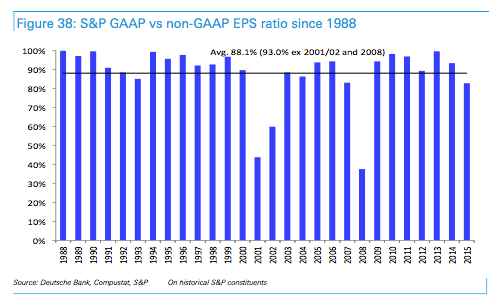
At the end of the day though, the overall picture is clear. The ratio of GAAP to non-GAAP earnings has only been this low during the crisis and the dot-com bust:
(Chart: Deutsche Bank)
Something to ponder as you assess where the “value” in the market really is.