Redbook Same Store Sales Growth Falls
The economy is faced with higher COVID-19 cases and no stimulus. Good news is the labor market is improving. Question is how much it can improve in the face of rising cases, hospitalizations, potential shutdowns, and changes to behavior. This economy dealt with the spike in cases in the summer fine.
Obviously, the spike is higher now, we have a fuller labor market, and less government support. This isn’t the worst case scenario. Worst case will always be in the spring. It's highly doubtful that deaths will ever get to the peak again because we have much better treatment.
Plus, we have the Eli Lilly therapeutic which prevents mild cases from getting worse. It’s a race between science and the virus to determine if December and January will show we are turning the corner or if deaths will significantly surpass the summer peak.
In the midst of conflicting trends, Redbook same store sales growth has been bouncing along its bottom in the low single digits. In the week of November 7th, same store sales growth fell from 3.2% to 1.1%. That’s a weak reading. Can we expect anything different? It seems likely that this holiday shopping season will be weak without a stimulus.
Market Ignores COVID-19
Good news is the market already expects weakness. Expectations couldn't be much lower. However, stocks have rallied because we have seen a reversal of fortunes. Before the vaccine, the market didn’t care about the great earnings news because it foresaw a terrible spike in COVID-19 cases. After the vaccine, it doesn’t care about the weak economic reports in November.
It appears that the stock market isn’t going to fall because of the spike in hospitalizations because everyone knows that will happen. Even optimists see it. If the market was going to react to that, it already would have. Sometimes the market ignores seemingly obvious things until the last minute, but this negative catalyst has already happened.
No Change In Small Business Confidence, But Uncertainty Increases
NFIB small business optimism index stayed at 104 in October. This slightly missed estimates for 104.8. Generally, the small business confidence index falls when Dems are in office. Amazingly, small business confidence wasn’t that weak even in the worst of the crisis because a Republican was president.
That's not saying that’s the right way to think of things. It’s just how this survey works. Therefore, when the index falls in November, don’t overreact. You would think it would fall even without the election because of COVID-19. We shall see. For now, we can look at the October reading.
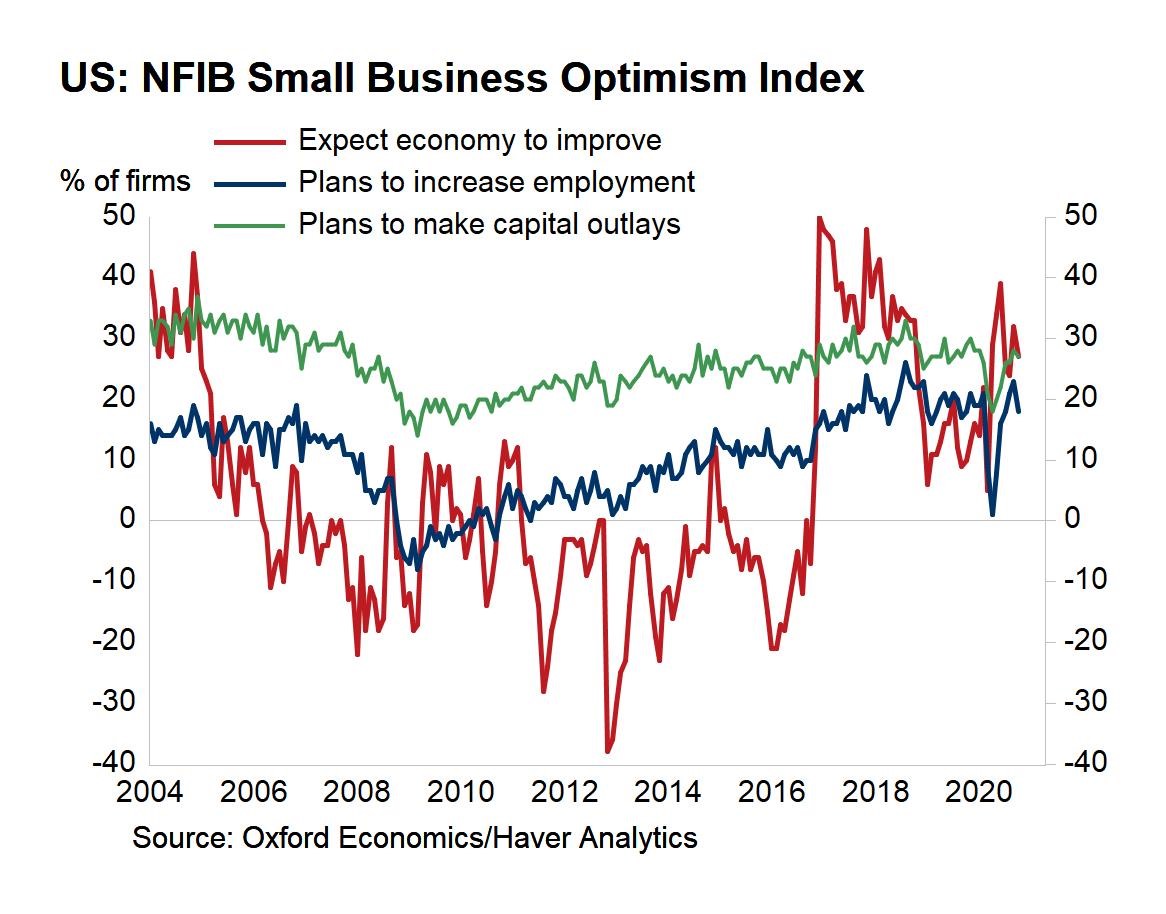
Even if the headline is somewhat manipulated by politics, the details of the report are always informative. Uncertainty was the highest since November 2016 which was the last election, implying uncertainty was caused by politics. As you can see from the chart above, plans to increase employment fell 5 points to 18%.
In other words, 18% more firms plan to increase employment than decrease it. That’s still a solid reading even though it’s weaker than September. It ended up bearing fruit as job creation was solid among small firms in the monthly labor report.
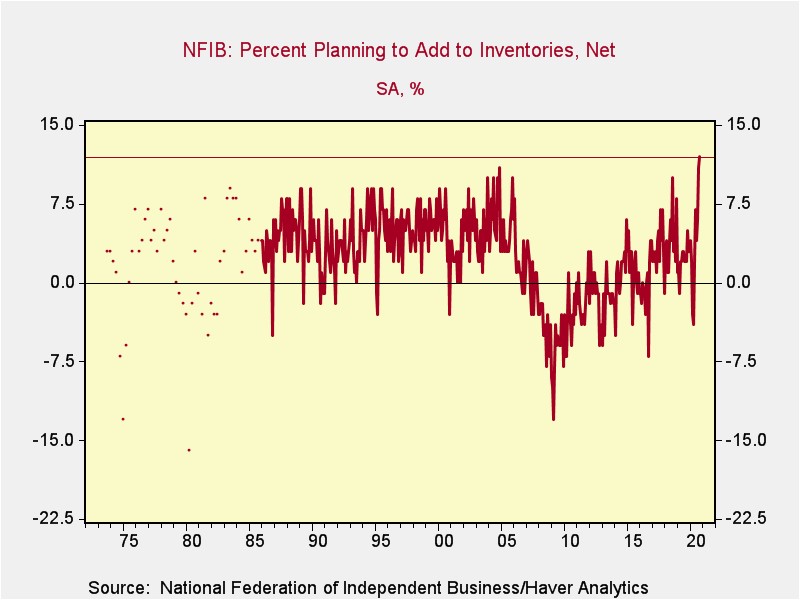
Net expectations for the economy to improve fell 5 points to 27%. Biggest improvement was in earnings trends. You wouldn’t expect a 9 point improvement in earnings trends (to -3%) in the same report as a 5 point decline in plans to increase employment. Another positive is seen in the chart below.
As you can see, the net percentage of firms planning to add inventories hit a record high. That means demand has been better than expected, catching business owners off guard. Adding to inventories creates more demand for suppliers in the next couple months which turns the economy’s wheels.
September JOLTS
It’s fine to look at past data now because it signals where the economy was before the incoming slowdown and subsequent recovery. It’s possible that if the economy weakens and then recovers, the data from September and October could be similar to the data in February and March.
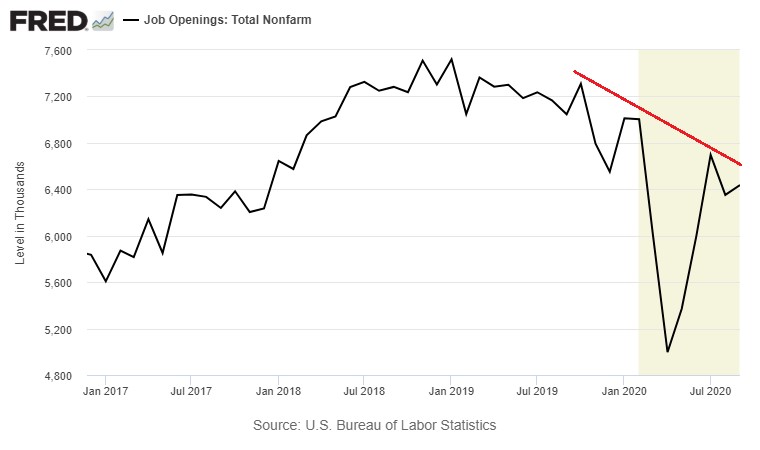
Timing of the spring recovery is still up in the air though. With that in mind, job openings were 6.436 million in September which was up from 6.352 million. However, the original August reading was 6.493 million, so we wouldn’t call it a victory. The chart below shows a negative trend, but most would ignore that. We can expect openings to pick up next year.
Leisure and hospitality industry had a 20,000 increase in openings as it got to 781,000. It’s interesting that hires fell from 5.952 million to 5.871 million because the BLS report showed solid job creation in September. It doesn’t make sense. BLS report can always be revised though.
COVID-19 Is Worse Than The Summer
COVID-19 seems worse than the summer outbreak as there are 61,964 people in the hospital which is a record high. However, that’s only a record because a few states didn’t report their numbers in the spring. When you take that into account, this isn’t as bad as the first outbreak.
However, it isn’t far away either. If people gather together indoors, it could be worse than the spring in terms of hospitalizations. However, we can see very little chance of deaths spiking to above 2,000 now that we have better treatments, a vaccine, and Eli Lilly’s therapy.
A vaccine and therapy won’t have any impact in November, but they will by January when the death rate would have a chance at hitting a new high. Specifically, the 7 day average of deaths is 991. It will easily surpass the summer peak even with better treatment because more people are in the hospital. The stock market doesn’t care about COVID-19, but in terms of humanity, the final 6 weeks of the year are potentially about to be deadly. 7 day average of deaths could get above 1,200.