

As the Brexit drama unfolded we remarked that it would be difficult to come up with a topic that sounds more boring than “British politics.” That said, “Japanese fiscal stimulus” would be right up there on the “snoozers” list if you didn’t know the context.
Of course if you do know the context, you know it’s pretty important and if you don’t count Zika or Warren Buffett calling Donald Trump a “monkey,” it’s all anyone is talking about on Tuesday.
We like to just tell it like it is, and to be honest with you, we already told you what was going to happen here on too many occasions to count. Here’s what we said on Saturday for instance, after the Bank of Japan underwhelmed:
“Of course we all knew the yen was going higher (i.e. stronger) regardless. There was no way they could have made a splash. That would have entailed another 20 bps in rate cuts, a bazooka for the ETF purchases, and some kind of coordinated message with Abe to suggest what role the bank will play in fiscal stimulus.”
The same thing goes for the fiscal stimulus package. Here, in a nutshell, is what Prime Minister Shinzo Abe announced (via FT):
“Shinzo Abe has put Japan at the forefront of a global shift away from austerity and back towards looser fiscal policy as he launched a new ¥4.6tn ($45bn) stimulus to boost a struggling Japanese economy.”
“Although Mr Abe proclaimed a total package of ¥28.1tn, the actual new government spending is ¥6.2tn, of which ¥4.6tn — 0.9 per cent of gross domestic product — will fall in the current fiscal year.”
“The package includes ¥2.5tn in welfare spending, ¥1.7tn for infrastructure, ¥0.6tn for small and medium-sized businesses hit by “uncertainty due to Brexit”, and ¥2.7tn for reconstruction after an earthquake on the southern island of Kyushu earlier this year. Few precise details are available — the package contains a laundry list of measures for ministries to spell out later — but the welfare spending is expected to include childcare subsidies and a payment of ¥15,000 ($147) each for 22m low-income individuals.”
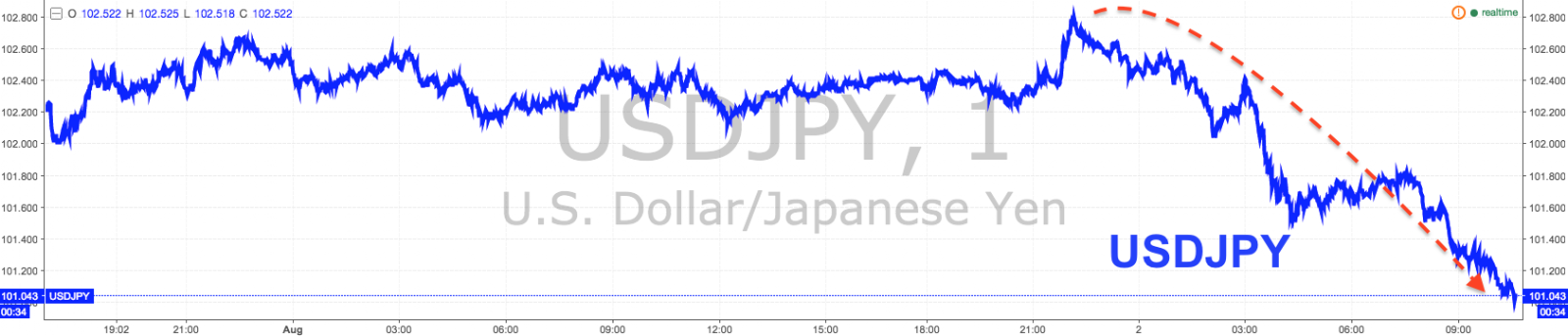
At the risk of sounding crass, the market just threw up all over that. In the words of the horse from the long-forgotten Nickelodeon cartoon Ren & Stimpy: “no sir, I don’t like it.”
Here’s a bit of analyst color:
RBS: “The market is buying the rumor and selling the fact, so the yen has rallied after the headlines.”
UBS: “There was no surprise at all.”
BMI: “Govt would be be much better off taking structural reforms and cutting spending instead of going in the opposite direction, which has proven not to work year in, year out.”
Credit Agricole: “As seen as yen reaction, investors seem to have expected more.”
Capital Economics: “We currently have a forecast of 0.8% growth for next year, but with this number, the risks are probably tilted to the downside, because we were hoping for a bigger fiscal boost.”
Yes, investors did “expect more,” which brings us right back to what we’ve been saying for weeks: there’s no way for Japan to live up to expectations because at this point, expectations are so high it’s not even clear what they are. Here’s the breakdown from Citi along with some desk chatter:
“These figures are largely in line with the announcement by Prime Minister Shinzo Abe last Wednesday and the latest media reports, so there is no additional “surprise” factor for markets to focus on. We believe this is a very important turning point for the Japanese fiscal policy that is expected to lead to a substantial Yen depreciation through the deterioration in the balance of payments in the long-run. However, in the short run it is lacking the catalyst to terminate the present Yen appreciation. We believe USDJPY could test its July low at 100.0, potentially the low in June at 99.0 after the break of it. However, we must note that the further USDJPY falls, the higher the probability of Yen selling and MoF intervention.”
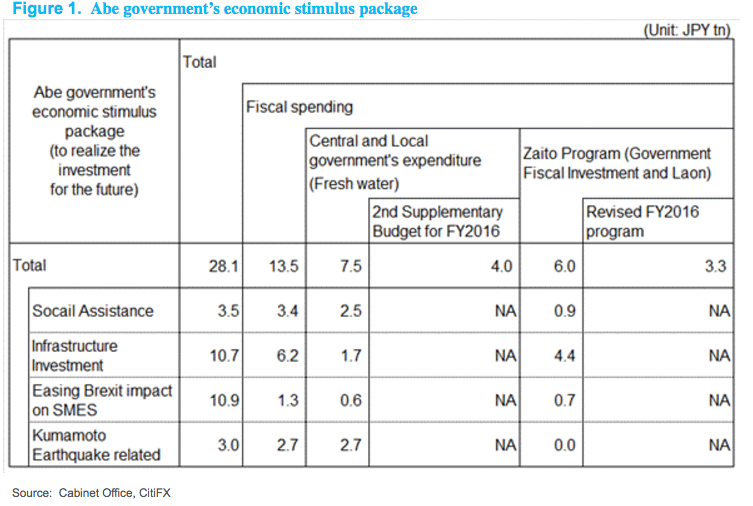
(Table: Citi)
The reaction: the yen hits a three-week high, the Nikkei dives along with European equities (more bank jitters), and Wall Street is following suit.
What is perhaps the more important undercurrent here is that investors appear to be pricing in a central bank admission of defeat. Have a look at the yield on the 10-year Japanese government bond:
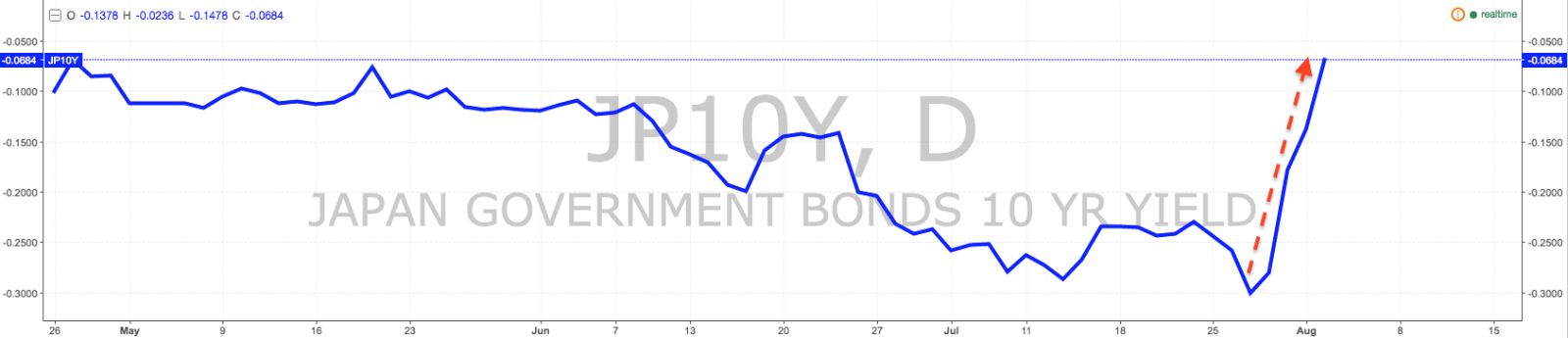
What you’re seeing there is the market questioning whether the Kuroda-mandated “review” of BoJ policy will ultimately lead to the central pulling back. Here’s BMI again: “Yen likely to continue gaining in coming weeks along with spike in Japanese bond yields which may create panic in BOJ.”
And here’s what Kuroda himself had to say:
KURODA: I DON'T THINK BOJ WILL SHRINK ITS POLICY AFTER REVIEW
Well Haruhiko, the market is clearly testing that. And as an investor you should be advised, the last chart shown above is the kind of thing that can cause painful VaR shocks.