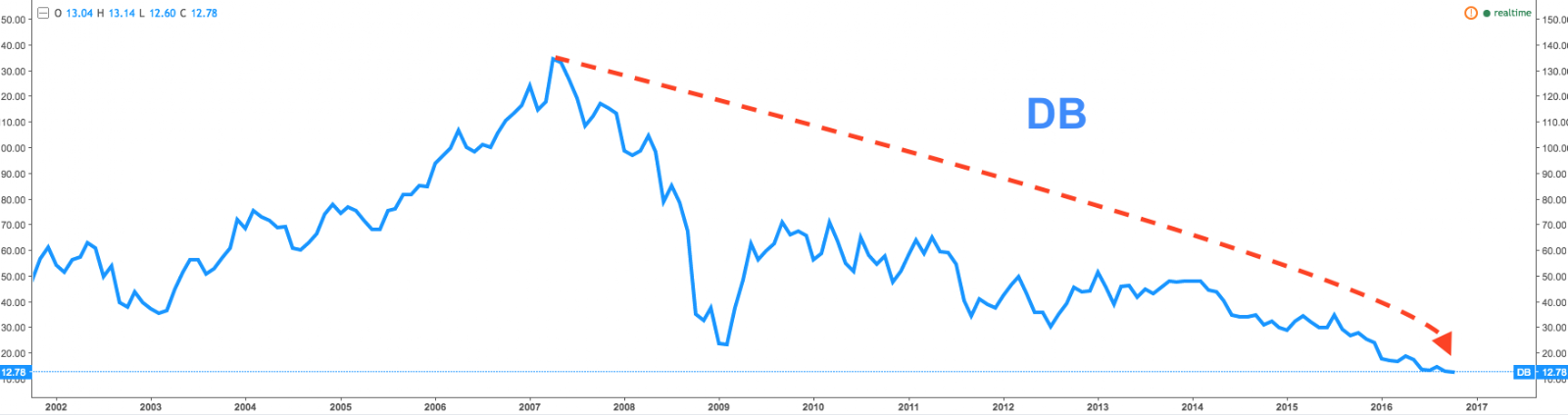

To quote Bill Murray from Groundhog Day, “well it’s Monday…. Again.”
And to paraphrase the same dialogue “....and that must mean we’re talking about Deutsche Bank and OPEC. You want a winter prediction? I'll give you a winter prediction. It's gonna be cold. It's gonna be gray. And it's gonna last you for the rest of your life."
You never really want to have a financial news network running this as the first paragraph of a headline story:
“Conventional wisdom about embattled German institution Deutsche Bank is that even though it's short on capital, it's in no danger of failing because it has enough assets to sell to pay off any liabilities on the horizon.”
Now for one thing, that’s entirely false. That’s like saying “even though I’m short on money, I can afford my car payment, the electricity, and the mortgage for one more month.” That inspires panic, not confidence. And see, here’s the problem. It’s like no one learned anything from Lehman. Take this analysis for instance, quoted by CNBC:
"’While the near-term issue is the potential for a settlement with the U.S. Department of Justice, the longer-term issue is the depressed level of profitability of the bank and their inability to grow capital through earnings or raise capital in the market,’ KBW analyst Frederick Cannon said in a research note.”
No. The “near-term” issue is that their counterparties start bailing. And then what the hell do you do with that derivatives book? “Raise capital”? Is that a joke? What happens if you can’t trade with anyone? That’s the real question. You’ll have to unload everything risky by about noon or you’re going to be getting pennies on the dollar because everyone knows that you’re either i) screwed or ii) what you’re selling is worthless. Or maybe some horrific combination of both.
Here’s what Christopher Whalen at “revered” (that’s another joke) bond rating agency Kroll had to say:
"Ill-considered public statements, whether made directly or on background to the news media, serve to erode confidence in markets and in specific financial institutions. We believe that political leaders who seek to obtain partisan political advantage by making such statements play a very dangerous game."
“Deutsche as both financially stable and having more than adequate liquidity."
Ok, sure Chris. Wasn’t your agency the one who rated a deal from subprime auto lender Skopos Financial in October? Enough said. Actually no. Not enough said. Here’s what Kroll had to say five months later:
“The collateral for Skopos Financial’s most recent securitization of subprime auto loans is performing worse than expected, feeding fears of an impending liquidity crunch in the asset class.”
“At issue is a $154 million transaction that Skopos completed on Nov. 9 with Citigroup running the books. That issue’s top class earned ratings of A/AA from DBRS and Kroll, but already has experienced enough collateral defaults to approach a “cumulative net loss ratio trigger event” set by Kroll.”
“Should losses reach that level, Skopos would have to stop collecting excess cashflows and redirect the money to bondholders.”
Ok. So if we were you (and we’re not, so this isn’t investment advice), you may want to stay away from this trainwreck. Here’s what WSJ had to say on Friday:
“Hedge funds that have placed bets against Deutsche Bank AG are reaping the rewards.”
“Deutsche Bank shares are down nearly 50% since the start of the year on concerns about its capital position, leading to large profits for a number of hedge funds who have been running short positions on the German lender, betting its stock will fall further.”
“However, it has been a bumpy ride. Deutsche’s shares fell as much as 8% in morning trading Friday, reaching a record, following reports that clients, including several large hedge funds, have pulled billions of dollars from the bank. But they later recovered to close up 6.4% in Frankfurt; in New York, the bank’s U.S.-listed shares advanced 14%.”
“Greenwich, Conn.-based AQR Capital Management, which runs $159 billion in assets, revealed that it had a short position in Deutsche Bank on Wednesday, according to a filing made public by the German regulator on Thursday.”
“AQR was also among a number of funds that have recently taken steps to withdraw securities or cash from the bank, or dial back their trading activities, The Wall Street Journal reported Thursday.”
“Deutsche Chief Executive John Cryan said in a message to employees Friday that media speculation that a few hedge funds had reduced some activities with the bank was causing “unjustified concerns.””
Sorry John, but I’m afraid the market will ultimately decide if these concerns are “unjustified.”
Place your bets; and remember: