

Ok, so two things to wrap the week: bond yields and volatility.
Both have been suppressed by central banks. Here’s what Citi said on August 30:
“We have written recently on the distortionary effect of central bank action on asset prices. One of the most jarring manifestations of this is the persistently low implied volatility across asset classes this year. Implied and realized volatilities are very low, both outright and relative to cross-asset correlations. Such divergences have historically met with sharp corrections. We can’t confidently say that these distortions aren’t here to stay. Whilst these relations seem to be aberrations from a historic perspective, given the extent to which markets are being driven by central bank action, as well as the prospect of more easing to come, we don’t really have much evidence to suggest this isn’t a paradigm shift in terms of how we think about volatility. It may well be the case that these distortions are actually here to stay.”
Well, we profoundly disagree. First of all, here’s vol and the 10Y on the week:
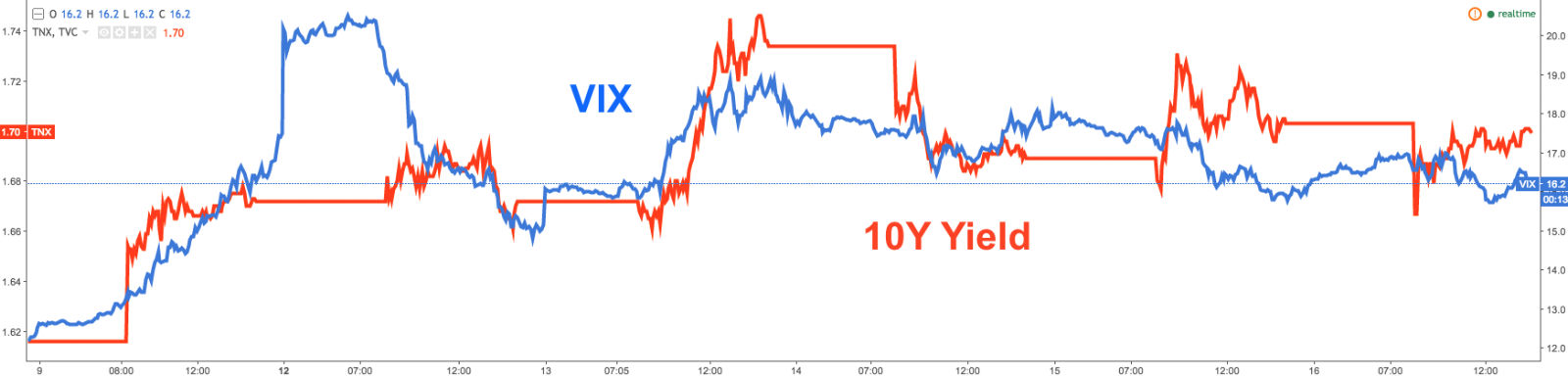
Much has been made of the so-called death of volatility, but as we’ve been pounding the table on for months, you can’t keep doing this. It can’t possibly last forever. Vol comes and it goes, but just as you can’t “smooth out” business cycles forever (the ultimate Keynesian dream), you can’t do completely away with vol. There were a number of risk events headed into this month. Here was Citi’s breakdown:
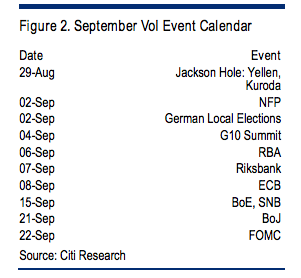
(Table: Citi)
So far, we’ve weathered the storm, generally speaking.
But as we discussed on Thursday, suppressing volatility has knock-on effects. For one thing, it prevents markets from purging misallocated capital. But more specifically, it allows vol targeting strategies to lever up making the inevitable unwind that much more painful.
Have a look at how we were positioned relative to history going into the month:
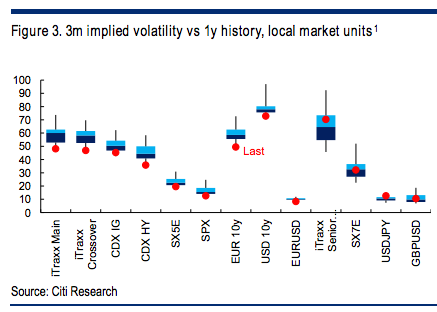
(Chart: Citi)
Anyone who things that’s sustainable in perpetuity has had way too much central bank Kool-Aid. Speaking of which, here’s an updated central bank balance sheet chart:
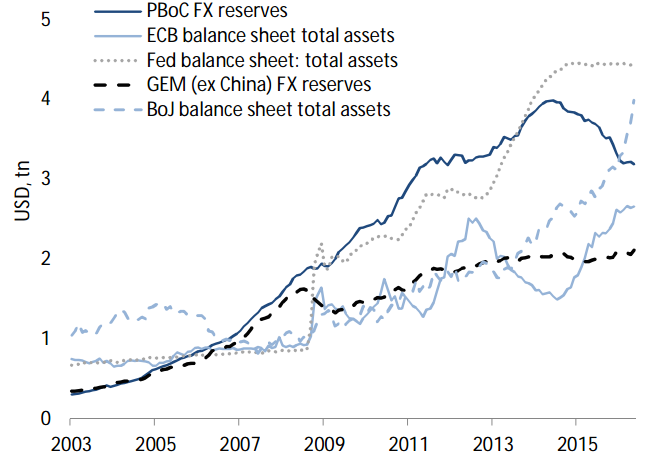
(Chart: Deutsche)
So it’s clear who’s in the driver’s seat here. But the problem now is that policymakers seem to have come (somewhat) to terms with the fact that this experiment is about to come to a decisive end. There’s nowhere else to turn. The BoJ is nationalizing the Japanese stock market, the ECB is funding corporate balance sheets, the noneuro countries are chasing Draghi down the rates rabbit hole, and the Fed can’t lead the policy normalization charge because if they do, they’ll spark a USD rally that will exacerbate what looks like a developing UST VaR shock and drive the dollar into the stratosphere, crushing EM and poking the Chinese currency bear.
Meanwhile, the quest for yield is getting hopelessly desperate. Japanese investors can’t pick up any yield in 10Y Treasurys any longer because the cost of FX hedging the positions is too high.
It won’t be long before stocks are truly the only game in town (if we’re not already there).
This is how bubbles get blown. Irrational, counterintuitive policies that are allowed to proliferate even when they clearly are embedding an enormous amount of risk into the system.
It’s not “irrational exuberance,” this is “irrational complacency.”