


Hey trader,
I spent this entire week on one subject. Stop losses.
Five straight days:
- Gravity points
- Channels
- Moving averages
- Integers
- Percentage losses.
Every method I have used across 39 years of trading.
But, I saved the best for last.
On Friday, I told members a story most of them had never heard. It goes back to my days as chief market technician at ThinkOrSwim.
Years back, I walked into a room of brilliant Russian programmers from St. Petersburg and pitched them an idea that changed how retail traders protect their money.
The tool we built together is still inside the most popular charting platform in the world. Nine out of ten traders have no idea it exists.
The Pitch
I used to travel the money shows with Don Kaufman and Brandon. Dallas. San Francisco. New York. Orlando, half a dozen times.
I met a client at one of those shows who got me thinking about a problem nobody had solved.
Every stop loss at the time was static. You picked a number, set it, and hoped for the best. The stop never adapted to what the stock was actually doing.
I went back to the team and asked one question. Have any of you ever considered building an algorithm around a trailing stop?
They looked at me, pens in hand, and said they had no idea how to do it.
I told them to build it around volatility. They asked what type.
I said average true range.
All of a sudden, they started looking at each other. They realized they could do it. That conversation produced the ATR trail stop.
What It Is
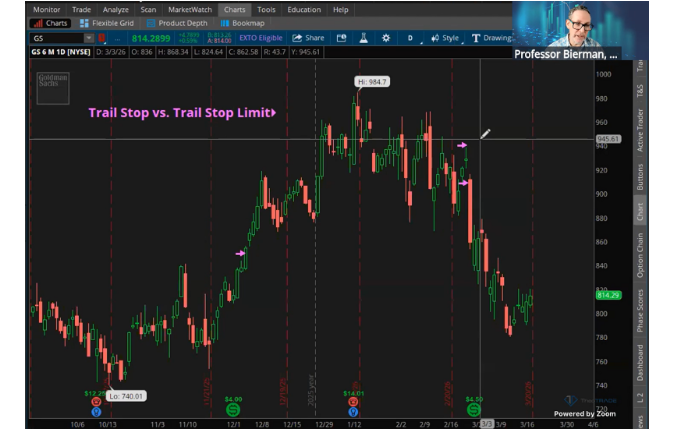
A trailing stop order is dynamic. It self-adjusts with the price of the security to lock in profits and limit losses.
You can adjust it manually, or you can have it algorithmically adjusted. I prefer study-driven adjusted because I do not want to go day after day adjusting the stop. Let the computer do it.
On the long side, the stop only moves up. It never moves down.
I told members to think of it like an elevator that can only go up. There is no down button.
On the short side, it is the polar opposite. The stop only moves down. It never moves up. I call it escalator down, elevator up.
The ATR trail stop takes this concept and builds it around real volatility. The algorithm calculates the average true range over a period you choose. It multiplies that by a factor you set. Then it creates a distance between the price and the stop that adjusts automatically every single day.
Welles Wilder created the average true range. I took his work and told those programmers to wrap it into a self-adjusting trail stop. They built it, and it became one of the most powerful tools on the platform.
Why It Works
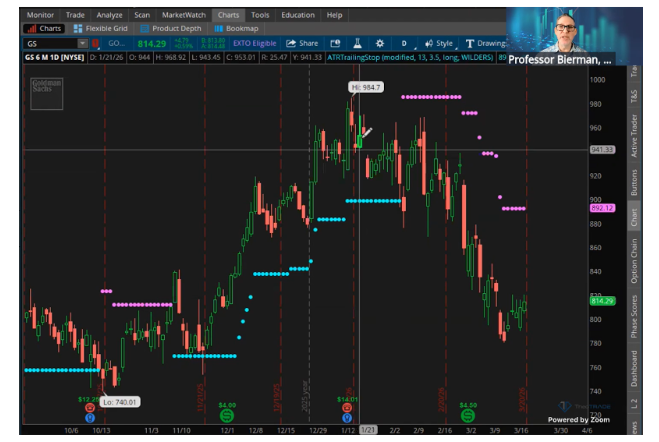
I used Goldman Sachs to demonstrate on Friday. Goldman's 13-day ATR is 28 points. That is a 3% average daily move.
If you bought Goldman on November 24th and set the trail stop to a 3.5 multiplier against a 13-day ATR, here is what happens. The algorithm walks itself higher every single day as the stock rises.
You do nothing. That is my favorite phrase in all of trading.
The stop populates as dots on the chart. When the dots sit underneath price action, you stay long. When they flip above, you get out.
If Goldman has a bad day, the stop does not go down. It just holds its position and waits. The only way you exit is if price drops through the dots or the dots reverse polarity and flip above.
I told members it is the easiest trigger protection system ever built. When I first saw the beta test, I nearly drooled on my keyboard. I knew it would bring in a million customers.
The reason it works where fixed stops fail is simple. A 10% stop on Goldman is meaningless if Goldman's actual volatility requires 12% breathing room. The ATR trail stop sizes itself to the stock. It gives a high-beta name the room it needs while keeping a tighter leash on a slower mover.
How It Changed Everything
Before this tool existed, traders either guessed at their stop placement or used rigid percentage levels that had nothing to do with the stock's behavior. The ATR trail stop made protection adaptive.
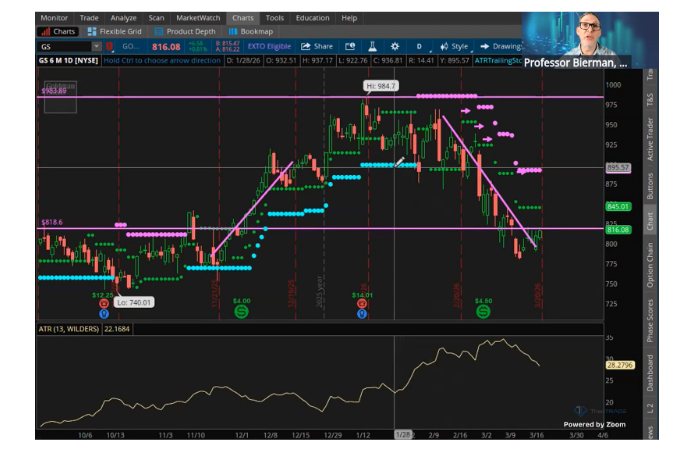
I showed members what happens when you run sensitivity analysis by changing the multiplier. Two versions side by side on Goldman told the whole story.
The 2.0 multiplier triggered a short signal on January 23rd. The 3.5 multiplier triggered it on February 5th.
One variable change moved the signal by nearly two weeks. That is the difference between catching a move early and missing the first leg entirely.
You can set it differently for every stock. A tighter stop on a low-beta name. A wider stop with more leeway on a high-beta name. You can change the ATR period, the smoothing factor, and which side of the trade you start from.
I played out of control for 10 of my 39 years in this business. I learned the hard way that if you do not play to control risk, you play to lose.
I live and die by one mantra. Think risk first, reward second, and the rest takes care of itself. If you can pull that off, you can pyramid and get wealthy.
Stop losses force your hand to adapt to disciplinary execution. The ATR trail stop automates that discipline so your emotions never enter the equation.
The Genesis COG System identifies the entry. The trail stop protects the position. Knowing when to buy is only half the battle. Knowing when the algorithm is telling you to get out is the other half.
Have a good weekend. Monday comes fast. Be ready.
Professor Jeffrey Bierman
Creator of the Genesis COG System