


Hey trader,
That massive put trade you dismissed as irrelevant? It just became the most important signal on your screen.
Most traders ignore deep out-of-the-money options because the math says they shouldn't matter.
After all, market makers barely hedge them. The probability of profit looks laughable.
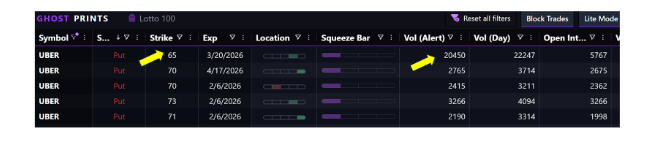
So when 20,000 contracts hit my Ghost Prints Surveillance Console at a strike 13% below the current price, it's easy to write it off as noise.
But that assumption breaks down the moment a stock can't hold gains after beating earnings. What looked like a lottery ticket becomes a loaded spring.
UBER's post-earnings collapse reveals exactly how these trades transform from background noise into price-moving catalysts.
When an Earnings Beat Doesn't Matter
First, UBER beat top-line expectations. Barely.
Next, company officers did two things: they blamed the effective tax rate and lower demand for rides, and they reduced forward guidance.
Ouch.
The stock collapsed at the next open.
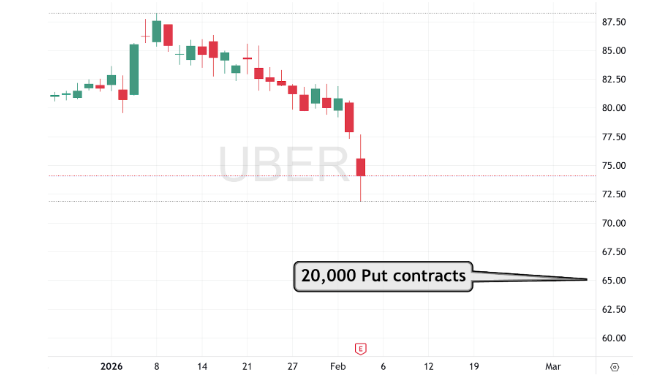
Then somebody bought over 20,000 puts at 65, March expiration. Deep out of the money. The kind of trade most people ignore.
But not this time.
Those 20,000 put contracts represented over 25% of the day's total UBER options volume. One trade. For a strike 13% below the current price.
Under normal circumstances, this trade barely moves the needle. Market makers sell those puts, carry minimal exposure, and don't bother hedging aggressively.
But UBER beat earnings expectations. The stock should have rallied. Instead, it faded.
The initial pop evaporated. Price consolidated. Then rolled over.
When a company beats numbers but the stock can't hold gains, something broke in the narrative. The market smelled it immediately.
That 20,000-contract position isn't just speculation. It's positioned for a breakdown that fundamental weakness just confirmed.
The Gamma Trap Waiting Below
Here's where it gets mechanical.
Every option has a "delta" - a measure of how much the option's price moves relative to the stock. Deep out-of-the-money options have low deltas, meaning market makers don't need to hedge much against them.
Those $65 puts currently carry a delta of just 9. Barely a blip.
But if UBER drops to $70, delta jumps to 20. At $68, it's 30. By $66, it's approaching 50.
That's when hedging requirements explode.
Market makers must short stock to offset their exposure. Each dollar lower forces more selling. That selling pushes the price lower. Which increases delta. Which requires more selling.
The feedback loop turns mechanical. What started as a low-impact trade becomes a gamma cascade.
And it happens fast.
The Post-Earnings Playbook
This pattern repeats across earnings failures.
Institutional traders bought massive out-of-the-money puts on Oracle three days before a 4.5% gap down. Taiwan Semiconductor showed the same activity before its breakdown.
Tesla has seen consistent far OTM put buying throughout its decline.
The trade structure is always similar. Big size. Deep out of the money. Low delta. Bought aggressively at the ask.
Then the stock fails to respond positively to earnings. Or guidance disappoints. Or the conference call reveals cracks.
That's when the low-delta trade transforms from irrelevant to inevitable.
How to Trade the Setup
UBER closed at $73 after rejecting the post-earnings bounce. The $65 puts expire March 20th.
A vertical put spread captures the breakdown without requiring UBER to collapse all the way to $65.
Buy the March 20th $70 put. Sell the $65 put.
Maximum risk is the debit paid. Maximum profit is the $5 width minus that debit. The breakeven sits around $68, depending on entry timing.
This structure profits if UBER continues fading toward support. You don't need the stock to reach $65.
You just need it to move in that direction as the original 20,000-contract position gains delta and forces mechanical selling.
The original trade was positioned for $65. Your trade profits from the journey there.
Why This Matters Now
Earnings season exposes weak narratives. Companies that can't deliver get punished immediately.
When you see massive out-of-the-money put buying right after disappointing price action on good numbers, pay attention. The delta looks irrelevant today. It won't stay that way.
Watch for stocks that beat earnings but can't hold gains. Watch for consolidation after initial pops. Watch for follow-through weakness in the following sessions.
That's when low-delta trades stop being noise and start forcing moves.
Brandon Chapman, CMT
Creator of Ghost Prints