


Hey trader,
When I ran my hedge fund, there was one number my prime broker asked about before anything else.
Not my returns, not my positions, my Value at Risk.
Value at Risk tells you how much money you could lose on your worst day.
It combines the probability of a market event with the dollar amount that event would cost your specific portfolio.
Every hedge fund in the world computes it. Mutual funds do not have to.
Retail traders almost never do.
That gap is where fortunes get destroyed.
Long-Term Capital Management had Nobel laureates and the most sophisticated risk models on the planet.
They lost $630 million in less than 15 minutes on an event they calculated had lottery-ticket odds of occurring.
Right now the S&P 500 is sitting at 6,800 with weekly momentum already breaking to the downside.
If we drop to 6,000, most of you have no idea what that does to your actual account in dollar terms.
The Metric That Changed an Industry
Long-Term Capital Management held $4 billion in real equity and $8 billion in leveraged positions.
Their convergence-divergence trade blew apart without warning. In under 15 minutes, $630 million was gone.
The probability they assigned to that event was one hundredth of one percent. That is the equivalent of winning the lottery.
It happened anyway. It changed the entire hedge fund industry overnight.
Here is why the LTCM story matters to you right now. Their team knew the math.
They understood the probabilities. They computed Value at Risk every single day.
What destroyed them was the assumption that a low-probability event would never arrive.
A lot of traders sitting in this market today are making the same assumption with far less sophistication.
The Math Behind the Number
VaR works by assigning a dollar figure to a probability. Let me walk you through a simple example.
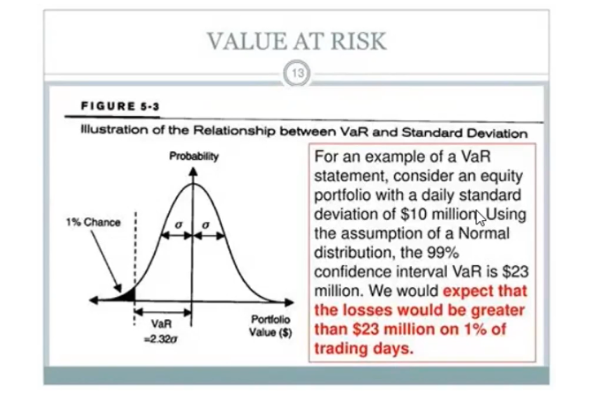
A $100 million portfolio swings $10 million in either direction on a normal day. Using a 99% confidence interval, the VaR comes out to $23 million.
That means on 1% of trading days, losses exceed $23 million. The other 99% of the time, you feel invincible.
That 1% is the day that ends careers.
Now apply this to your own account. The S&P 500 is at 6,800 and the weekly momentum is already deteriorating.
The histogram bars are getting more elongated every week. That is momentum breaking in plain sight while the candles mislead you into thinking everything is fine.
If we fall to 6,000, that is roughly a 12% decline in the index. But a 12% index decline does not mean a 12% portfolio loss.
Traders loaded with high-beta tech, financials, and industrials face a multiplied version of that move.
I told my members today that some of you could lose 25 to 30% of your net worth in a single session.
Why Right Now
I told my audience today that there are three things Wall Street cannot tolerate. Inflation, negative earnings growth, and uncertainty.
Right now you are sitting in the epicenter of uncertainty.
The Supreme Court struck down tariffs. Refund decisions are out of the administration's hands entirely.
Nobody knows what gets hit next or how the resolution unfolds.
Even Fed Governor Waller caved. The most dovish voice on the committee now says the next jobs report could force a rate hike.
No rate cuts are coming this year.
There are no massive earnings catalysts left. There is no rate cut tailwind.
The market is standing on a ledge with nothing behind it.
A lot of you sit there every day saying it did not happen today. That logic works 99% of the time.
Value at Risk exists because of the other 1%.
Compute It Before It Computes You
You can run Value at Risk on your own portfolio today. Take your positions and apply a 5% market decline.
Calculate what your leveraged exposure would actually lose in dollar terms.
If that number makes you sick, you are overexposed.
I am prepared for a thousand point drop. I will not shed a tear because I have positioned for it.
I carry nearly equal long and short exposure across 20 positions. My risk of ruin is zero.
The weekly momentum on the S&P 500 has already broken to the downside.
I track these shifts across every timeframe through the Genesis COG System.
The system identified this deterioration before today's session confirmed it.
You do not need to predict the day. You need to know your number before the day arrives.
See how the Genesis COG System tracks momentum breakdowns across timeframes in real time →
Professor Jeffrey Bierman
Creator of the Genesis COG System