


Hey trader,
Wednesday morning, I took a textbook Bollinger Band breakout on the euro.
Every rule was followed…Every box was checked.
I lost $100 in under fifteen minutes.
The euro spiked 20 pips and gave back all 20 within minutes. Gold did the same thing. So did the Nasdaq. So did the S&P 500.
Four markets reversed at the same time.
Longs got stopped...Shorts got stopped…Nobody won.
This is a pattern I call the pirate flag. It sweeps both sides and leaves nothing behind.
I lost $100 on the first trade and cancelled the second before it triggered. Here is how to recognize a pirate flag before it cleans you out.
What a Pirate Flag Looks Like in Real Time
A pirate flag forms when the market prints higher highs and lower lows in rapid succession.
Price ends right back where it started. The name fits because the market robs both sides.
It shows up during news-driven volatility or geopolitical headline reactions. The move looks real going up.
It looks real coming back down. Neither direction holds.
A pirate flag punishes action in every direction. The trader who followed the breakout loses.
The trader who faded the move also loses. The damage compounds when you re-enter.
The natural instinct after getting stopped is to flip direction. That puts you right in the path of the second sweep.
Here is how it played out Wednesday.
At 8:30 AM Eastern, weekly jobless claims data hit. The euro broke out above its Bollinger Band and launched higher.
The breakout triggered a long entry near 1591 with a stop at 1580.
Within minutes, the euro ran to 1595, then reversed all the way to 1575. I moved the stop to 1583 per the Bollinger Band rules.
The reversal blew through it. The loss was $100 on a full e-mini contract.
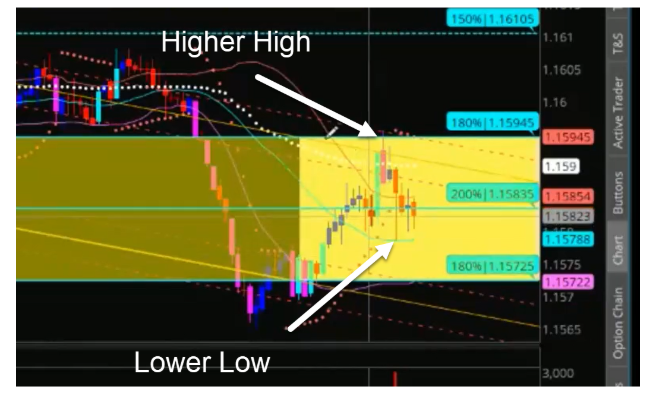
Then I checked the other markets. Every single one printed the same pattern at the same time:
- Gold created the same widening candle and pulled back inside its range
- The Nasdaq spiked into overbought territory and fell back
- The S&P 500 pushed up and reversed to overnight resistance
- Crude oil broke out of its Bollinger Band and came right back down
Higher highs. Lower lows. Price ending where it started.
Pirate flag across the board.
What Kept the Damage at $100
The trade itself was not the problem. The environment was.
A $100 loss is a rounding error in a trading week. A $500 loss from widening your stop or doubling down is not.
Two things protected the account.
The first was stop discipline. When the Bollinger Band confirmed the adjustment to 1583, I moved it immediately.
The rule said move it. I moved it.
The market reversed through that level seconds later.
The second was position sizing. I took a full contract and told the room that micros might have been smarter.
The risk was defined before the entry, not after. If I had widened the stop hoping for recovery, that $100 turns into $250 or more.
The math only works when you follow it.
The Trade I Cancelled
After the pirate flag cleared, the euro settled near the zero and formed a new channel.
A second setup appeared at 1594.5. The channel boundary, the beacon level, and the Bollinger Band all converged at that price.
Three signals in agreement. On paper, this was stronger than the first trade.
I placed the buy stop limit. Stop at 1586. Target at 1610.
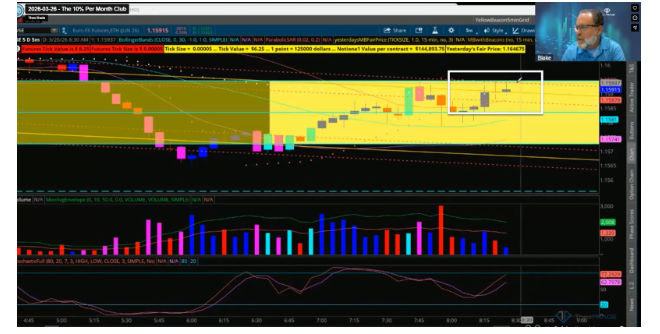
Then the market went flat.
Four consecutive candles of nothing on the euro. The S&P 500 was stuck at overnight resistance.
The Russell was rising while crude was rising. But the dollar was not weakening proportionally.
A televised cabinet meeting was scheduled for 10:00 AM. Any headline could trigger another pirate flag.
I asked the room for a consensus. The vote was to cancel.
I pulled the order.
That decision might have cost money. The euro could have broken out and run to 1610.
It also could have spiked and reversed for a second pirate flag.
The setup was valid. The environment was not.
Cancelling a good setup in a bad environment is discipline, not fear.
How to Spot a Pirate Flag and What to Do About It
The pattern has three warning signs. Any one of them should put you on alert.
All three together means stop trading.
- Correlated movement across unrelated markets. When gold, crude, the euro, and equities all print widening candles at the same time, the move is likely to reverse.
- Speed. Wednesday's 20-pip spike and 20-pip reversal happened inside four five-minute candles. Stops on both sides are getting swept.
- The aftermath. If price settles right back where it started, the market has no conviction. Every signal that follows is suspect until a new structure confirms.
Once you see it, stop trading. Do not re-enter. Do not fade the reversal.
Let the volatility pass.
Wednesday also reinforced the confirmation rules I review with the room constantly:
- Beacons require a close beyond the level
- Bollinger Bands require a close beyond the band
- Channels require a break through the boundary
- Divergences and one-count reversals require a break through a price level
Gold gave five buy signals that morning and never reached fair price.
The S&P 500 flirted with overnight resistance and never confirmed a breakout. Every market that did not confirm kept you out.
The confirmation rules do not guarantee winners. They guarantee that when you take a loss, it is a calculated one.
What This Means for You
Pirate flags will happen again. Geopolitical headlines, surprise data, and policy announcements will keep creating violent two-way moves.
Your defense is pre-defined stops, proper position sizing, and the willingness to cancel when the environment shifts.
Wednesday proved all three. The market will be there tomorrow. Protect your capital today.
Today’s pirate flag swept stops in four markets. The methodology that kept the damage to $100 is exactly what I teach inside Dark Wires.
The signal hierarchy. The stop management rules. The confirmation process that tells you when to stay out.
👉 Watch the Dark Wires replay now before it comes down.
Blake Young
Senior Market Strategist, TheoTRADE