


Hey trader,
Stocks with high short interest see some of the most dramatic price spikes you'll ever see.
However, most stocks with high short interest never get that pop. Or if they do, it's long after it's fallen off your radar.
The trick isn't knowing there is fuel (short interest) for the fire. It's knowing WHEN that fuel hits the fire.
THAT'S where options come into the picture.
And today, you'll learn not only how to time these moves but create trades optimized for these opportunities.
The Block Hunter Console flagged two simultaneous 10,000-contract prints in SMR today.
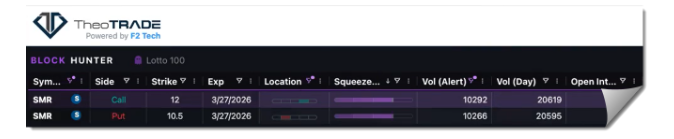
The structure was a pseudo-synthetic: selling the $10 puts and buying the $12.50 calls for March 27 expiration.
Total size was 20,000 contracts on a stock carrying 11.5% short interest.
Let’s dig into this trade so you can see EXACTLY how to turn all this information into a trading edge.
What the Print Tells You
The Block Hunter Console flagged two simultaneous 10,000-contract prints in SMR during today's session. Total size was 20,000 contracts.
This was not a standard call buy or a call spread. The institution sold the $10 puts and bought the $12.50 calls for March 27 expiration.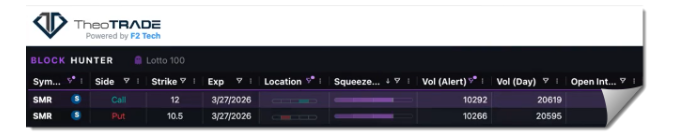
That combination creates a pseudo-synthetic long position.
How?
Buying calls gives you exposure to the upside that pays you more as the stock rises.
Selling puts pays you a premium that decays until expiration. The difference is your max profit with the put sale is that premium, while the call you bought has unlimited upside.
Think of it like selling the put to raise cash to buy the call option. It’s kind of like going 1.5x bull.
Now, on a stock with 11.5% short interest, the most conservative interpretation is that it's a hedge against an existing short.
Here's where it gets interesting.
The Console registered three squeeze bars on SMR. That means 32.5 million shares are sold short on a 149-million-share float. The fuel is there. And now we know where the fire starts.
Four data points from a single print. The symbol is SMR, the direction is bullish, the target zone is $12.50, and the timeframe is March 27.
How the Hedge Becomes the Squeeze
Think of this trade as building a box around SMR.
The $10 short puts create a gamma wall underneath the stock. As SMR approaches that level, the market maker hedges by purchasing shares. That buying generates structural support.
The stock has a hard time breaking below $10 as long as those contracts are open. That's the floor.
Now flip to the upside. The $12.50 long calls create the opposite force. The institution bought those calls, which means the market maker sold them.
As SMR approaches $12.50, the market maker's delta exposure grows. They have no choice. They buy shares to stay neutral.
Inside the box, the stock can meander. The shorts are comfortable. Their delta is managed. The hedge contains volatility. Nothing dramatic happens between $10 and $12.
But once SMR breaks above $12, two forces compound at the same time.
The market maker starts buying shares to hedge the growing delta from those 20,000 short calls. That buying pushes the stock higher.
That move forces short sellers sitting on 32.5 million shares to start covering. Their buy-to-cover orders pour fuel on the same move gamma is already driving.
The gamma squeeze gets the stock out of the box. The short squeeze propels it.
SMR has done this before. It moved from $14 to $22 in a week on this kind of setup. An earlier cycle produced a run from $34 to $58. The mechanics behind those moves were identical to what today's print is building.
How to Structure the Trade
Now that we know the trigger level, we can build around it.
The $12/$14 call vertical for April 17 expiration offers the cleanest risk profile. Skew improves at the 40-delta level, where the sold call carries a higher implied volatility of 96% compared to the bought call.
That means we're buying cheaper volatility and selling more expensive volatility. The net cost of the spread drops as a result.
- Buy the April 17 $12 call
- Sell the April 17 $14 call
- Cost: Approximately $0.64
- Exit target: $1.09 (a 70% return on the spread)
- Max risk: $0.64 (the cost of the spread)
- Catalyst: Gamma squeeze from 20,000 contracts at $12.50, amplified by 11.5% short interest
SMR does not need to reach $14 for the spread to hit the profit target. A move just north of $13 gets you to $1.09 within the 29-day window.
The $12 strike aligns directly with the gamma threshold from today's print. That is where the market maker begins accumulating shares. That is where short covering accelerates the move.
What the Console Is Tracking Now
The Block Hunter Console caught the 20,000-contract pseudo-synthetic and confirmed both the floor and the trigger level for SMR.
The institutional inventory at $12.50 is built. The gamma wall at $10 is in place. As SMR approaches $12, the gamma from those contracts creates mechanical buying pressure as market makers hedge their exposure.
That pressure compounds with 32.5 million shares sold short. Every dollar SMR gains forces additional share purchases from two directions at once.
Most traders saw SMR's short interest and waited for a reason to get in. The institutions built the reason today. The Console showed you the size, the structure, and the level.
The hedge was designed to contain the stock. The gamma it created is the force that breaks the containment.
Today's article walked you through one print on one stock. The Console is flagging these setups every session across hundreds of names.
- You get the block trades filtered for size and intent.
- You get squeeze bars that quantify the short interest pressure behind each name.
- You get fill location data that separates opening trades from closing trades, so you know whether the institution is building a new position or exiting an old one.
The 90-Day Block Hunter Challenge puts all of this in your hands and teaches you how to read it in real time. You will learn how to spot the print, interpret the structure, and build the spread around it.
One print gave you the floor, the trigger, and the timeframe. The spread gives you the means to act on it with 64 cents of risk. The Console is what found it in the first place.
Brandon Chapman, CMT
Creator of Ghost Prints