A short lesson on how CTAs drive energy prices, why most traders focus on the wrong signals, and how I use OILU to track actual momentum in the energy sector.
Most people get energy wrong. They think OPEC meetings, hurricane warnings, or headlines about the Strategic Petroleum Reserve move the market. But they’re chasing noise.
Energy doesn’t trade on stories. It trades on positioning.
The biggest moves come from fast, systematic capital — commodity trading advisors, quant funds, and algorithmic models. They don’t care about production forecasts or CEO interviews. They respond to price, volatility, and flow.
You can see it clearly in OILU — a leveraged note tied to a derivative index of the ten largest U.S. energy names like ExxonMobil (XOM), Occidental Petroleum (OXY), and Valero Energy (VLO). When positioning shifts, OILU moves fast. It doesn’t drift. It rips.
If you want to trade energy with real edge, stop listening to analysts. Watch upstream names. Watch the 20-day moving average. Track compression in ATR and breakout strength in RSI and MFI. Look for real-money rotation in ETFs like XLE and FENY.
This is how I trade energy. Not on headlines. On structure and momentum.
What Really Moves Energy
Most traders think oil reacts to supply shocks or political drama. They’re wrong. Energy trades on how headlines are interpreted by the biggest players.
Commodity trading advisors move on models and triggers — not opinion. When they flip long or short, they do it with size.
That’s why I use OILU. It doesn’t hold futures or charge ETF-style fees. It tracks momentum in the top 10 energy names and responds directly to positioning shifts.
How I Trade OILU
I don’t care what oil is doing in isolation. I care about how OILU responds around structure.
Commodity trading advisors don’t think like retail traders. They don’t care about earnings or conference calls. They move based on models, volatility, and systemic triggers. And when they flip from short to long, it’s not subtle. The move is fast, mechanical, and massive.
That’s what makes leveraged products like OILU so useful. It doesn’t hold futures, and it doesn’t charge traditional ETF fees. It simply tracks the derivatives on the ten biggest U.S. energy names. When the CTAs flip, OILU reacts almost instantly.
You can see this in the data. The biggest OILU moves happen when:
- RSI and MFI drop into oversold territory
- Price compresses tightly under the 20-day EMA
- CTAs suddenly reverse direction based on volatility triggers
If you’re only watching the news, you’re always late. But if you understand how price responds to positioning, you start to see the trade before it hits the tape.
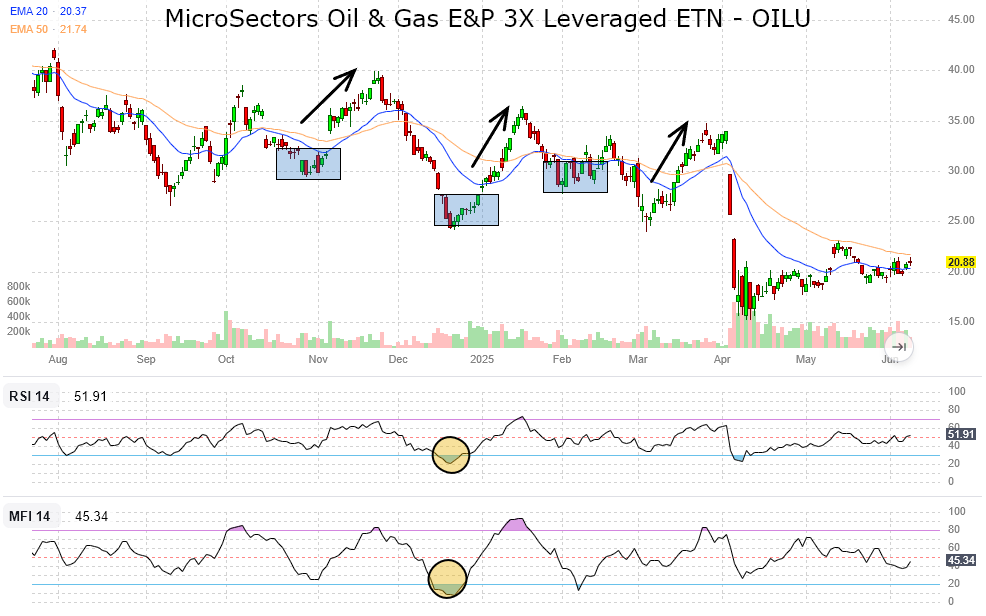
The two indicators I trust most:
- RSI — measures momentum
- MFI — adds volume to the signal
When both drop into oversold territory, that’s when short covering often begins. When both are stretched and OILU is extended above the 20-day, I stay out. Especially if CTAs are already long.
The trigger I watch closest is the 20-day EMA. If price reclaims it with RSI moving above 50 and MFI rising, the structure is shifting. Add ATR compression and you have a setup worth watching.
How I Track CTA Flow in Real Time
You don’t need a Bloomberg Terminal to see what fast money is doing. Start with:
- SocGen CTA Index – benchmark for trend-following exposure
- Nomura QIS Reports – institutional quant outlook
- Commitment of Traders (COT) – shows futures exposure (3-day lag)
- ATR and moving averages – show volatility regimes and structure breaks
CTA funds don’t think. They react. And they’re often early — not because they’re smarter, but because they’re mechanical.
Watch how fast the move happens. The faster it is, the more likely it's them.
Final Thought
If you want to trade energy, stop chasing the headlines.
OPEC can cut or hike all it wants. What matters is whether expectations were already priced in — and whether fast money was leaning the wrong way.
That’s why I use OILU. It’s a fast, clean read on systemic capital shifts. You’ll see it in the technicals before you hear it on TV.
This is how I trade energy. With structure. With indicators. With positioning.