


The Russell 2000 made a new all-time high on October 15th.
Most traders saw a breakout continuation…
The Ghost Prints Surveillance Console saw something different.
Institutions deployed massive bearish exposure on IWM the same day it hit that high.
Over 5,500 contracts in a single print. Open interest spiked to 19,028 contracts at the 241 strike.
Someone was laying down some serious coin on a bearish bet into all-time highs.
After analyzing the situation, I decided to follow suit. And I was rewarded with a nice 70% return.
Today, I'm going to take you step by step through this setup from ideation to execution.
Because it's not enough to just have a bearish thesis…You need to know HOW to turn that into an edge.
What's Really in a Bull Market?
Traders love to crow about their success and fall back on the idea of a bull market. But what does that actually mean?
From a technical analysis perspective, a bull market isn't exclusively defined by trend. It includes internal trends using breadth and volume along with the external trends that most traders hang their hat on.
Technical analysis also looks at leading indicators of the economy, sector relative strength, and other factors.
I bring this up because being blissfully happy and neglecting your relationship with the market typically ends in a breakup and loss.
Being a bull or a bear is ultimately pointless. It reflects bias more than analysis. In the two-way market, it's good to take trades in both directions.
But you also need to recognize the more significant signals that the market occasionally provides.
Along with other volatility indications, option activity can help you identify key points when institutions are taking on bearish exposure or hedging.
This creates opportunity to hedge alongside them or trade with the hedges.
One such occurrence happened on the iShares Russell 2000 ETF on October 15th, 2025. This trade was picked up by the Ghost Prints Surveillance Console.
The Signal That Contradicted the Chart
October 15th looked perfect for bulls. IWM had just broken out to fresh all-time highs. The chart was clean. Momentum was strong. Every technical indicator screamed continuation.
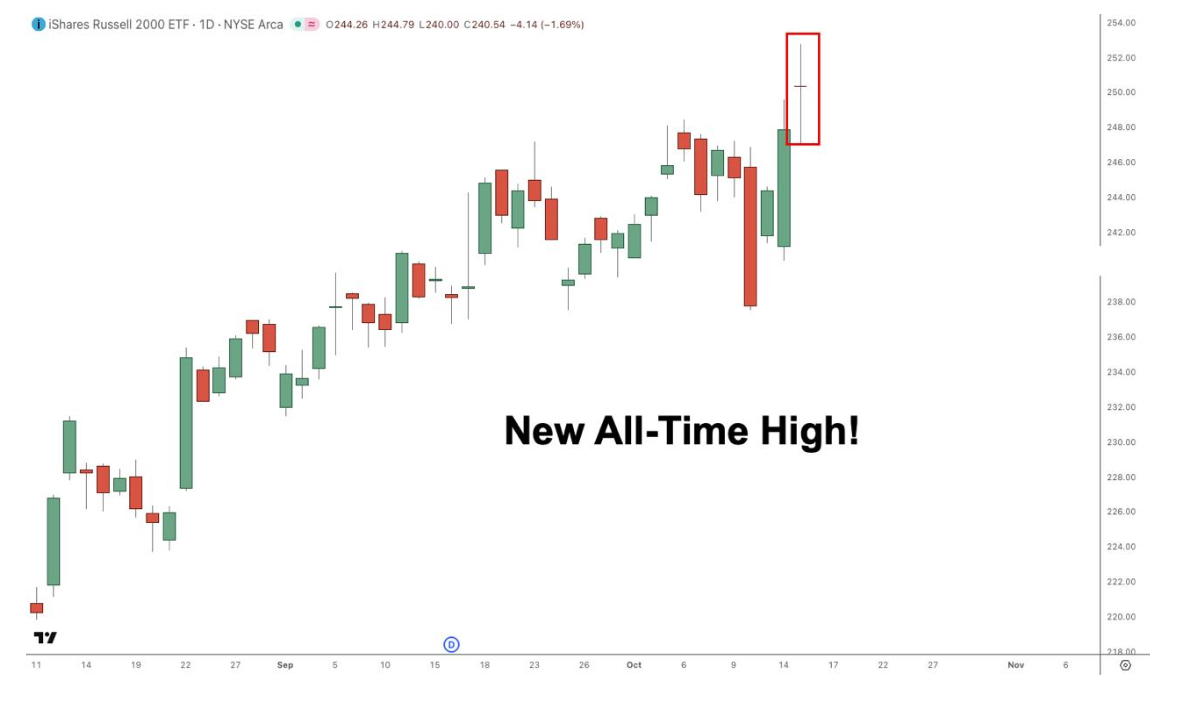
But the Ghost Prints Surveillance Console flagged something that didn't match the bullish narrative.

A massive put position hit the tape. Over 5,500 contracts in a single alert on the 241-strike puts expiring November 7th. The location data confirmed protective positioning. Open interest jumped to 19,028 contracts.
This wasn't retail speculation. This was institutional scale hedging at the exact moment everyone else was celebrating new highs.
The question became critical. How much weight do you give to a significant hedge at a point where the underlying just broke out to a new all-time high?
Do you place greater weight on the internal trend of order flow or the external trend of rising price?
Making the Call: Order Flow Over Price Action
For me, the answer was clear. I chose the order flow.
This doesn't mean abandoning every long position or turning completely bearish. Your market expectations don't have to be the exclusive consideration when hedging or making a bearish trade.
Many traders carry significant long stock exposure in their portfolios. This signal simply indicated an opportunity to take profits, increase cash, or add some bearish exposure.
For Ghost Prints, we used this information to make a trade on IWM. But the same signal could justify hedging a portfolio or reducing exposure to small caps entirely.
The key insight is that when institutions hedge at breakouts, they're seeing something the crowd doesn't. They're preparing for what price hasn't revealed yet. The choice is whether you trust what everyone can see or what most traders never access.
Structuring the Put Vertical
For this type of print, we're looking to buy an out-of-the-money put vertical. This benefits from volatility skew, making the spread cheaper, but also captures the potential downward movement in the price of IWM.
For this type of trade, I like to go 30-45 days out and buy a 0.40 delta option and sell $2 further out-of-the-money. With skew on my side (buying a low implied volatility option and selling a higher implied volatility option), the debit should typically fall between $0.50 to $0.80.
Here's exactly how I structured the trade:
The Trade Setup:
- Expiration: November 21st (30-45 days out from October 15th entry)
- Buy: 243 put (approximately 0.40 delta)
- Sell: 241 put ($2 further out-of-the-money)
- Net Debit: $0.64 per spread
- Maximum Loss: $0.64 (occurs if IWM closes above 243 at expiration)
- Maximum Profit: $1.36 (occurs if IWM closes below 241 at expiration)
- Breakeven: 242.36 at expiration
- Target: 70% gain, which equals $1.09 exit price
 In this case, the spread cost $0.64. Upon entry, I was immediately looking for a 70% gain.
The math is straightforward.
You risk $64 per spread to make up to $136. That's a 2.1-to-1 maximum reward-to-risk ratio.
But I wasn't looking to hold until expiration.
The target was a 70% gain, capturing most of the profit potential while leaving time for the trade to work.
Why 70% instead of the full profit? Because time decay accelerates as you approach expiration.
The last 30% of profit comes with diminishing returns and increasing risk that the position reverses.
Taking 70% lets you compound wins faster by redeploying capital into new setups.
How the Trade Played Out
The spread allowed the trade to bounce around for a couple weeks with little to no decay as it moved in-the-money. The beauty of this structure is how it handles time during that initial phase.
IWM chopped around near its highs. Bulls remained confident. The breakout looked legitimate. But the positioning I saw on October 15th told a different story.
Then as the price got a little more steam to the downside and some help from time decay, the trade reached my 70% return objective.
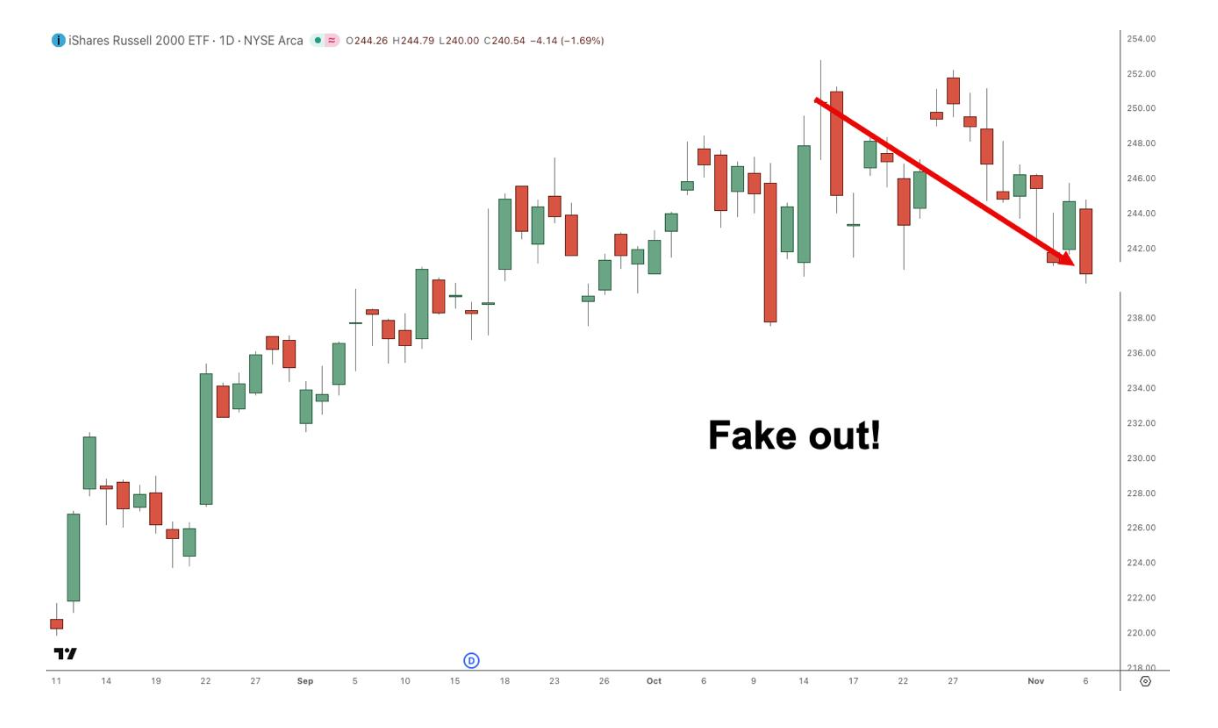
IWM's fake breakout collapsed. The downward momentum accelerated.
The 70% return target hit on November 6th, the same day IWM confirmed the breakdown from its failed all-time high attempt.
The external trend had told one story. The internal trend revealed the truth. And the trade structure captured the move efficiently.
Finding Your Own 70% Setups
The IWM trade happened because I saw what the institutions were doing before the price revealed it.
The Console gave me that view.
Now the question becomes whether you want that same visibility.
Every week, I'm finding these divergences across different sectors and timeframes.
The pattern repeats constantly.
Breakouts that look perfect but have massive hedges underneath them…
Quiet consolidations where institutions are loading calls before the explosion…
Failed support levels where smart money already positioned for the breakdown.
The Console surfaces these setups automatically.
You don't need to scan hundreds of charts or chase alerts in seventeen different chat rooms.
The pressure detection system does the heavy lifting.
You see the signal, evaluate the setup, and decide if you want to take the trade.
I've opened access to the same system I used for this IWM trade.
You'll see:
- The alerts as they happen
- Learn how to read institutional positioning the way I do
- Get the actual trade ideas I'm taking based on what the Console flags.
The difference between profitable traders and everyone else often comes down to information access.
The institutions see order flow that retail traders never access. That gap is closing now.
If you want to stop trading against institutional positioning and start trading with it, everything you need is waiting on the other side of this link.
See How the Console Identifies These Setups
Brandon Chapman
Creator of the Ghost Prints System