


Hey trader,
Every day, I pick up my daughter from school at 10:00 A.M.
I have road rage the whole way there and back. She sits in the passenger seat and white-knuckles it while I fight Chicago traffic.
What she does not know is that by the time I get home, PayPal has already paid for another textbook.
You see, I trade PayPal almost every other day.
Buy at $44 - sell it at $45 - $25 to $30 in profit each time.
And it will put my daughter through college.
This is how I survive a bear market. I do not swing for the fences. I play ping pong.
I call it the Bierman Ping Pong Game. It is the single most practical skill I can teach you right now.
It’s not glamorous, but it will keep you alive.
The Game Nobody Wants to Play
Most traders want home runs. They want to buy the low and ride it to the moon.
That playbook is dead. The market is broken technically, fundamentally, and psychologically.
PayPal trades at eight times earnings. Not one hedge fund owns it. Not one active manager in the world wants to show this stock to their clients.
That is exactly why it works for me. The stock is in a lock box. It bounces between $44 and $45 like a metronome.
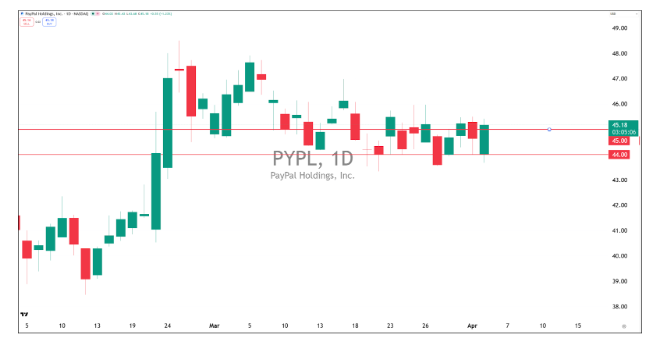
I do not need it to go anywhere. I just need it to keep bouncing.
How the Ping Pong Game Works
The concept is simple. You find a stock trapped in a narrow range with a floor underneath it.
You buy near the bottom of the range. You sell near the top. Then you do it again.
The key rules I follow every single time:
- The stock must have fundamental support underneath it. PayPal at eight times earnings is not going to zero. That valuation is the floor.
- The range must be tight enough that you can trade it in days, not weeks. If you are waiting a month for $2, you are in the wrong stock.
- You never short these names. The risk reward is too lethal. One emergency Fed cut and you are bankrupt on the margin call.
This is not a bull market strategy. This is a survival strategy built for exactly this environment.
Adobe Proves the Same Point
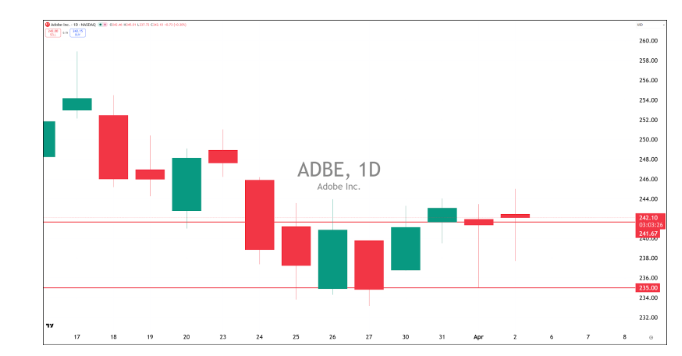
I sold put spreads on Adobe at 235 to 240 this week. The stock trades at eleven times forward earnings.
Insiders are loading the boat. An activist investor group is circling the company to unlock value.
I do not need Adobe to go up. I need it to sit still for three weeks. If it closes above 241, I bank $250 from theta decay alone.
I priced it right. That is the entire lesson.
TLT. Same Game. Different Asset.
TLT is the 20-year Treasury bond ETF. Jeff calls it one of his favorite trading vehicles because he uses bond funds to generate income.
You cannot invest in it. Bear markets force you to trade. Bull markets force you to invest. Jeff says to write that down.
Buy it at $85. If it bounces to $87, sell it. Trade it back and forth over and over again.
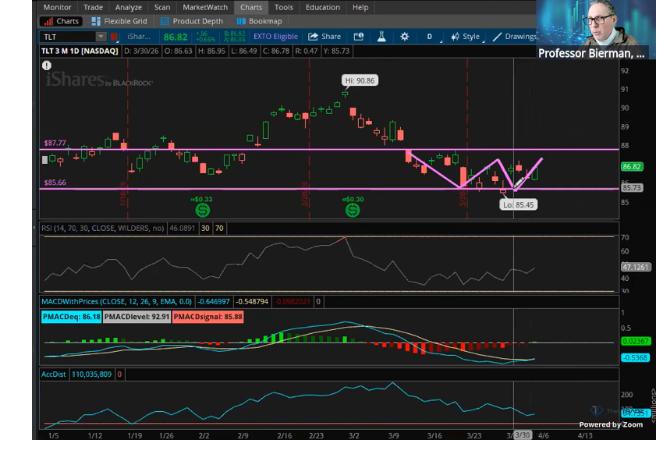
The farthest it might fall is $79. That would put the yield at 6%. You cannot own it for more than a week.
You cannot short it either. If the Fed announces an emergency rate cut, TLT goes straight to $90 and you get a margin call. The risk reward is too lethal on the short side.
But as a ping pong trade, it works. Buy the call, sell the put spread, and grind.
Why This Matters Right Now
You are in a bear market. Value stocks are the cheapest they have been since 2018. Money managers refuse to buy them.
That means these channels will persist for weeks, possibly months. Every one of them is an opportunity to grind out profits while the rest of the market panics.
I make sure the downside is mitigated on every trade. You should too.
The Genesis COG System identifies exactly when these range-bound setups form and when the channel is about to break. It tells you when to play the ping pong game and when to step aside.
Most traders will spend the next three months watching their accounts bleed. You do not have to be one of them.
Have a good weekend. Monday comes fast. Be ready.
Professor Jeffrey Bierman
Creator of the Genesis COG System