


Hey trader,
The private credit market is unraveling, and the contagion is spreading to investment-grade bonds.
Redemption gates are going up across the biggest names in private credit. Blackstone, Blue Owl, BlackRock, and Morgan Stanley have all restricted withdrawals in recent weeks.
Default rates in private credit have reached 9.2% according to Fitch. That is more than double the rate in the broadly syndicated loan market.
That stress does not stay contained. It bleeds into public credit markets, and the options flow is already pricing it in.
Most traders are focused on oil prices and tariff headlines. The institutional money is watching something else entirely.
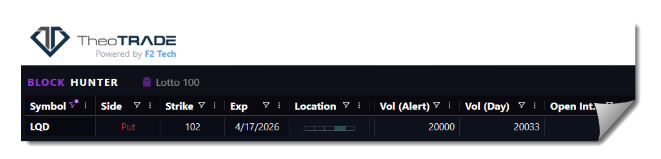
The Block Hunter Console flagged 20,000 put contracts bought in LQD today in a single print. LQD tracks U.S. investment-grade corporate bonds.
The strike was $102 for April 17 expiration, and the trade was not a roll. Someone stepped into the market and bought downside protection on corporate credit while the rest of the market was watching equities sell off.
I'm going to break down how the private credit crisis creates a tradeable opportunity in public credit. Then we'll look at what the 20,000-contract LQD print reveals about institutional timing.
And finally, how to structure a position around the level where this inventory is sitting.
Why Private Credit Stress Hits LQD
Private credit funds lend to mid-market companies that cannot access public bond markets easily. When those funds face redemption pressure, they need to raise cash.
The most liquid assets on their books get sold first. That often means investment-grade corporate bonds.
The chain works like this. Investors request redemptions from private credit vehicles. Fund managers sell their most liquid holdings to meet those requests.
Investment-grade bonds are among the first to go because they trade in deep, liquid markets. That selling pressure drives spreads wider even when the underlying companies have no credit problems.
Investment-grade credit spreads have widened to 120 basis points as of this week. That is a significant move from the multi-decade tights where they started the year.
The $1.35 trillion maturity wall facing corporate borrowers in 2026 adds another layer. Companies that need to refinance are doing so at rates that have nearly doubled for some issuers.
The institution that bought 20,000 LQD puts is positioning for that pressure to continue.
What the Print Tells You
The Block Hunter Console flagged the trade during the session. The structure was a straight put purchase at the $102 strike for April 17 expiration.
No spread. No roll. The fill came at the ask, confirming this was a new position being initiated.
The $102 strike carries a delta of approximately 0.17. LQD was trading near $109 at the time, so this strike sits roughly seven dollars out of the money.
The market is pricing it as a low-probability event. The institution disagrees.
Paying the full debit on 20,000 out-of-the-money puts represents a significant capital commitment for a trade that only works if corporate bonds see meaningful downside within 28 days.
That conviction matters. When an institution buys far out-of-the-money protection without legging into a spread, the thesis is not a gradual grind lower. The thesis is an acceleration in selling pressure that pushes LQD toward levels the market currently considers unlikely.
Why the Opportunity Exists Right Now
The disconnect between the private credit headlines and public credit pricing creates the setup.
Private credit defaults have reached record levels. Redemption gates are going up at the largest funds in the industry. Regional banks carry between $100 billion and $150 billion of exposure to the very funds that are now restricting withdrawals.
Investment-grade bonds have widened, but the move so far has been orderly. The institutional print suggests the next leg may not be.
If forced selling from private credit vehicles accelerates, investment-grade spreads can gap wider in a way that catches the broader market off guard. LQD sits at the center of that plumbing with over $30 billion in assets.
How to Structure the Trade
The institution bought naked puts, but a vertical spread offers defined risk for traders who want exposure to the same thesis.
- Buy the LQD April 17 $106 put
- Sell the LQD April 17 $104 put
- Spread width: $2
- Max risk: The cost of the spread (the debit paid at entry)
- Direction: Bearish on corporate credit
- Catalyst: Continued private credit redemption pressure, forced selling into public markets, spread widening
LQD does not need to reach $102 for a put spread at higher strikes to produce a profit. A move toward $106 puts the bought strike in the money and accelerates the value of the spread as expiration approaches.
The skew in LQD currently favors the structure. Downside put implied volatility is elevated relative to the call side, which is typical when institutional desks are buying protection.
That elevated skew is confirmation of the directional pressure the Console already identified.
What the Console Is Tracking Now
The Block Hunter Console flagged the 20,000-contract print and confirmed the institution was initiating a new bearish position in corporate credit.
The trade was not a hedge adjustment. It was not a roll. It was a fresh outlay of capital aimed at a specific level and a specific timeframe.
Private credit stress has been building for months. The headlines have shifted from concern to outright redemption freezes at some of the largest fund managers in the world.
That pressure has to go somewhere. The options flow in LQD tells you where the institutional money expects it to land.
The print gave you the instrument, the direction, and the timeframe. The spread gives you the structure to act on it with defined risk.
See exactly how Block Hunter catches institutional positioning before the crowd catches on.
Brandon Chapman, CMT
Creator of Ghost Prints