

Well, here we go again.
Both crude and stocks got off to a rocky start on Thursday as the Dow plunged triple digits and oil fell more than 2.5%. The culprit: why, the Fed of course.
This week has reinforced the market themes that have played out for most of this year. On Monday we got a nice bounce in equities thanks in no small part to Goldman’s more upbeat take on the near-term outlook for crude prices only to see a sharp reversal a day later when Williams and Lockhart struck an unexpectedly hawkish tone at a luncheon sponsored by Politico. June, Lockhart said, is most assuredly a “live” meeting.
Given the comments from the San Francisco and Atlanta Fed chiefs, the market probably should have expected the April Minutes to reflect a near-term tightening bias. Nevertheless, there was perceptible incredulity in the air on Wednesday afternoon after the Minutes did indeed suggest that a June hike is not only on the table, but in fact likely depending upon the data.
All of that would have been enough to derail stocks and put an unceremonious end to the oil bounce, but just in case anyone was still unclear as to whether June is in play, we got Jeffrey Lacker this morning reiterating what he recently told the Washington Post. The market, Lacker said, “took the wrong signal in March and April [and has] overestimated how likely [the FOMC] is to pause.” “I supported a hike in April,” he added, for good measure.
Next up was Bill Dudley and wouldn’t you know it, he leaned hawkish too. Or at least that was the market’s read through. “The market’s pricing of Fed hike odds was way too low prior to minutes,” the New York Fed chief said, adding that June “is definitely a live meeting.”
Ok, got it. Every Fed President - voting member or no - wants you to think that the committee remains ready to go next month. For now, stocks, the USD, oil, and EM are taking them at their word. As I put it on Wednesday, “if oil falls, the dollar soars, and China starts behaving badly, we’ll get perhaps the best test yet of the Fed’s supposed ‘data-dependence.’”
As noted above, crude is moving sharply lower today. That despite constructive commentary out of Barclays whose Michael Cohen told the Argus Canadian Crude Summit that demand will exceed supply by 500,000 b/d in 2017. Prices, he said, should be $60 next year and $85 by 2020. Cohen also suggested uneconomic US production will be imperiled once hedges begin to roll off. The surge in Iranian production and any ramp by the Saudis will “taper,” he added (for their part, Citi notes that the “primary impediment or risk to oil prices surging much beyond $50/bbl near-term” is a Saudi ramp to 11 million b/d).
But as we’ve seen with the recent rally from the 20s to the mid-40s, crude often ignores the fundamentals. The supply/demand picture was still decisively bearish throughout the run up and to the extent that picture is changing, there’s still the very real potential that prices will move with expectations for the Fed’s next move (i.e. with the outlook for the USD).
Speaking of the USD, we hit a 7-week high on Thursday. In his comments, Lacker was careful to note that in his opinion, a strong dollar wouldn’t meaningfully impair the performance of US corporates. Here’s Citi’s rather non-committal take on the USD and the likely increase in DM policy divergence:
“We have previously highlighted long term USD cycles, typically lasting ten years to the downside and 5-6 to the upside. The current USD uptrend began in 2011. So following the pattern makes 2016-2017 as a likely peak/ reversal. We have also pointed out how these long trends tend to override Fed policy cycles at times central bank policy divergence given the Fed’s more hawkish demeanor:
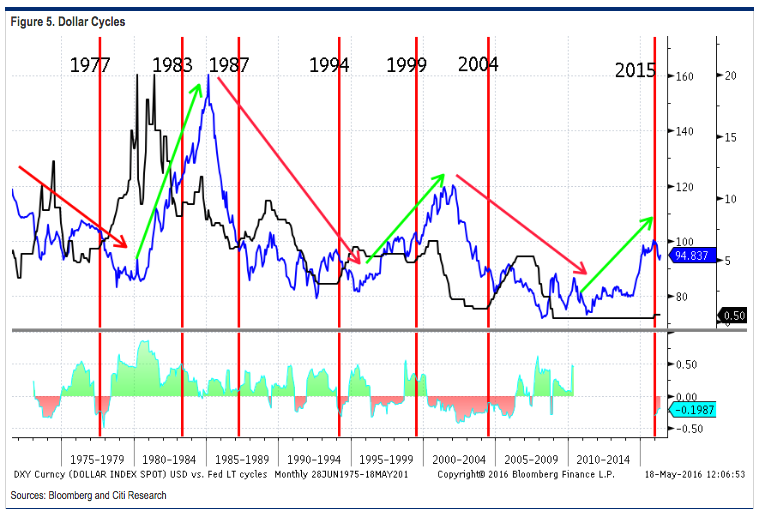
“For much of the rally, policy divergence themes in one form or another have been the big driver. Fed hikes expected, easing forecast elsewhere. This is why the USD move was tentative from 2011 to 2014 (no Fed hikes, limited action elsewhere) but accelerated thereafter with negative ECB policy rates, QE in 2015Q1, two rounds of BoJ QE and a Fed hike in December 2015.
“On this logic, anything that makes Fed tightening more or less likely, and other CB easing a higher or lower probability, should change the probability of the USD trend either ending or extending.”
And then there’s China, the third factor investors should be watching to determine how likely the Fed is to renege on what seems to be an implicit promise to hike next month.
The trick for the PBoC since last August has been implementing a yuan devaluation on Beijing’s terms. That is, a controlled devaluation that isn’t accompanied by destabilizing capital outflows. Needless to say, that’s proven difficult as evidenced by the enormous drawdown in China’s FX reserves since last summer. The outflows have moderated of late and China won’t be in any mood to see them accelerate anew. With that in mind, Credit Suisse is out with some interesting commentary on Thursday regarding how Beijing will likely attempt to deal with a stronger USD. Here are some key excerpts:
“Chinese FX policy and the USD-G10 rally driven by the market pulling forward pricing of Fed rate hikes have weakened Asian currencies sooner than we had expected.
“Our recent trip to China leads us to believe that Chinese FX policy and the Chinese growth cycle can remain drivers of further strength in the USD vs. Asian currencies. We expect USDCNY to continue trending gradually higher.
“However, we think the Chinese government will be happy to engineer some depreciation of the CNY REER, even if this means a rising USDCNY, as long as the pace does not destabilize markets. We expect the PBOC to continue testing the market’s tolerance for CNY weakness vs. the USD.
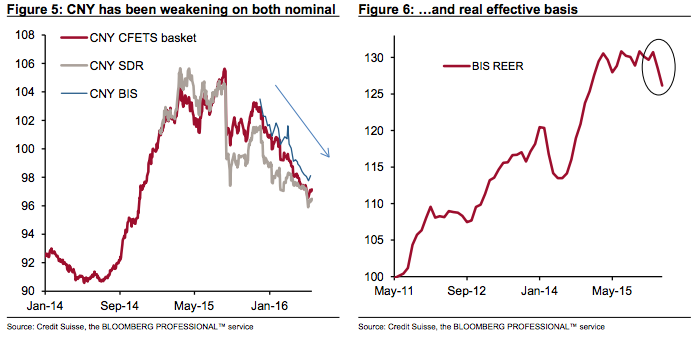
“If USDCNY fixes higher were to produce an onshore run on the CNY, we would expect the government to respond by pausing or reversing the move somewhat.”
Once again, it’s a delicate balancing act and USD weakness has been associated with stability for China in terms of capital outflows over the past several months. There are no guarantees that the Chinese will be able to keep things under control if the Fed’s poor communication strategy ends up throwing FX markets into turmoil.
Those three variables (USD, crude, and China) will play a big role in determining the direction of US equities in the weeks ahead of the June meeting. And US equities will in turn play a role in shaping the Fed’s decision. Or at least that’s been the dynamic since at least last September.
Then again, who knows. Perhaps the hawkish chorus indicates that the FOMC has decided to make an honest effort to return to data-dependence and break the vicious cycle whereby the mere mention of a rate hike cause market turmoil and that market turmoil then causes the Fed to lean dovish again. Perhaps. But I for one, seriously doubt it.