


Hey trader,
Oil spiked on the Iran conflict. Then it faded.
XLE gapped higher at the open, reversed intraday, and gave back most of the move. Exxon, Chevron, and Occidental all printed the same pattern. Big gap, big fade.
The market was saying this is temporary.
While that reversal was happening, someone bought 42,000 call contracts in XLE at the $68 strike.
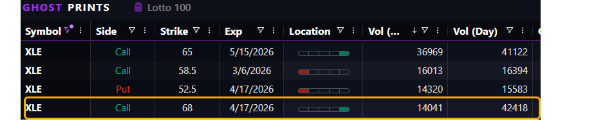
It also picked up another large trade at the $65 strike price as well.
The Ghost Prints Surveillance Console flagged the trade in real time. The positioning tells you more about what institutions are actually preparing for than what oil did today.
We are going to break down why the trade was structured this way, what buying on the reversal signals about conviction, and how far out of the money this strike sits relative to where XLE is trading right now.
Why Buying Calls Into a Fade Matters
The trade did not hit at the open when XLE was spiking. It came in during the reversal.
Oil jumped early in the session, then faded back as the day progressed. XLE followed the same path. The market was repricing the conflict as temporary.
That is when the 42,000 contracts printed.
Buying into strength makes sense if you think the move continues. Buying into weakness when the market is telling you the catalyst is overblown requires a different thesis.
The thesis here is simple. The conflict might be temporary today, but the risk has not gone away.
Oil could reverse lower tomorrow if tensions ease further, or it could spike higher if something escalates. Owning stock in that environment carries symmetrical risk.
You lose on both sides. Calls cap your downside at the premium paid and leave the upside unlimited.
What $68 Strikes Tell You About the Bet
The $68 strike sits way out of the money. This is not a near-term bet on oil grinding higher.
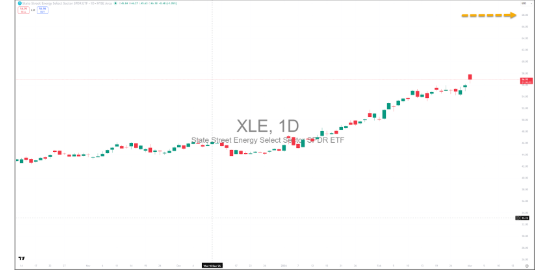
It is a bet on a shock move.
If the Iran situation stays contained and oil drifts lower over the next few weeks, those calls expire worthless. The premium is gone.
The buyer accepts that outcome. The trade only works if something breaks. A supply disruption, an escalation in the conflict, or a broader geopolitical shock that sends oil substantially higher.
At that point, energy stocks do not grind higher. They gap. That is exactly the scenario this positioning anticipates.
The Mechanical Advantage of Calls Over Stock
Owning XLE exposes you to the full downside if the conflict resolves and oil sells off. A meaningful pullback from current levels translates directly into stock losses.
Buying the $68 call limits your loss to the premium paid. If XLE never reaches $68, the most you lose is what you spent to enter.
That asymmetry is the reason institutions use options instead of outright stock in situations like this. The dollar amount at risk is capped. The potential gain is not.
Market makers who sold those 42,000 calls now carry short gamma exposure. If XLE starts moving toward $68, delta on those contracts climbs.
The market maker must buy stock to hedge. That buying pressure adds fuel to the move if it starts. The more XLE rises, the more stock the market maker has to buy, which pushes XLE higher.
The trade is not just a directional bet. It creates the conditions for the bet to work mechanically if the catalyst fires.
What Today's Price Action Confirmed
XLE reversed intraday, but it did not collapse. It faded from the highs and held support.
Oil pulled back, but it did not break down. The intraday move suggested profit-taking, not a full repricing of the risk.
The 42,000-contract call buyer stepped in during that fade. The timing signals conviction that the downside from here is limited, but the upside remains open.
If the market truly believed this conflict was over, oil would have sold off hard. XLE would have given back the entire gap.
Neither happened. The risk premium is still in the price.
The VIX spiked to 25 intraday before settling back to 21. Skew remains elevated at 146.
Institutions are not treating this as a one-day event.
How to Structure Exposure
The institutional trade provides the framework. XLE, directional bias (bullish on energy), out-of-the-money strikes, and near-term catalyst-driven timeframe.
For traders looking to structure similar exposure, a call vertical in XLE using the April expiration offers time for the situation to develop. The structure matches the institutional approach:
- Buy an at-the-money or slightly out-of-the-money call
- Sell the $68 call to collect premium and reduce cost (matching institutional strike)
- Risk profile: Limited downside (premium paid), defined upside (spread width minus cost)
- Catalyst: Iran situation escalation or sustained oil price strength
- Target: XLE reaching $68 or above
The $68 short strike matches the institutional positioning. Selling that strike collects premium from the same level where 42,000 contracts are already positioned.
The Bigger Picture
A 42,000-contract call purchase in XLE during an intraday reversal is not noise. It reflects a specific view about how geopolitical risk translates into energy sector exposure.
The Ghost Prints Console caught this trade as it was happening. That is what forensic-grade pressure detection does.
It reads the footprint while the position is being built, not after price confirms the move.
Oil faded today. The market called the conflict temporary.
A 42,000-contract institutional bet is sitting in XLE right now, positioned for what happens if that assessment is wrong.
The question is whether you see that information when it is actionable, or after it is too late.
Brandon Chapman, CMT
Creator of Ghost Prints