


Hey trader,
Someone just made a massive bullish bet on Ford.
The Ghost Prints Surveillance Console flagged 25,000 call contracts bought at the $14.50 strike for March 13 expiration.
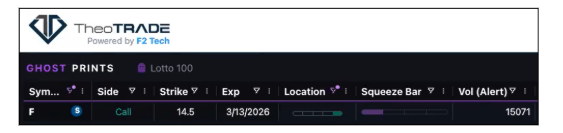
That same trade included puts sold at the $13.50 strike. It created a bullish combination trade with a cumulative delta of 57.
Ford missed on earnings and still rallied. Now institutional money is positioning for a breakout above $14.50.
There is just one problem. The fundamentals do not support the price.
The PEG ratio sits at 10.84. The dividend yield is at a five-year low.
Revenue projections are flat. The only reason earnings estimates improved is because the company is slashing EV spending.
This is a case study in how to evaluate whether flow deserves your capital or your caution. The Ghost Prints Console caught the trade.
What the Combo Trade Tells You
A bullish combination trade involves buying calls and selling puts simultaneously.
The buyer collects premium from the short puts and uses it to finance the long calls.
On the Ghost Prints Console, the trade showed up as a spread. Expanding the details revealed 25,000 call contracts at the $14.50 strike bought at the ask and approximately 25,000 put contracts sold at the $13.50 strike.
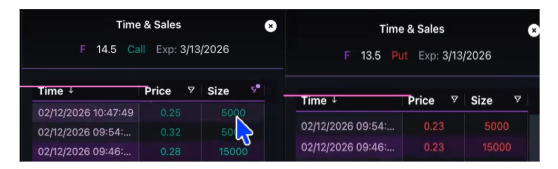
The cumulative delta came in at 57. That means for every dollar Ford moves higher, the market maker's hedging obligation on this position increases by 57 cents per share equivalent, multiplied across 25,000 contracts.
Ford was trading around $14 when the trade hit. That puts the stock right between the two strikes.
The $14.50 call carried a delta of about 33. The $13.50 short put carried a delta of about 24.
Combined, they produced that 57 figure.
The maximum delta this structure can reach is 100. But it only gets there if Ford breaks decisively above $14.50, where the call delta climbs toward 50 and the put delta fades toward zero as the strike moves further out of the money.
The key level is $14.50. If Ford can break above it, the call delta accelerates and market maker hedging begins to push the stock higher through forced buying.
Below that level, the combined delta actually shrinks as both strikes lose directional influence.
Why the Fundamentals Push Back
Ford reported earnings recently and missed. The stock rallied anyway.
That kind of reaction usually signals that the market is pricing in something forward-looking.
In this case, the forward-looking story is cost reduction. Ford is pulling back aggressively on EV spending, and analysts revised earnings estimates upward as a result.
Current year estimates moved from $1.43 to $1.53 in the last 14 days. Next year jumped from $1.68 to $1.83.
Both revisions exceed 5%, which qualifies as significant in earnings revision analysis.
The catch is that none of this improvement comes from selling more vehicles. Revenue expectations are flat at $172 billion this year and $173 billion next year.
Over the past five years, Ford grew earnings at half a percent annually. The next five years project just 1.5% growth.
The PEG ratio tells the story clearly. At 10.84 based on five-year expected earnings growth, Ford trades at an extreme valuation relative to what it can actually grow into.
Price-to-book and price-to-sales sit roughly at their 10-year median values. Enterprise value to EBITDA runs around 14.91, which matches the 10-year average.
The forward PE of 9 looks attractive only because this year's earnings are expected to spike from cost cuts. That number likely flattens once the one-time benefit of reducing EV spend works through the financials.
The Dividend Illusion
Ford pays a 4.3% forward annual dividend yield. That sounds attractive until you compare it to the five-year average yield of 5.76%.
If you went to a bank for a five-year CD on Ford's dividend, you would be locking in the lowest rate in five years.
The math on yield targeting is straightforward. Ford pays 60 cents annually, or 15 cents per quarter.
To achieve the five-year average yield of 5.76%, you divide $0.60 by 0.0576. The answer is approximately $10.
Ford needs to trade at $10 before its dividend becomes attractive relative to its own history.
The company has plenty of cash flow to maintain the dividend. Operating cash flow runs around $12 billion annually against $2.9 billion in dividend payments.
There is little risk of a dividend cut. At $14, you are paying a premium for income that does not justify the price.
The Leverage Concern
Ford carries a debt-to-equity ratio of 3.47. The quick ratio sits at 0.98, meaning the company barely has enough liquid assets to cover current obligations.
Include inventory and the current ratio improves slightly, but not by much. For a company generating $172 billion in revenue, that liquidity profile leaves almost no margin for error if economic conditions deteriorate.
This matters because the bullish case depends on cost reductions translating to earnings growth. If tariff uncertainty, rising input costs, or weakening consumer demand disrupts that plan, Ford's thin liquidity leaves little room to absorb the hit.
How to Read the Setup
The Ghost Prints Console detected legitimate institutional bullish positioning. Someone committed real capital to a structure that profits from Ford breaking above $14.50.
The March 13 expiration gives this trade about 30 days to work. The combination structure reduces the net cost of the position because the short puts finance part of the long calls.
The question is whether $14.50 represents a ceiling or a launchpad.
Fibonacci projections based on the initial move off the April 2025 lows place the 2.618 extension around $15. That aligns with prior resistance.
The 4.236 extension reaches roughly $19, but that assumes an extended move from a trend that has been running for nearly a year.
Traders watching this setup have two paths. If Ford breaks and holds above $14.50, the gamma squeeze mechanics from those 25,000 call contracts begin to force market maker hedging.
That creates momentum.
If Ford fails at $14.50 and fades back into the range between the two strikes, the combined delta shrinks. The trade loses directional pressure.
Both the call and put deltas diminish simultaneously when the stock sits between the strikes. The market maker's need to hedge in either direction fades with it.
The Bottom Line
Institutional flow says bullish. Fundamentals say the upside is limited at these valuations.
Earnings revisions are positive but driven entirely by cost cuts that are likely already reflected in the price.
The $14.50 strike is the trigger level. Above it, momentum builds.
Below it, the combination trade slowly loses its influence.
Ford goes ex-dividend tomorrow at 15 cents per share. That creates a brief opportunity where the dividend can offset the cost of a protective put if you want exposure with defined risk.
A March $13 put costs about 21 cents, and the dividend covers most of that expense.
But the bigger picture remains. Ford at $14 is not a compelling value entry, and the bullish flow depends on a breakout that the fundamentals struggle to sustain beyond the near term.
Watch the $14.50 level. The Ghost Prints Console will show you whether institutional money adds to this position or lets it expire.
See exactly how Ghost Prints reveals institutional positioning before the crowd catches on.
Brandon Chapman, CMT
Creator of Ghost Prints