Fiscal Stimulus Bails Out The Fed
At face value, the equity market’s initial reaction to the Fed Minutes was very confusing. The Fed boosted its economic projections and said it expected “further gradual rate hikes.” Objectively, these are hawkish statements. The market rallied on signals of further hikes even though a few years ago it couldn’t handle one rate hike without falling. Stocks rallied on news they would have hated 3 years ago. This is a sign of how far the economy has come. It is strong enough to handle the rate hikes and the Fed balance sheet unwind. The market is being helped by the tax cut. The Fed said “upside risks” to economic growth exist because of the tax cuts. I think the fiscal stimulus is a Fed bailout because it is now going to be able to normalize rates without an immediate recession.
The worry is that the stimulus came too late in the cycle, but with the employment to population ratio for ages 25-54 below previous cycle peaks, we may be in a Goldilocks scenario where inflation doesn’t get out of control because of economic growth, but growth is strong enough to withstand a more hawkish Fed. Without the stimulus, the worry would be about an immediate recession in 2018 as rates rise. Worrying about the Fed raising rates too much because the economy is growing is a much better situation to be in than worrying about a potential recession especially because the Fed funds rate is low and the economy is late in the cycle.
FOMC Was Dovish: Stocks Rally
As I mentioned, I’m reviewing the initial market reactions to the Minutes, before the sentiment shifted. I’ll review why it shifted after I finish this discussion. I think investors initially were happy about the statement because even though it was hawkish, there wasn’t any action. For the fear of 5 rate hikes in 2018 to be realized, there will need to be intra meeting hikes, hikes at meetings without press conferences, or more than 1 hike per press conference meeting. This fear of an aggressively hawkish Fed appears to be misguided based on the Minutes. I had mentioned in a previous article that 2 hikes in the March meeting is possible. That would put a damper on stocks, not only because the Fed funds rate would be higher than expected, but also because investors would need to price in an uncertain Fed which can surprise the market with a hike.
The motivation to raise rates quickly would be fear of having rates too low before a recession. Keep in mind that my point about rates being raised 50 basis points is a risk, rather than a likely event. We need to take a step back and realize that the core inflation still isn’t at the Fed’s target, so the Fed is far from chasing inflation.
The CME Fed fund futures shows the odds of rate hike in March fell from 81.7% to 77.5% based on the Minutes. The chances bounced around a few percentage points as the market digested the press release. It’s tough to figure out if the Fed funds futures cause the markets to move or if the markets move the Fed fund futures. Sometimes the dog wags its tail and sometimes the tail wags the dog.
Then The Fed Was Hawkish: Stocks Fall
Traders are trying to gauge if there’s a Powell put in the market. The Fed said the correction in stocks was small potatoes. I don’t think that’s a problem because I think the Fed is either a hindrance to the market or has no effect since it is in a rate hike mode. With growth and earnings accelerating, I would expect the Fed won’t come to the market’s rescue after corrections. In an extreme event where stocks fell 20%, the Fed might get involved, but it’s difficult to see how stocks would fall 20% on no fundamental catalyst.
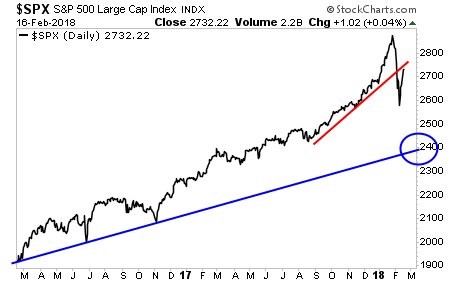
Stocks ended up crashing after the initial rally. At one point the S&P 500 was up over 1%, but it closed down 0.55%. In this month there have been two examples of days where the market was up at least 1% at one point and then closed down 0.5% or more. The last month which had two of these occurrences was August 2011. One of the biggest talking points among traders is whether this will be a V bottom or a W bottom. The V bottom is the shape of the letter as it has one major decline. The W bottom has a decline and then a re-test of the lows. Obviously, it’s possible the market breaks through the lows. The chart below shows an example of where stocks can go based on the trend line. The red line acted as resistance today. The next support line is at 2,400.
Some claim the reason for the reversal in stocks on Wednesday afternoon was the sharp selloff in bonds. The 10 year bond yield closed at 2.95%. It’s tough to say if bond yields caused stocks to fall because the 10 year bond sold off as stocks rallied. Then the 10 year bond continued to sell off as stocks sold off. It’s a tricky correlation because the 10 year yield is higher than when stocks bottomed, yet stocks are up about 4% since then. The ten year yield is up 44.5 basis points year to date, yet the S&P 500 is up 1% in that time frame. I continue to think 3.5% on the 10 year is a sell signal. The market is inching closer to that marker almost every day.
I also continue to believe the dollar is causing the selloff in stocks. As soon as stocks started moving lower at about 2:25 PM, the dollar index rallied. Its low on the day was $89.61. It closed at $90.11. The dollar is now 33 cents off its recent high where stocks bottomed. It’s possible that the Fed was more dovish than investors expected, but the fact that it is raising rates at all is hawkish and good for the dollar. As you can tell, sometimes parsing near term action in markets can be convoluted. Either stocks sold off because of the strong dollar or heightened rates. Some traders say rates went up because of the increase in inflation expectations which then forced stocks lower.