I know, you're probably laughing at the prospect that a fundamentals measure like PEG provides an edge. You may think that we're beyond looking at fundamentals in the current market. You may be thinking that growth perennially outperforms value. The reality is that fundamentals and valuation always matter. It's just a matter of which fundamentals are important. The great thing about the PEG ratio is that it's always a relevant and comparable measure, even if you're a growth investor.
In this post, you're going to learn about the PEG ration and its application.
What is PEG?
The PEG ratio divides the stock's current P/E by the projected earnings growth rate provided by analysts. Since we're incorporating both P/E and growth rates, let's start by defining P/E.
Price-to-Earnings (P/E)
This is a ratio comparing the company's share price to its earnings per share (EPS). This ratio is often called a price multiple or earnings multiple. P/E is one of the more difficult measures to use when determining valuation. The reason is that a growth-oriented company may reasonably trade at a higher multiple than a lower growth company. When using P/E, you can compare it against its 5-year mean or a similar company in its industry. There is a cautionary note when the P/E is too low (less than 6). It's an indication that the market may be expecting that the current earnings may not be sustainable.

Price/Earnings-to-Growth (PEG)
This measure normalizes the P/E by incorporating the projected earnings growth rate of the company by analysts. The earnings growth rate can use historical earnings growth over the past year or five years. However, a better and more up-to-date measure is to use analyst projections for next year's earnings or a 5-year projected EPS growth rate. Thus, a higher P/E isn't a problem as long as it is justified by higher future earning growth.

Here is an example using Apple Inc (NASDAQ: AAPL).
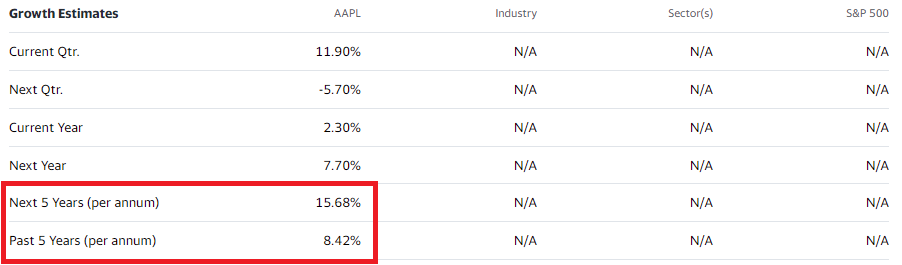
Using AAPL as an example, if you were to use an 8.42% growth rate or a 15.68% growth rate it would materially impact the current valuation. Which will be more applicable? When considering the valuation, the future earnings growth would likely be a better measure.
Using PEG in Fundamental Analysis
The idea of incorporating fundamental analysis is to find stocks that are trading below their intrinsic value. How do you do that? While figuring out the intrinsic value is a more difficult process, most the time it is about finding relative value. That means you look for companies that are trading at a more attractive valuation compared to the market, peers, or a group of stocks. This is where the PEG ratio shines.
Since the PEG ratio normalizes a stock's P/E by incorporating earnings growth, it allows you to use set levels when comparing companies. For example, a PEG ratio below one would be considered a value candidate. A PEG ratio above two would mean the valuation is elevated, and a ratio above three is extreme.
As you apply these PEG levels, they can be used in a screen to identify companies trading in a value territory below 1 or can be used to find the best relative value by taking the lowest PEG from a list of stocks.
Conclusion
The PEG ratio is one of most flexible valuation tools available to investors wanting to incorporate valuation in their investment decisions. The ability to compare companies of different fundamental stock types (growth, value, and income) and industries provides a level of flexibility that a P/E ratio or other valuation ratios can't provide.
Want to learn more about Ultima right now? Watch Don's preview outlining the strategy.
See how unlocking the Vomma Zone can help you better understand when volatility is about to rise.
Want learn more about how to work with me? Check out Trader by Your Side!
Not a subscriber? Become a TheoTrade member