

All you have to do to understand how nervous markets are ahead of Wednesday is have a look at how the major averages across the globe performed today.
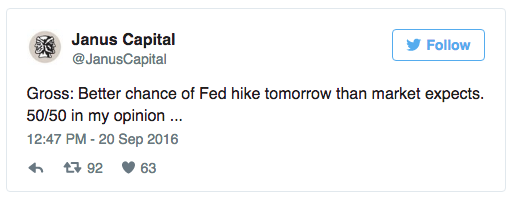
Everything is mixed from the US to Europe to Asia. There are lingering concerns that the market may be pricing the Fed decision wrong. Barclays thinks that’s the case and so does BNP. Incidentally, so does Bill Gross who tweeted the following earlier:
The entire enterprise has become so terribly distorted and convoluted that there’s really no telling what happens in the event either the BoJ or the Fed make a “mistake.” Consider the following. Earlier this year, the yen surged against the dollar after the BoJ adopted negative rates. Why? Simple. Because the market took it as a sign that the Japan was tacitly admitting its other measures have run their course and are no longer effective at the margin.
Now, the same BoJ is considering whether to lower rates further as opposed to extending asset purchases thereby (hopefully) driving short-term rates lower and long-term rates higher, thus steepening the curve and helping banks survive. But given the bank’s recent experience with NIRP, would more negative rates simply lead to a still-stronger yen?
Now think about that in the context of the Fed decision. If Barclays and BNP are right and the Fed hikes, the dollar should, by all rights, rise. So what would that mean when set against an uncertain outlook for the yen? Who knows, right? It’s a recipe for FX turmoil.
What’s important to note going into Wednesday is that it isn’t just the BoJ that’s “reviewing” its policies. It’s the Fed and the ECB as well. We’ve reached a veritable tipping point. Here’s Deutsche Bank with some color:
“The FRB and ECB have also begun assessing monetary policy methods around the same time of the BoJ's comprehensive assessment. Yet the content differs in each case. The BoJ is: 1) addressing reasons for not having achieved the 2% price stability target, and 2) conducting a practical assessment of benefits and costs of QQE accompanied by negative interest rates. The ECB is conducting a technical review ahead of an extension of the closed-end asset-purchase program currently slated to end in March 2017. The FRB is considering easing measures for recessionary conditions in light of the declining natural interest rate (such as buying risk assets along the lines of the BoJ).”
“The BoJ and ECB are facing drawbacks and limitations of QE accompanied by negative interest rates. A common issue in Japan and the Euro zone is the direct link between declining super long-term interest rates (not short-term rates) and reserve shortfalls at pension funds and life insurers with mismatches of assets and liabilities. Both regions also face the limitation of fewer assets available for purchases.”
Note the nod to the possibility that the FOMC will begin purchasing “risk assets” - like corporate bonds and stocks.
Here’s a schematic of the various outcomes:
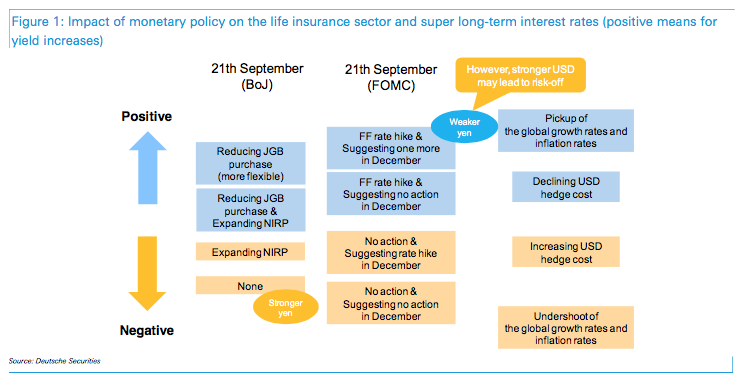
(Chart: Deutsche Bank)
We’re reminded of a certain phrase… it starts with “cluster” but we can’t remember the rest.