

Sometimes there’s nothing worse than “expectations.”
Allow us to give you a poignant example. This is from BNP on Monday (summarized by Bloomberg):
“BNP Paribas favors holding long XAU/JPY and USD/JPY positions via options heading into Friday’s BOJ meeting as the bank’s economists expect a 20bp IOER cut. Trade recommendation based on BNP analysis suggesting the market continues to hold large long JPY positions, especially relative to recent years during Abenomics. USD/JPY to also remain supported as U.S. front-end yields continue to push higher. Government likely to announce a JPY10t-JPY15t fiscal stimulus package around the same time as the BOJ meeting, creating the impression of de-facto helicopter money. Expectations for aggressive action from Japanese authorities have increased considerably over the past few weeks and measures could struggle to clear a rising bar.”
See anything inconsistent in that analysis? We do. If “expectations for aggressive action have increased considerably” and “measures could struggle to clear a rising bar,” then why in the world would you want to be long USDJPY going into the meeting? You wouldn’t. You’ll get slaughtered. Need proof? Well, just look at today’s action:
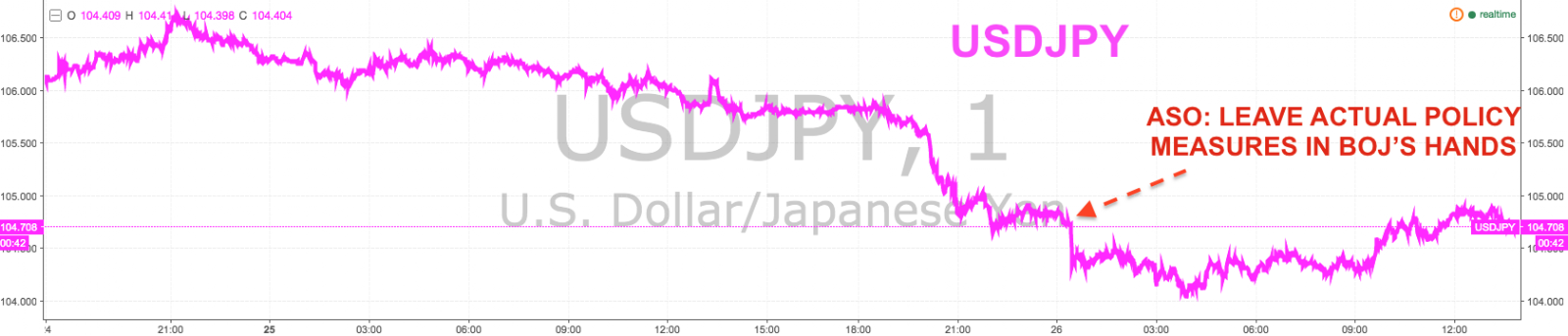
Oops. That’s Finance Minister Taro Aso suggesting that perhaps helicopter money is a pipe dream. And here’s what Bank of Tokyo-Mitsubishi UFJ (which just resigned as a primary dealer out of concerns that the BoJ has literally broken the market for Japanese government bonds) had to say:
“USD/JPY’s decline today is due to ebbing expectations for BOJ easing and Japanese Finance Minister Taro Aso’s comments saying monetary policy measures should be left to the central bank.”
This is how sensitive this market has become to policy maker speak. Can you guess what happened to the Nikkei after Aso’s comments?
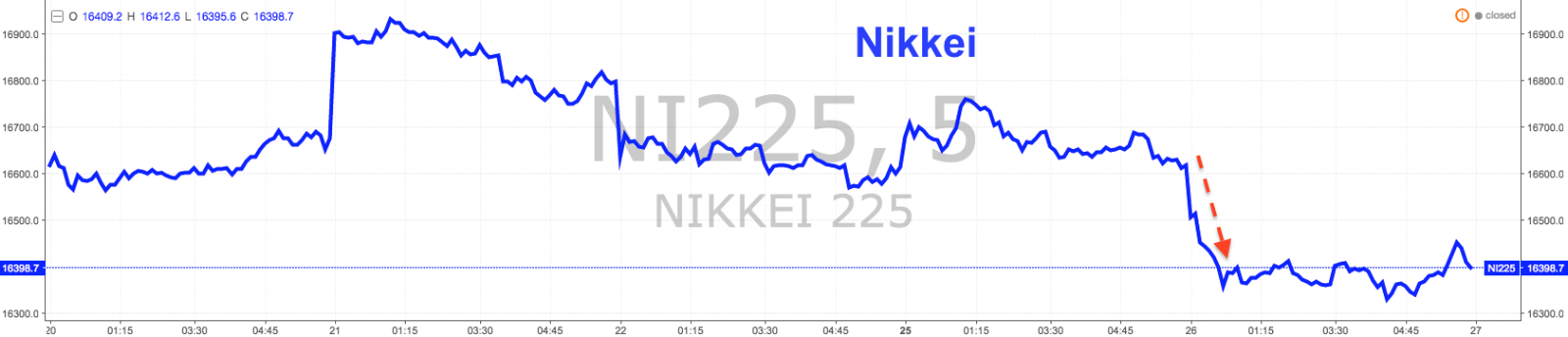
The problem here is that it’s now almost impossible for the Bank of Japan to live up to expectations on Friday. They’d have to cut by at least 20 bps, up the ante on ETF purchases, say something about the feasibility of continuing to corner the JGB market and that would all have to be accompanied by an announcement of at least JPY20 trillion in fiscal stimulus from the government.
It’s highly unlikely we’re going to get all of that because frankly, it would be highly irresponsible to do all of that at once. But in the absence of that kind of coordinated policy announcement, the yen is going to soar, crippling the carry trade, and likely derailing risk. This is how Bloomberg put it early Tuesday morning: “Stimulus is the name of the game. The yen rallied today after Japan’s government indicated there will be none.”
For today at least, the damage was contained. The red tape was largely confined to Japan. But make no mistake, this is Kuroda’s week. It’s a no presser Fed meeting, which means that aside from anything that can be divined from parsing the statement, the FOMC is likely to be a non-event - especially considering the fact that, as Deutsche Bank’s Joseph LaVorgna noted on Monday, they’ll be flying blind with respect to the Q2 GDP print.
We got a sense of just how critical Friday’s BoJ announcement is going to be at around 1:20 ET today when someone in the Japanese government apparently thought it was imperative to make sure that hope still floats. This was the headline from Nikkei:
“BOJ Officials Said to Be Leaning More Toward Easing”
And this was the color via Bloomberg:
“Top officials are said to be looking at multiple proposals including cutting interest rates further into negative territory, expanding govt bond buying beyond 80t yen annual level, or expanding purchases of other assets such as ETFs, newspaper reports, without attribution.”
About ten minutes later, this hit the terminal:
“Japanese govt is considering 10,000-15,000 yen ($95-$140) vouchers for low-income individuals as part of its plan to boost the economy.”
But in a sign of things to come, that wasn’t enough to move the proverbial needle. In fact, USDJPY continued to grind lower after a knee-jerk pop.
The bottom line: the easing bar is now set to “helicopter.” Anything short of that is going to be a disappointment. As we said at the outset, expectations can be a dangerous thing.