Housing Stays Strong
Housing data was strong again this week as you’d expect. November housing market index rose 5 points to 90. Present conditions index was 96 which is about as high as it can get. Expectations index was up 1 point to 89 and the traffic index was up 3 points to 77. There is likely less traffic because of the pandemic. However, buyers are very motivated because interest rates are still at a record low.
Average 30 year fixed rate fell from 2.84% to 2.72% this week which is a new record low. Rates are still catching up to the decline in the long bond yield earlier in the year. That’s not to say yields are up that much as the 10 year yield is at 84.7 basis points. It has fallen in the past few days. 30 year fixed rate is about as low as it can get. West’s housing market index was 98 which is obviously a record high.
It was incorrect to say last week that the housing market would be done with above 20% growth in purchase applications. Yearly growth rose from 16% to 26% in the week of November 13th. Weekly growth in the composite index rose from- 0.5% to -0.3%. Purchase index went from -3% to 4% growth. Despite extremely low rates, refinance growth fell from 1% to -2%.
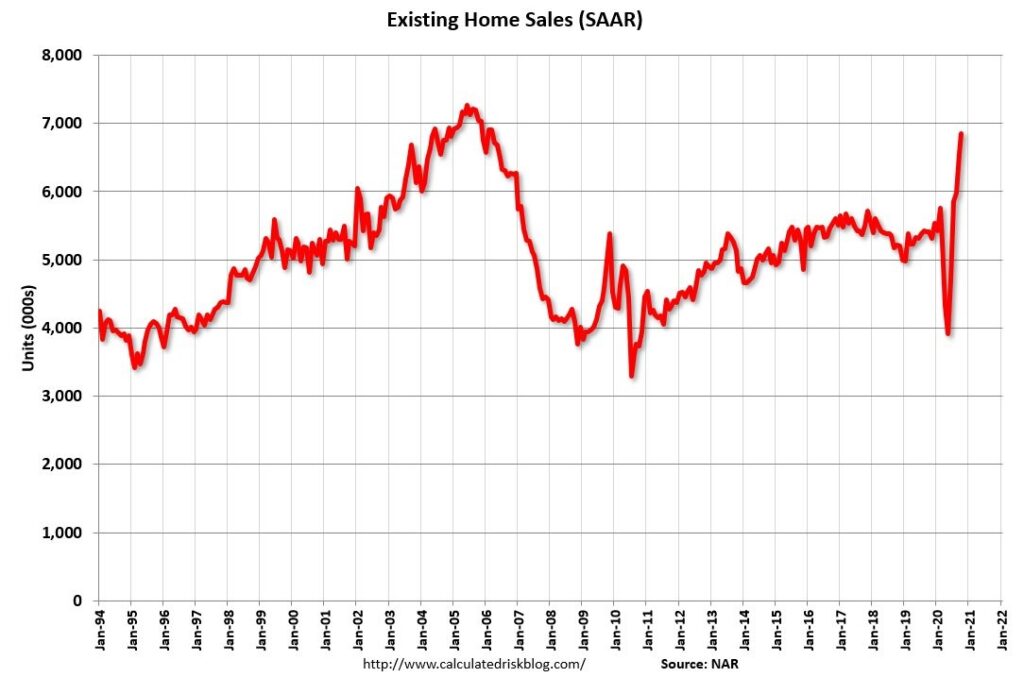
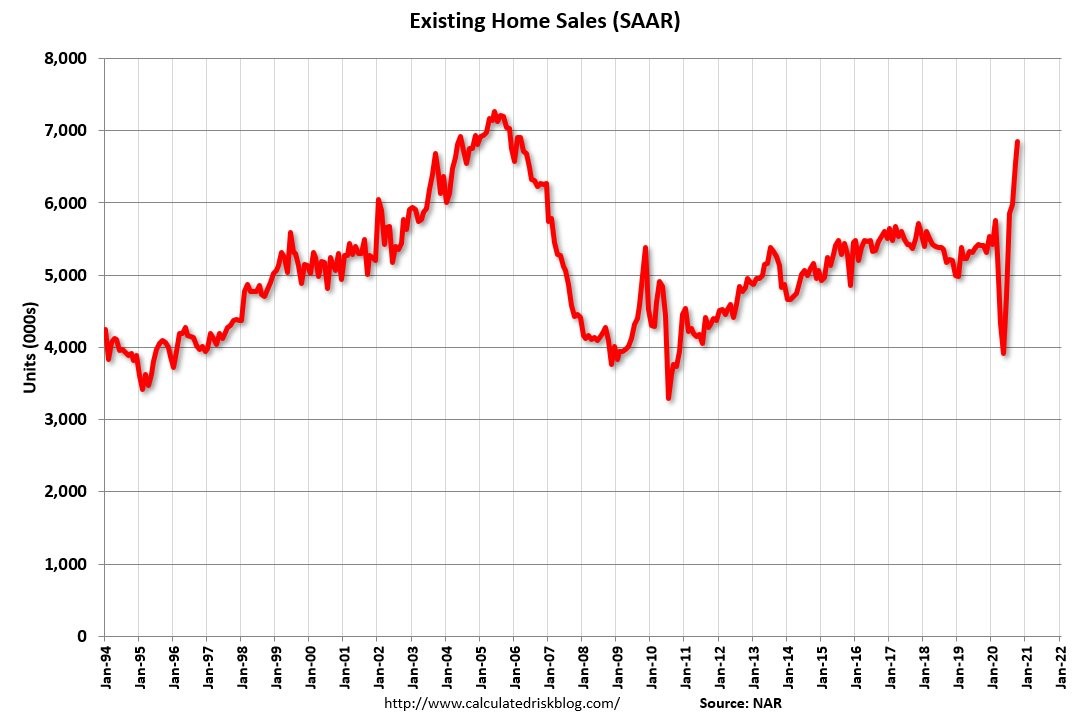
Existing home sales report from October was strong. The chart above says it all as existing home sales went vertical after a quick decline in the spring. Sales rose from 6.57 million to 6.85 million which beat estimates for 6.47 million. It’s shocking economists actually expected a decline. This sales reading beat the highest estimate which was 6.68 million. It has been that kind of year for the housing market.
Monthly growth fell from 9.9% to 4.3% and yearly growth rose from 21.4% to 26.6%. It’s quite a reversal from the spring as in May, yearly growth was -26.6%. Median prices were up 15.5% yearly to $313,000. That’s the 104th straight month of price growth. Obviously, double digit price growth can’t continue indefinitely.
Amazingly, properties stayed on the market for only 21 days which is down from 36 days last year. We are in a pandemic, yet the housing market is stronger than last year. Unsold inventory fell from 2.7 months to 2.5 months which is a new record low.
Housing market is in amazing shape. This isn’t close to a bubble. Housing demand is coming from household formation not speculators who are flipping houses for a profit like they were in the bubble in the early 2000s.
Weak Jobless Claims Report: Opposite Of Last Week
Last week’s jobless claims report was very good, but this one wasn’t. It’s just one week, so we can’t take this to mean the economy is weakening, but no one would be surprised if it does weaken. There will be 40 million doses of the vaccines (for 20 million people: 2 doses each) by the end of the year if they are approved. Pfizer will ask the American government (FDA) for emergency use of its vaccine on Friday, with Moderna applying a few days later.
BioNTech CEO stated their goal is to supply several hundred million doses in the first 4-5 months of 2021. There will probably be no impact on the economy by the end of the year though. The economy will trough as the vaccines start to go out. Worst month of this likely slowdown should be somewhere between December and February.
On Thursday, California’s governor Gavin Newsom announced that there would be a curfew for non-essential workers. Gatherings must shut down from 10PM to 5AM. That will cut Thanksgiving gatherings short. A curfew applies to 94% of the state’s population. It's unlikely that this will be the only state instituting restrictive measures starting this month.
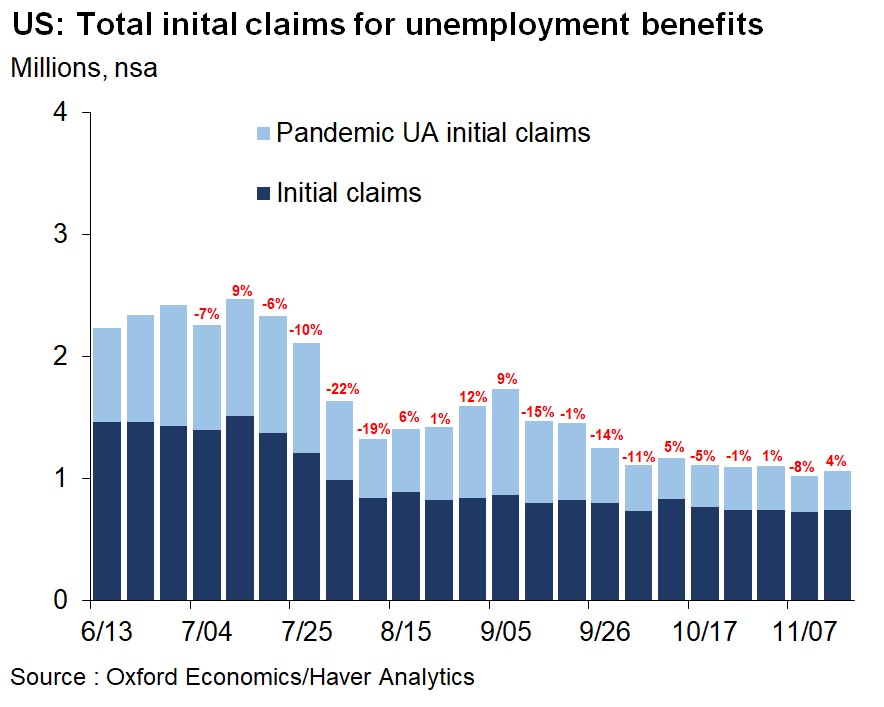
Seasonally adjusted initial jobless claims rose from 711,000 to 742,000 in the week of November 14th. That was way above the consensus of 710,000 and the highest estimate which was 725,000. Last week’s report was a 46,000 decline and this week’s was a 31,000 increase. If you combine the two it’s like a slight decline. Maybe the labor market got much worse or maybe the seasonal adjustment was wonky.
Good news is non-seasonally adjusted claims rose only 18,344 this week to 743,460. However, the bad news is they only fell 18,788 last week. That’s a better number in relation to the seasonal adjustment this week. But it completely cancels out the decrease last week unlike the seasonally adjusted reading.
PUAs rose 24,000 to 320,000 which explains why the chart above shows a 4% total increase (including non-seasonally adjusted regular initial claims). Louisiana had a 30,000 increase in PUAs to 40,000 which is clearly incorrect.
Continued Claims Fall Again
Continued claims fell from 6.801 million to 6.372 million in the week of November 7th. Finally, it is below the peak in the last recession. A 429,000 decline was 7,000 more than the last report. It’s unfortunate that just as the labor market is getting to last cycle’s starting line, the economy is slowing as economic restrictions are increasing by the week. In the week of October 31st, PEUCs increased 233,458 as you can see from the chart below. Extended benefits were up 78,441.
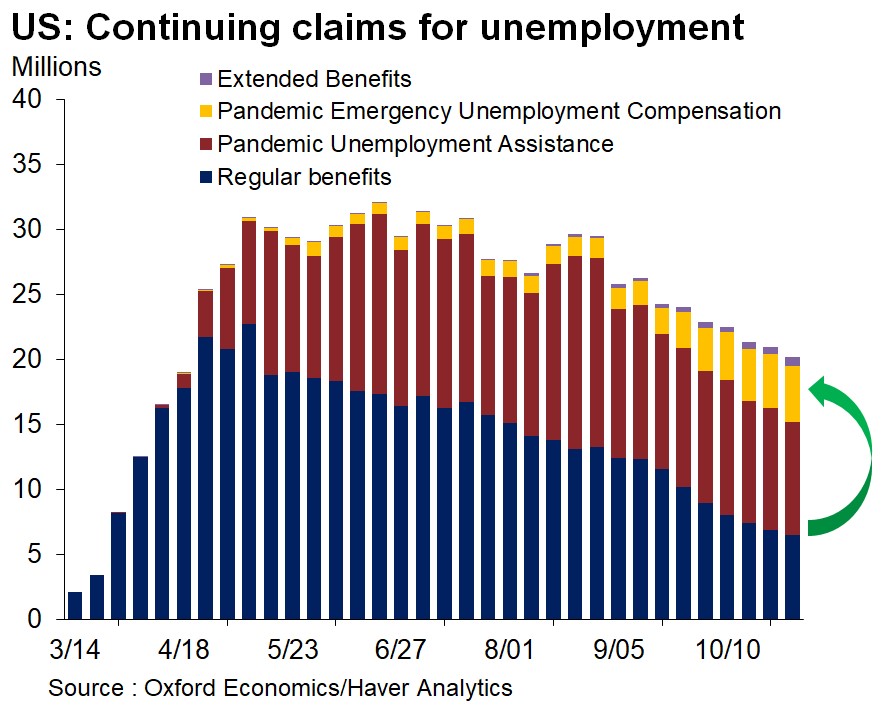
Overall number of people on some benefits programs fell 841,000. However, there are now 13.9 million people on pandemic benefits which is a disaster because they expire by the end of the year. Government must do something to prevent chaos for these people.
Generally, when the government is forced into action, it does something. Let’s see if the government figures something out. On Thursday, Senate majority Leader Mitch McConnell agreed to resume negotiations with the Democrats over a new COVID-19 relief bill. Over 14 million people have little or no confidence that they will be able to pay next month’s rent. The time for action is now.