


The S&P just touched 6,800. New all-time highs. Everyone's celebrating.
But pull up the daily chart and look at what's actually happening. The market isn't climbing. It's dancing.
Tippy-toeing on razor-thin candles that barely touch each dip before bouncing higher.
This is what traders call "trip the light fantastic." Dancing nimbly on your toes.
Fred Astaire. Gene Kelly. Beautiful to watch. Except when you're doing it on the edge of a cliff with nothing underneath.
Algorithms buy every single dip with mathematical precision. They've compressed volatility into microscopic movements.
The entire rally exists on borrowed momentum. It requires constant machine intervention just to stay elevated.
The Genesis COG Scanner tracks exactly when these algorithmic support patterns break down. When machines stop defending channels and start attacking them instead.
When the dancing stops and gravity takes over.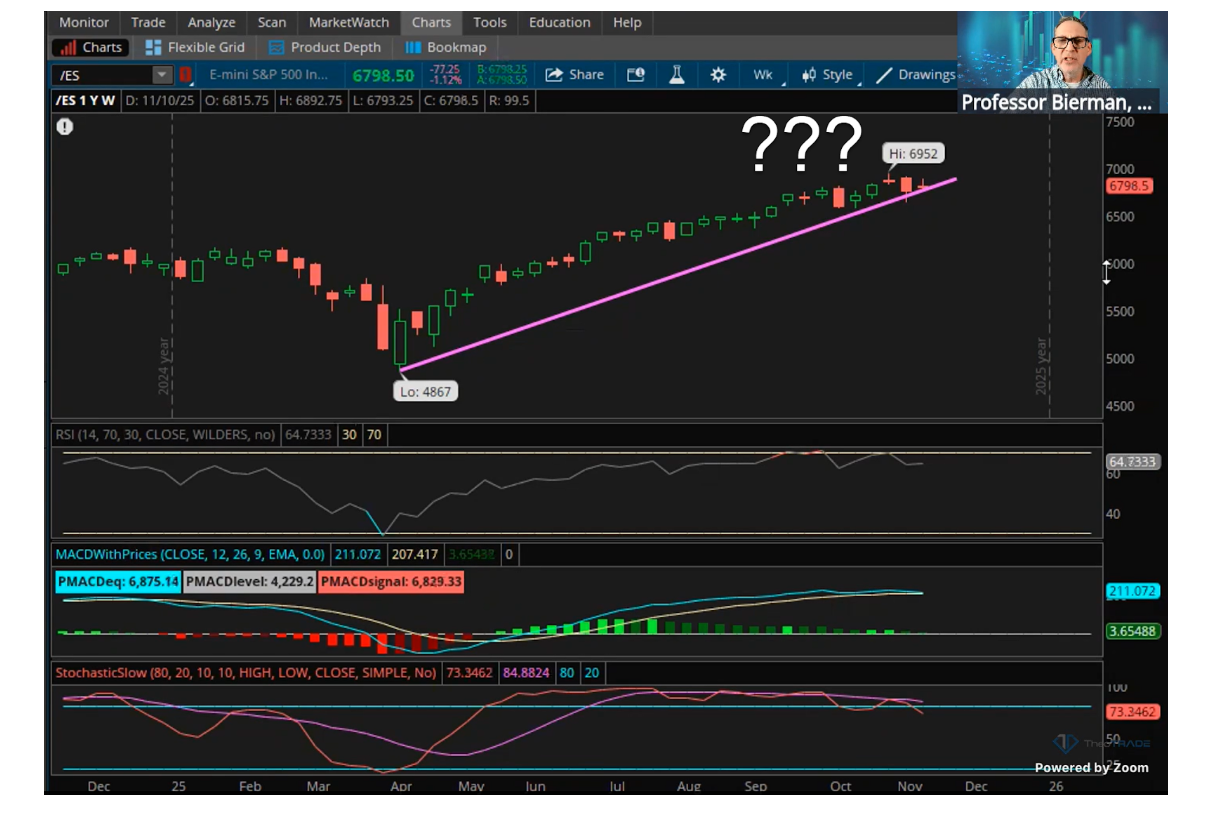
Here's what separates this rally from sustainable momentum. I'm tracking money flow underneath price action.
While the S&P makes new highs, institutional money isn't flowing in at the same rate. The accumulation distribution line has gone flat even as price climbs.
That tells me everything. The machines create the illusion of strength.
But real institutional conviction has already left the building.
The Algorithmic Dance That Can't Last
Every dip gets bought instantly. Not by fundamental investors analyzing balance sheets.
By algorithms programmed to defend specific price levels within narrow channels.
Watch how this plays out intraday. The market drops 40 points.
Within minutes, buyers appear. Not retail traders clicking buy buttons.
Systematic programs executing predetermined orders at mathematical inflection points.
This creates perfect linear channels that walk prices higher for months. The slope integrity stays intact because machines refuse to let it break.
They defend specific boundaries with billions in buying power.
But here's what most traders miss. This mechanical support only works while the programming holds.
Algorithms trade slopes and momentum indicators. When those indicators confirm a breakdown, the same machines that defended every dip will attack every bounce.
The programming flips instantly.
I track the exact momentum signals that trigger these programming changes. Pull up any major index and look at what's happening beneath the surface.
The divergences are building across multiple timeframes simultaneously.
The RSI is barely holding its ground while price makes new highs.
The MACD histogram is compressing toward zero for the first time in months.
The stochastic is rolling over at extreme readings.
Bearish divergence between price and momentum keeps expanding.
Money flow is declining while price climbs.
Each signal alone means nothing. But when all five converge while the market dances at all-time highs with compressed volatility, that's not a trading environment.
That's a trap waiting to spring.
I've been trading for 38 years. Bearish divergences work nine times out of ten.
Not because charts predict the future. Because algorithms process these same momentum signals and execute based on mathematical thresholds.
What Happens When the Dancing Stops
The danger isn't gradual decline. The danger is instant reversal.
Look at the air underneath current price levels. There's no liquidity support.
No meaningful consolidation areas. No logical places where buyers accumulated positions at lower prices.
The entire structure exists because machines keep buying. When they stop, there's nothing underneath to catch the fall.
One red candle. One marubozu that closes 300 points lower.
That's all it takes to trigger forced liquidations across the system.
Everyone positioned near these highs faces immediate margin calls. They can't exit gracefully because there are no buyers.
The same lack of liquidity that allowed the tippy-toe dance higher becomes the mechanism that destroys accounts on the way down.
This isn't theoretical. I've seen this pattern play out dozens of times over 38 years.
The setup always looks the same right before it breaks.
The market has been tripping the light fantastic for way too long. Dancing on air. Defying gravity through pure algorithmic intervention. But gravity always wins eventually.
The Money Flow Reality Check
Pull up accumulation distribution on the S&P. While price makes new highs, the money flow line has gone flat.
Not declining hard. Just stopped rising.
That divergence reveals exactly what's happening beneath the surface. Institutions aren't adding exposure at these levels.
They're maintaining positions, maybe reducing slightly. But they're not buying with conviction.
The machines create price movement. But institutional money creates sustainability.
When those two disconnect, you're watching mechanical manipulation without fundamental support.
[CHART: S&P with accumulation distribution showing flat/declining while price rises]
I track money flow on every position I hold. When I see money flowing in with price, I stay long.
When money flow goes flat while price climbs, I start planning exits.
The slope of the money flow line matters more than the absolute number. A steep slope means urgent buying or selling.
A flat slope means indifference disguised as stability.
Right now the money flow slope is telling me institutions have stepped away. They're not panicking out.
They're just not adding. And when the machines finally stop defending this channel, there won't be buyers to cushion the fall.
Why Professional Money Is Already Positioned
Every bear gets mocked for claiming "this time is different." Usually they're wrong.
Markets historically rise despite constant worry.
But watch what's actually happening with positioning right now.
Everyone has excused every warning signal for months. The government shutdown delayed economic data, so we flew blind.
The AI narrative justifies any valuation. The Fed will cut rates in December.
Every concern gets rationalized away.
Meanwhile the market prices in perfection for the next five years. Not five months.
Five years of flawless execution, zero competition, infinite growth in stocks trading at 40x earnings.
That complacency shows up in positioning. I'm tracking institutional money flow.
They're not adding exposure at these levels. They're maintaining positions, maybe trimming slightly.
The accumulation has stopped.
The professionals I work with are 60% cash right now. Not because they hate stocks.
Because the asymmetric risk has become impossible to ignore.
The potential upside if this keeps grinding higher is maybe 100-200 more points. The downside if the algorithmic support breaks is 1,000 points or more in a matter of days.
When risk-reward inverts that severely, cash becomes the position. Not bearish.
Mathematical.
Your Position Right Now
You're either positioned for what comes next or you're exit liquidity for those who are.
The machines will keep this dance going until something breaks their programming. A major economic disappointment.
A Fed decision that contradicts market expectations. A single high-profile stock that gaps down and triggers systematic selling.
You won't get advance warning. The breakdown happens in milliseconds.
One candle breaks the channel. Money flow accelerates lower.
Forced liquidations trigger more selling. Within hours, you're underwater on positions that felt safe yesterday.
I'm not telling you to panic sell everything. I'm telling you to recognize what's actually holding this market elevated.
It's not fundamentals. It's not earnings growth.
It's not economic strength. It's algorithmic programs defending mathematical levels because that's their programming.
When that programming changes, the support disappears instantly.
The smart trade right now is reducing exposure on strength. Taking profits in extended positions.
Building cash reserves for better opportunities. Stop treating every dip like a gift when the structural foundation is this fragile.
The market is tripping the light fantastic. Dancing beautifully on its toes.
But that dance only continues as long as the machines keep playing the music.
The challenge is knowing when the music stops. Algorithms execute these reversals faster than human reaction time allows.
They identify channel breaks before price confirms the breakdown. They position ahead of major moves while retail celebrates new highs.
That's exactly why I built the Genesis COG Scanner to track these patterns across the entire market simultaneously. When machines stop defending support and start attacking resistance, you'll know before the breakdown becomes obvious.
When money flow divergences reach critical thresholds. When momentum indicators cross the algorithmic trigger points.
Because one missed beat and this entire choreographed performance collapses. The dancers who recognize the tempo change exit gracefully.
Everyone else gets trampled in the rush for the door.
Professor Jeffrey Bierman
Creator of the Genesis COG System