Elon Musk Charged With Fraud
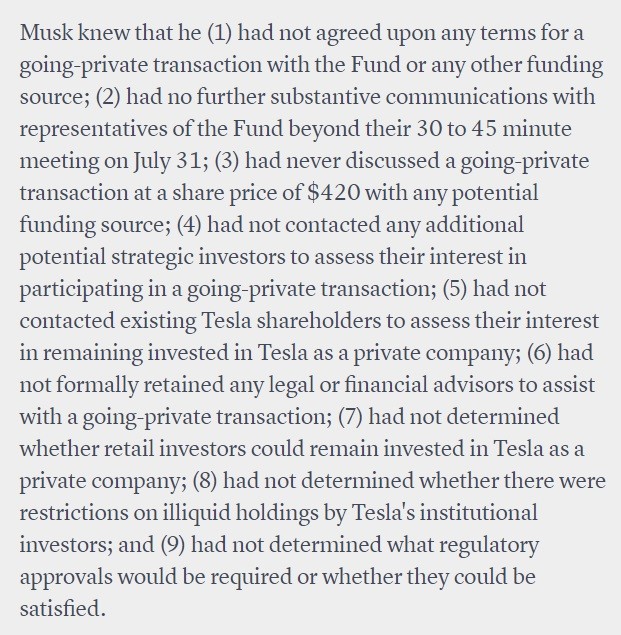
The biggest news on Thursday was that Elon Musk is being charged with fraud by the SEC. This caused Tesla stock to fall 12.66% after hours. The image below explains the SEC’s case against Musk.
It pertains to the August 7th tweet where he stated “Am considering taking Tesla private at $420. Funding secured.”
If there wasn’t an agreement to take Tesla private, Elon’s motivation could have been to hurt the short sellers and critics of his company.
He faces intense pressure to produce the Model 3 profitably and with high quality control. I think the situation looks very grim for Musk. By August 24th, Musk called off the privatization plans.
It’s very unusual for a company to not have a formal announcement of plans to go private and then call the whole thing off in 3 weeks.
The situation was bungled so badly that the head of Investor Relations didn’t know about the plan.
When asked how firm the offer to take Tesla private was, the investor relations head said, "I actually don't know, but I would assume that given we went full-on public with this, the offer is as firm as it gets."
Elon came up with the $420 take over price by adding 20% to the existing valuation. That’s a standard take over premium. If the Saudi Arabian sovereign wealth fund made an offer, there would have been much more detailed valuation work than that.
Elon Musk is denying these charges.
If the SEC wins, Musk could lose his position as head of the company.
If he’s guilty of criminal fraud according to the Justice Department, he could face jail time.
Tesla gets a premium because of Elon Musk’s celebrity status. However, it could end up in favor of Tesla in the long run. Especially if a CEO who is laser focused on production and meeting deadlines takes the helm.
Elon Musk - Stock Market Rebounds Thursday
The S&P 500 ended its 4 day losing streak on Thursday as it increased 0.28%.
It regained much of the losses which occurred after the Fed rate hike on Wednesday. The Nasdaq was up 0.65% . The Russell 2000 was down 6 basis points.
Even though stocks rallied, the CNN Fear and Greed index fell 4 points to 49. This supports my neutral opinion on stocks in the near term. Apple helped the tech sector move higher as it was up 2.06%.
The tech sector increased 0.54%. The best two sectors were utilities and communication services as they increased 0.96% and 0.8%. The materials sector fell 0.97% and financials fell 0.34%.
The decline in the financials makes sense because the yield curve flattened. The 10 year yield was flat at 3.05% and the 2 year yield increased 2 basis points to 2.83%.
The chance of at least one hike in December is now 79.5%.
Elon Musk - Weak Core Capital Goods Orders
The trade report hurt GDP estimates, but the August durable goods report helped them as month over month new orders growth was 4.5% which more than doubled the consensus estimate for 2.2% growth.
It met the highest estimate in the consensus range. The July report was revised to show a 1.2% month over month decline instead of a 1.7% decline.
This August report was all about the volatility in civilian aircrafts as core capital goods orders were weak. That's a bad signal for economic growth and is consistent with the trend of hard data reports missing estimates while soft data reports beat them.
Excluding transportation, month over month orders were only up 0.1% which missed the consensus for 0.5% growth and the low end of the consensus range which was 0.3% growth. July had 0.2% growth.
The July report was the exact opposite of the August report because the July headline number was weak because of aircraft orders, but core capital goods order growth was decent.
July’s core capital goods order growth was revised up from 1.4% to 1.5%. August saw a 0.5% decline in core capital goods orders which missed the consensus expectation for 0.4% growth. It also missed the low end of the range which expected 0.2% growth.
Orders for civilian aircrafts were up 108% in August on a month over month basis after falling 41% in July. Motor vehicles orders fell 1% and machinery orders increased 0.1%.
Core capital goods shipments were up 0.1% in August and 1.1% in July. Total unfilled orders were up 0.9%. This was possibly because of primary metals pre-buying before tariffs. Inventories fell 0.4% in August after being built up 1.2% in July.
The wholesale and retail inventories reports showed there were strong builds in August.
Elon Musk - Disappointing Pending Home Sales
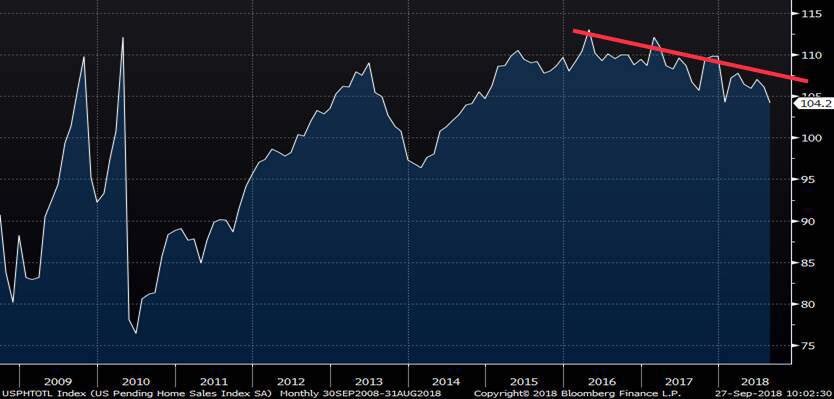
As you can see from the chart below, the pending home sales index was 104.2 in August which was down from 106.1 in July. There was a month over month decline of 0.8% in July and a month over month decline of 1.8% in August which missed estimates for flat growth.
All regions had declines on a month over month basis with the west being the worst as it fell 5.9%. On a year over year basis, all regions except the south saw pending home sale declines. The south was up 1.3%. Worst was the west again as it fell 11.3%. Overall index was down 2.3%.
Elon Musk - Uneven Housing Recovery
Housing market has been weak this year. However, all real estate is local. The 2008 crisis was an unusual example where housing was highly correlated.
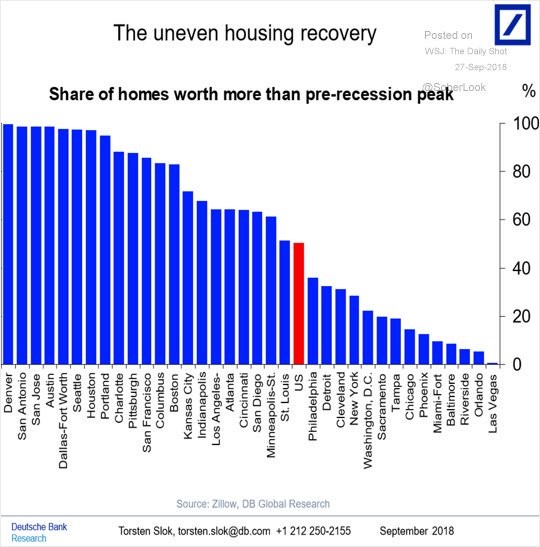
As you can see from the chart below, some cities have seen almost all their homes recover in value from the financial crisis. However, other cities have barely seen any homes recover.
About half of homes in America have seen their homes recover in value. It’s no surprise that San Francisco and Seattle have seen more of a recovery than the overall country. Their housing markets are hot.
Some even say they are in a housing bubble. Amazon is headquartered in Seattle and many tech firms are in Silicon Valley. There will only be a burst in housing in those cities if tech has a downturn.