Economy Is Doing Well?
Bloomberg economic surprise index hit its highest level in 2 years. That’s based on January data which tells us the economy likely would have had a nice rebound in the 1st half of 2020 if it wasn’t for the coronavirus. Even if the coronavirus has a big impact on global growth in Q1 and Q2, eventually there will be a recovery in which case the previous trend will regain form.
U.S. economy is in great shape to deal with an exogenous shock (that’s an outside shock). We could have been looking at a recession if this virus impacted the economy 6 months ago as the U.S. economy was in potentially its worst slowdown of this expansion.
Atlanta Fed GDP Nowcast shows Q1 GDP growth will be 2.7% based on the latest economic data shows. It shows that this would have been a decent quarter without the coronavirus hurting growth. Housing market is still strong. We expect weakness in the February and March data when it comes out in the next few weeks. By the time those reports come out, the selling pressure will likely be done.
Pending Home Sales
We already knew the housing market was on fire. Just in case you were skeptical, another great housing report was released on Thursday. Pending Home Sales index was up 5.2% monthly after falling 4.9%. That beat estimates for 2.2% growth. It beat the high end of the estimate range which was 2.2%. Actual index was up from 103.2 to 108.8.
On a yearly basis, growth was 5.7%. There was strong growth across the board. Northeast was up 1.2% to 92.9. It had the weakest growth. West was up 5.5% to 92.6. It had the lowest index. Others were above 100. Midwest was 105.3 as it had 6.5% growth. South was 129.4 as it had 7.1% growth. Biggest housing market is doing the best which is great news for overall readings.
Average 30 year fixed mortgage rate as of February 27th was 3.45%. That was down 4 basis points from last week. It was slightly wrong to state that the average rate would hit the lowest level since 2016. It only matched the lowest level since then.
More importantly, the average rate will likely fall further in the next few weeks because the 30 year and 10 year yields are at record lows. Rates are already low, but I think if news headlines say this is a record low, it will encourage buyers to pull the trigger. It will also encourage a new wave of refinancing.
Kansas City Fed Manufacturing Index Increases
Kansas City Fed manufacturing index was the last regional Fed manufacturing report to come out. It increased which means 4 of 5 increased. It didn’t have a big spike like the Philly Fed index, but it was still solid. Barring any coronavirus worries, the ISM manufacturing PMI should be at least in the low 50s.
Kansas City Fed index rose from -1 to 5 as you can see in the chart below. Production index flipped from -4 to 8. Volume of shipments index rose from -4 to 9 and the new orders index rose 10 points to 8. The only sharply negative index was the backlog of orders which rose 4 points to -16.
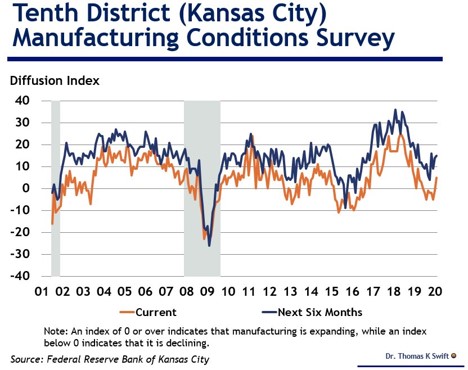
Despite worries about the coronavirus, the expectation index was also positive. Composite rose 2 points to 16. Expected volume of new orders rose from 9 to 21. Capex index fell 1 point to 7. Nine out of 12 firms in the comment section mentioned either the coronavirus or supply chain issues. It’s great that the expectation index still was up despite this concern.
Specifically, one firm stated, “The longer the 737 Max situation continues and if Coronavirus is not contained, we are going to see negative supply and demand issues at our company. Once the trade deals are finalized, I believe they will have a net positive affect on our business.” This comment hit on all 3 worries. They are the trade deals, the coronavirus, and the Boeing 737 Max delays.
Durable Goods Orders Before The Coronavirus
Durable goods orders report from January gives us the final picture before the coronavirus. We will start getting updates on how the virus hurt orders next month. Monthly new orders growth was -0.2% which beat estimates for -1.2%. That’s pretty good since the December reading was revised up by 0.5% to 2.9%.
Ex-transportation growth was 0.9% which beat estimates for 0.2%. The prior reading was revised up by 0.2% to 0.1%. Finally, core capital goods orders growth was 1.1% which beat estimates for 0.3%. Prior reading was revised up 0.4% to -0.5%. Positive revisions and estimates beats, what more can you ask for?
Yearly growth fell because the comp got tougher. Headline yearly orders growth fell from -3.2% to -3.9%. That’s very good news because the comp went from 3.7% to 8.4%. 2 year growth stack went from -0.5% to 4.5%.
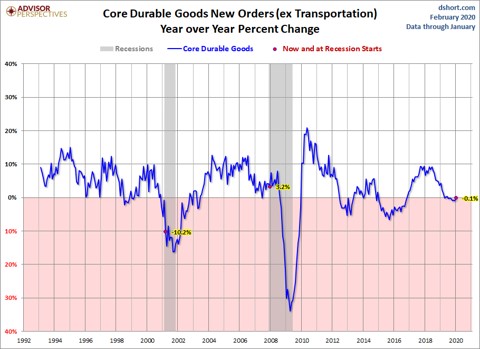
As you can see from the chart below, core orders ex-aircraft had growth of -0.1%. Yearly growth in non-defense capital goods ex-aircraft fell from 1.3% to 0.9%. The comp went from 1.9% to 4.1%. 2 year growth stack went from 3.2% to 5%. This was a very good report. I expect weak results in February because of the coronavirus.
Conclusion
The economy was doing very well before the coronavirus. That's based on the housing market reports, the regional Fed manufacturing data, and the durable goods orders report. Economic surprise index hit a 2 year high. Data will reverse in February and March as the coronavirus leaves its mark. Therefore, I think the economy will avoid a recession and there will be a recovery in 2H 2020.