

This has been the year that markets finally began to question central banks in earnest.
It started in January when the Nikkei took a dive and the yen surged following the Bank of Japan’s decision to take rates into negative territory. That was the shot across the bow. By all accounts, the move below zero should have sent Japanese stocks soaring and the yen plunging. When the opposite happened, it was the market effectively saying: “ok, we’ve had enough of this and we no longer believe it’s working.”
Not one to simply throw in the towel, Mario Draghi and the ECB eased further in March and even moved to begin monetizing corporate bonds. The Fed then abruptly reversed course opting for a dovish message. At the time, stocks had bounced off the February lows and it looked as though oil was setting up for a sharp rally. The last thing the market needed was a Fed hike and a soaring dollar.
The BoJ stood pat in April and once again, the yen soared proving that Japan had officially reached the limit. If they eased the yen soared and if they didn’t ease the yen soared. The market was betting against them no matter what they did. Last month, the Fed decided to make one final stand. They trotted everyone out with a hawkish message and released decidedly hawkish
Minutes from the April meeting which seemed to suggest that a June hike was all but certain. They came the May jobs number. Here’s a snapshot of Treasurys during that period which demonstrates the sharp reversal in Fed rhetoric:
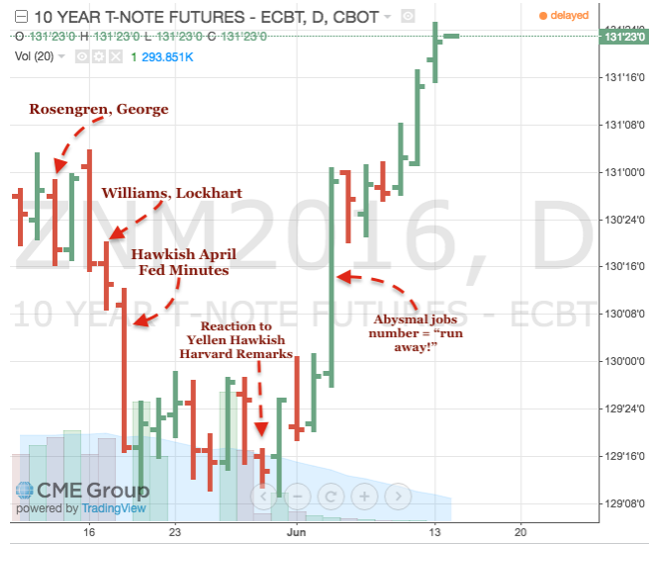
At the June meeting, they didn’t even try. The statement was dovish and so was the press conference. It was over. It felt like the Fed had finally become just as fed up with the market as the market was with the Fed.
The question then became simply this: what now?
Well, today we may have a gotten a hint of what’s coming. In what marked a rather surprising move considering recent rhetoric, St. Louis Fed chief James Bullard revealed he was the outlier dot on the most recent Fed dot plot and also confirmed that he was the “missing” dot in the long-run forecast.
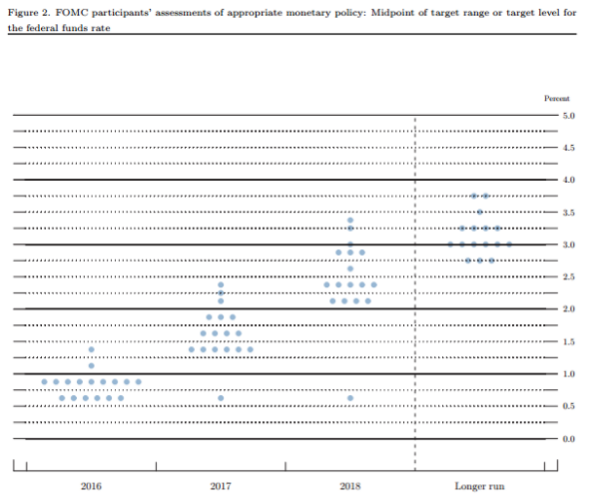
In a sharp rebuke of the Fed’s communication policy, Bullard essentially suggested that the FOMC admit it has no idea where the economy or rates will be over the long-term and abandon any attempt to project beyond two years. Here’s what he said:
"The Fed's actual pace of rate increases has been much slower than what was mapped out by the committee in the past. This mismatch between what we are saying and what we are doing is arguably causing distortions in global financial markets, causing unnecessary confusion over future Fed policy, and eroding credibility of the (Federal Open Market Committee).”
“The dot plot appears to be too steep. Fed funds futures markets do not seem to believe it. They are priced for a much shallower pace of increases.”
"On balance, real output growth, the unemployment rate, and inflation may be at or near mean values that could be sustained over the forecast horizon provided there are no major shocks to the economy.”
"Key macroeconomic variables including real output growth, the unemployment rate, and inflation appear to be at or near values that are likely to persist over the forecast horizon. Any further cyclical adjustment going forward is likely to be relatively minor."
In other words, Bullard thinks the economy is going to stay right where it is and as such, policy should stay right where it is as well.
Make no mistake, this isn’t some inconsequential Fed banter. This is a notable shift. They are literally throwing in the towel. And that’s probably a good thing. Communication has become overcommunication. It isn’t necessary. This should essentially be a panel of technocrats that meets quietly and makes adjustments when necessary consistent with a simple dual mandate. Instead, it’s a team of celebrities tasked with managing global capital markets.
Of course there’s always a punchline. Remember what Deutsche Bank “suggested” the Fed do a few weeks back? Allow us to remind you. Here’s the quote:
“Dear Fed: Take just one step at a time and say you don’t know the destination.”
Done and done.