Dovish Fed - Big Rally Wednesday As Stocks End 7 Day FOMC Losing Streak
The stock market rallied sharply on Wednesday. S&P 500 increased 1.55%, the Nasdaq rallied 2.2%, and the Russell 2000 increased 1.05%.
Equities loved the great earnings report from Boeing, the weak earnings report from Apple, and the dovish Fed guidance. Apple stock rallied 6.83%. This was the first FOMC day rally in 7 meetings. The VIX fell 7.68% which pushed the CNN fear and greed index to 58 out of 100 which signals greed.
There is a plethora of greed in the market as the S&P 500 is up 6.95% year to date. That’s amazing performance for the year considering the expected 3% earnings growth.
Dovish Fed - Stocks are forecasting that everything will go well?
They think the Fed will pause rate hikes, the U.S. economy will stop slowing, America will make a trade deal with China, and the Chinese economic slowdown will either end or not have a huge impact on the American economy. If a couple of those projections go wrong and earnings fall this year, stocks will need to quickly reverse course.
Every single sector was up Wednesday. Worst sectors were utilities and consumer staples which increased 0.65% and 0.74%. This was a prototypical ‘risk on’ day.
Best sectors were consumer discretionary and technology which increased 2.16% and 3.03%. Apple drove the tech sector higher. Thursday will be a big day for the consumer discretionary sector because Amazon is reporting. Alphabet is reporting on Monday.
Dovish Fed - Fed Moves Dovish
Fed formalized what it has been saying for the past few weeks as its statement was dovish. The Fed took a dovish turn in December after its rate hike because the market was tumbling.
Fed won’t release economic expectations and its latest dot plot until its March meeting. But based on the statements and press conference, it’s clear at the least, the Fed will shift to projecting 1 hike in 2019.
The “s” at the end of the word statement isn’t a misprint. The Fed added an extra statement to discuss the balance sheet. It capitulated in this meeting as it expressed willingness to stop the balance sheet unwind and rate hikes.
Dovish Fed - It emphasized the risks the economy faces.
It’s important to recognize how sharp a turn this was. In October, the Fed was on board with 3 hikes in 2019. Now it’s probably looking at 1 hike in 2019 as of the March meeting.
In the end the Fed probably won’t hike at all unless the economy turns around sharply in the 2nd half. In December, Powell stated the balance sheet was on autopilot. Now he’s willing to end the balance sheet reduction if the economy weakens further.
Personally, I expect the unwind to keep going at the same speed until 2020 unless the economy slows further.
Let’s not ignore the effect of the stock market. The Fed changed its tune because of the decline in stocks. I’m surprised the Fed sounded this dovish because the stock market has rallied so sharply this year.
It seems like the Fed is behind the curve as it is still reacting to the decline in December even though that has reversed. If the Fed followed the stock market better, it could have suppressed the volatility at the end of the year.
It could have taken the December rate hike off the table. The good news is now that the Fed is dovish, the risk of a recession in 2019 is almost off the table.
Dovish Fed - FOMC Statement Changes
The past few FOMC statements haven’t had much to analyze. This statement had a lot of changes because the Fed formalized its guidance changes that it started leaning towards in late December.
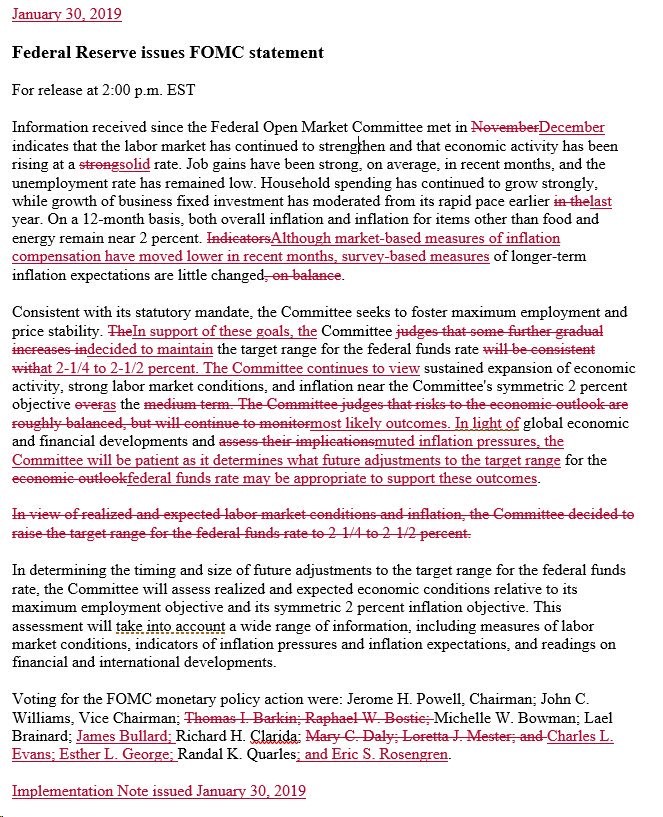
The first change in the statement is a dovish one. Economic activity went from “strong” to just “solid.”
Personally, I don’t think the economy was strong in December unless you’re only focusing on consumer spending. I think the economy was strong in the first half of 2018. Either way, this is a small move which suggests the Fed is pausing rate hikes.
Instead of stating “indicators of longer term inflation expectations are little changed on balance”, the Fed stated “although market-based measures of inflation compensation have moved lower in recent months, survey based measures of longer term inflation expectations are little changed.”
A key part of the new sentence is where the Fed says market measurements of inflation have fallen. It means the Fed has wiggle room to be dovish. I have been saying this for a few months.
Dovish Fed - The Fed finally caught up to the obvious.
Second biggest dovish move was when the Fed took away “some further gradual increases” and replaced it with the fact that it “decided to maintain” rates. Saying there are no more gradual increases is a big turn. I still wouldn’t rule out the Fed claiming it will hike rates one time in 2019.
However, there is no chance the Fed hikes in the first half of 2019.
Biggest dovish change was the Fed getting rid of the point that “risks to the economic outlook are roughly balanced” and adding that there are “muted inflation pressures” and that “the Committee will remain patient.”
The word “patient” was the most important part of the FOMC statement as it seals the deal that no rate hikes are coming in the near term.
Dovish Fed - Conclusion
It’s fair to wonder if the Fed can shift back to being hawkish since it became dovish in a few weeks. It’s easier for the Fed to react to negative factors by quickly becoming dovish than it is to switch to being hawkish.
The Fed would need to gradually switch its language for a few meetings before it could discuss rate hikes. That’s why none are coming in the first half.
If the stock market hits a new record high, I could see Fed members discussing in the media the need for hikes again. Yes, the Fed is reacting to the stock market again like it did under Yellen and Bernanke.
I will be discussing Boeing, Microsoft, and Facebook’s earnings in future articles.