

It’s not always a good idea to follow Goldman Sachs’ investment recommendations. Who could forget the famous NY Times op-ed penned by departing investment banker Greg Smith who offered the following rather scathing critique of the firm’s attitude towards those the bank is ostensibly obligated to serve:
“Over the last 12 months I have seen five different managing directors refer to their own clients as ‘muppets,’ sometimes over internal e-mail.”
That peek inside the bank’s corporate culture has spawned any number of “muppet” memes over the past several years, and some critics have even taken to suggesting that Goldman’s recommendations should serve as a contrarian indicator. That is, they recommend their clients buy whatever the prop desk is trying to sell (oh wait, Dodd-Frank did away with prop trading… wink).
That characterization is probably unfair. After all, no one gets it right all the time and as for the whole “muppet” thing, well, boys will be boys we suppose. But one thing the bank does seem to have right is how investors should position if they’re determined to stay in stocks going into what is almost sure to be a rather harrowing back half of the year.
For most of this year, Goldman has suggested some variation on a rather commonsensical approach given the current environment: rotate into high quality names with strong balance sheets and a high percentage of revenue derived from domestic sales. Here’s an excerpt from a January note:
“For investors concerned about a recession in 2016, our recommended strategies of strong balance sheets and domestic sales exposure should deliver relative outperformance even in the event of an economic downturn. We believe these strategies should continue to generate strong returns given the trends of relative US economic strength, a rising US dollar, high corporate leverage, and oil-exacerbated credit market weakness.
Of course you needn’t believe that a recession looms in order to see the utility in that approach. Recession or no recession, the high yield market’s day of reckoning is nigh and when high yield defaults start to pile up, you’re not going to want to stick around in any names that have highly levered balance sheets. Have a look at the following chart which shows leverage in the HY space:
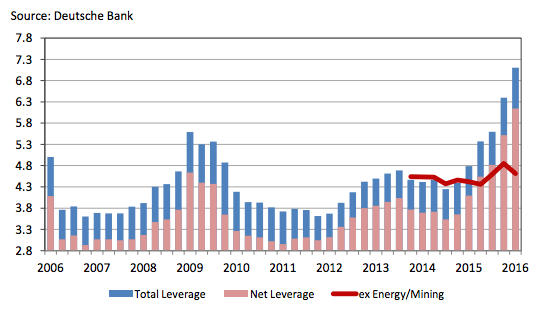
(Chart: Deutsche Bank)
Further, dollar strength seems inevitable at this point. Even if Janet Yellen does nothing, doing nothing is still more hawkish than doing something and you can bet the ECB and the BoJ will ease further before the end of the year. As such, you don’t want to be in names that have a lot of revenue coming in from abroad.
On Wednesday, Wells Fargo is out with a strategy update that in many ways mirrors Goldman’s sentiments. Here are some key excerpts:
“We see scope for quality outperformance to continue amid high policy and political uncertainty, lackluster earnings trends and expensive valuations, and thus continue to recommend quality over both growth and value as a style factor this year.”
“Low debt-to-equity, high return-on-equity, and low EPS volatility comprise our screen for quality ideas in the S&P 500. Intriguingly, low EPS volatility has outperformed considerably over the last 12 months, while high return on equity and low debt-to-equity company stock performance has been less compelling. Sector level performance transitions appear to be at play here, as energy makes up nearly a quarter of low ROE companies, diminishing top-bottom return spreads with the recovery in energy commodities.”
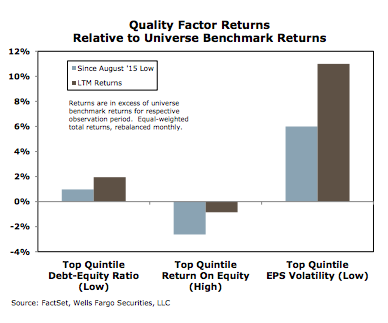
(Chart: Wells Fargo)
As suggested above, you’d think this would be common sense. But investors and traders have a flair for the dramatic and as a rule, everyone generally wants to be a hero. That’s why you get the MOMO chasing, the greater fool market theory (“It’s expensive, but I’ll buy it because someone else will buy it from me at a higher price”), and the bid for things like mixed shelfs from cash flow negative energy companies.
Between the Brexit vote, the political turmoil sweeping the common currency bloc, the wars raging across the Mid-East, and the most unpredictable election in US history, Wells and Goldman are probably right. This is not the time to be a hero.