

It’s often difficult to talk about the interplay between politics and markets without ruffling a few feathers. But you have to be able to separate your politics from your trades.
You may think you’re unequivocally right in your political convictions but guess what? If the majority of market participants don’t agree with you, and if the headline scanning algos are set to sell the news you’re buying, you may indeed be correct in your political theorizing, but you’ll be decidedly incorrect in the P&L department.
Allow us to give you a good example that came across the terminal on Saturday morning. Consider this headline:
“Trump Victory May Be Best for Europe, Hungary’s Orban Says”
Now first of all, note that we’re not saying this particular one-liner is going to have any impact whatsoever on markets. The point, rather, is that while you might agree with Hungary’s Prime Minister with respect to immigration and you may agree that what the world needs in terms of leadership are more leaders like Trump and Viktor Orban, but we can assure you that broadly speaking the market does not. And while the market may be wrong in terms of the signal it sends about the relative societal utility of this or that political outcome, what it can’t be wrong on (by definition) is the number you see on the screen.
Think about it the other way around. That is, rather than positing a market going down because of political outcomes you may view as positive developments, think about a market going up against a backdrop you think is decisively negative. Do ever higher levels on the S&P accurately reflect the state of the global economy and the risks inherent in the current geopolitical backdrop? No, almost certainly not. Is S&P 2175 thus the “wrong” number? Well not really. It is the number. You can think it’s “wrong” all you want, but at the end of the day, your trading account is going to reflect that number regardless of what you think about it.
So as we head into the US election, don’t get caught flat-footed by commingling your politics with your investments. Let’s say you love Donald Trump. Good for you. You’re not alone by any means. Go out and vote for him. But when it comes to how you trade over the next three months, stay cognizant of how the market is likely to interpret things. Let’s look at history. Here are average annual post-election returns on the S&P broken down by which party wins the White House:
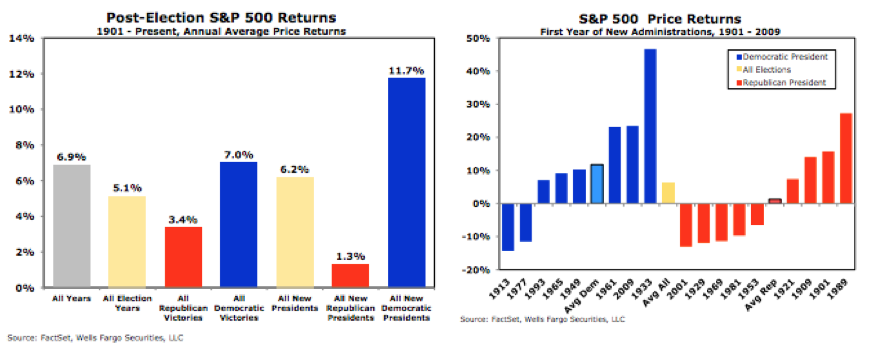
(Charts: Wells Fargo)
Clearly, history favors Democratic wins when it comes to stock prices. Again, that isn’t a political statement - it’s just math.
Recall that on Friday we discussed the fact that global trade is slumping. We also suggested that any further shift among the electorate towards nationalism, isolationism, and protectionism will likely exacerbate what is already a worrisome trend. In the context of that discussion, consider the following, also out on Friday, from Citi:
“The US presidential election came up frequently in recent travels, In Asia just about every conversation touched on the US election, as did many in Europe. The key takeaways are that most investors do not see much election risk priced in, except maybe in MXN, but that there is a fear that a tightening of the Presidential race would raise fears of a trade war and put downward pressure on both US and foreign asset markets. There was a broad, but not universal, fear that this would prove USD negative. A couple of clients suggested that a tight race in September and October would bring these risks to the front burner, especially since many investors were skeptical of the asset market rally to begin with. The uncertainty with respect to the other aspects of Trump’s economic platform also raised concern, as well as fear that political pressure on the Fed would ramp up, given that a Trump presidential win could easily mean that Republicans would continue to have a majority in both houses of Congress. The pushback from some was that it might be more appealing for Republicans to focus on traditional Republican issues such as taxes in the early days of a new Administration, rather than on something as controversial as abrogating trade pacts.”
See what we mean when we say people are concerned with the prospect of trade wars and de-globalization? It came up in virtually every single client conversation Citi’s Global Head of G10 FX strategy had in his recent travels abroad.
As Citi alludes to, this would be a big concern in any market environment but with this “most hated rally” becoming more loathsome to more people with each passing close above the previous day’s record highs, it’s all the more disconcerting.
On that note, we’ll close with a chart from Deutsche Bank which shows that at least on one measure, we’ve just crossed the Rubicon into “mania”:
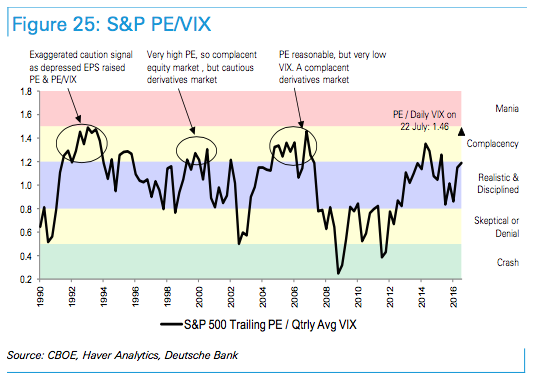
(Chart: Deutsche Bank)