
It’s arguable that Federal Reserve policy and fiscal policy has been disjointed for a while. In the past few years we have had the Fed take the place of fiscal policy. Even mainstream economists recognize that Congress should enact more pro-growth measures to pick up the slack from what the Fed is doing. Most economists believe QE has done all it can do to help the economy. The entire recovery has relied on Fed policy, so it would be correct to call policy disjointed. Looking at President Obama’s record of being the first president without a year of 3% GDP growth, the stats back up this thesis.
While President Trump will have the GOP holding both houses of Congress, he can still manage to create a more disjointed scenario than Obama because his policies cannot work. I’m not saying Trump will have another 8 year presidency without 3% GDP growth one year, because I have no idea what the economy will look like in in 2024 (I only know the demographics will be weak).
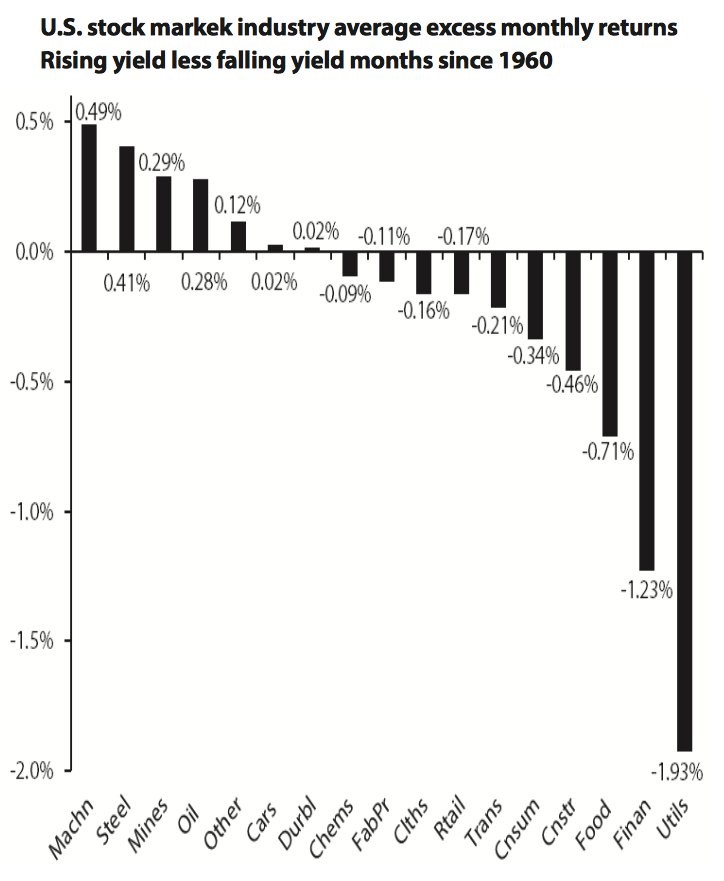
Donald Trump’s policy proposals contradict themselves much like the market itself has. Financial stocks have been increasing in the past few days after Trump’s election because interest rates are rising even though, as you can see below, the financials are the second worst industry to own historically in rising rate scenarios.
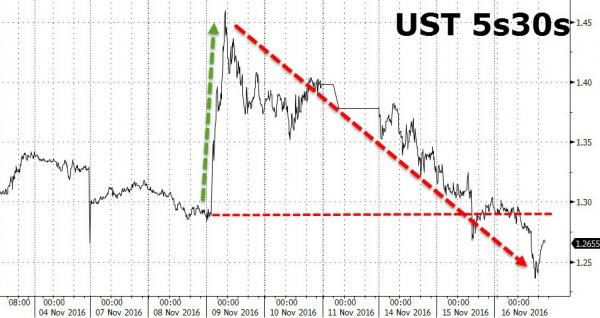
Adding to that negativity, the yield curve has flattened as the 5 year/30 year spread has decreased 3 basis points since the election, as you can see below. Financial stocks realized that today by selling off, but they are still up big since the election.
Getting back to Trump’s disjointed policy proposals, Trump has criticized the Fed’s ZIRP policy and caused a rising rate environment, even while he plans to borrow more money to finance infrastructure spending and tax cuts. A couple days after the election I realized this changing environment. We’ve experienced near zero percent interest rates for the past 8 years under the Obama administration which was able to help lower interest payments on our national debt as a percentage of the budget. Now Trump has awakened the bond vigilantes with his spending increases. The chances of a rate hike in December are 90.6% because of this new found inflation.
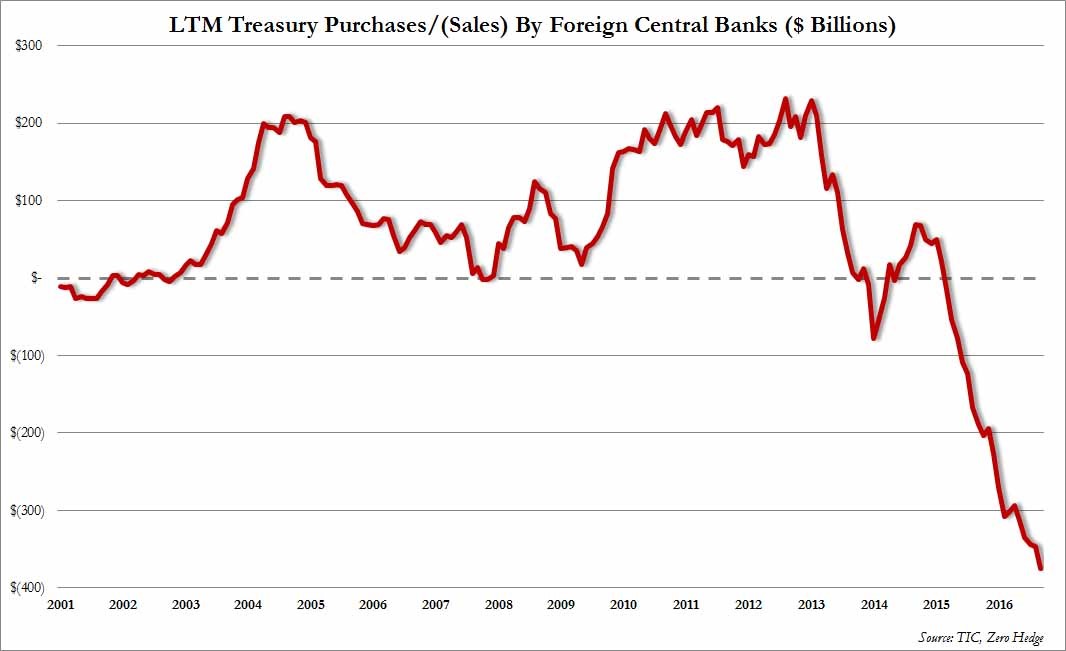
What Trump should do is have a policy of sound money with lower spending. This would lower inflation which would lower the interest the government pays on the debt. It would also lower the total debt the government owes. Trump is doing the exact opposite which could blow the lid off the treasury market. We are already seeing foreign governments sell their treasuries as you can see in the chart below. There has been a new all-time high of $374.7 billion in selling of U.S. treasuries by foreign governments.
Fed policy of zero percent interest rates coupled with quantitative easing made sense because they were both stimulative measures. The new policy of the Fed will be quantitative easing while raising interest rates. With interest rates rising, the value of the bonds the Fed owns will fall. A few months ago I did an interview with Michael Lebowitz where I brought up this point. He stated that the Fed wouldn’t care about losses since it can simply print more money. When we talked about that potential policy, it wasn’t as real as it is today. Trump’s inflationary pressures are bringing about an acceleration of the demise of Fed policy as it will be even more questionable than before.
There are two scenarios for the direction of the economy and both are bad. The first is the economy has higher growth and inflation with increased spending from President Trump. In this case the Fed going through with QE 4 will look strange because it was supposed to be an emergency measure. This will show, in plain sight, that the Fed needs to backstop the U.S. debt or it will default. Money printing causing inflation is an indirect way of defaulting on the debt because it lowers the debt’s value.
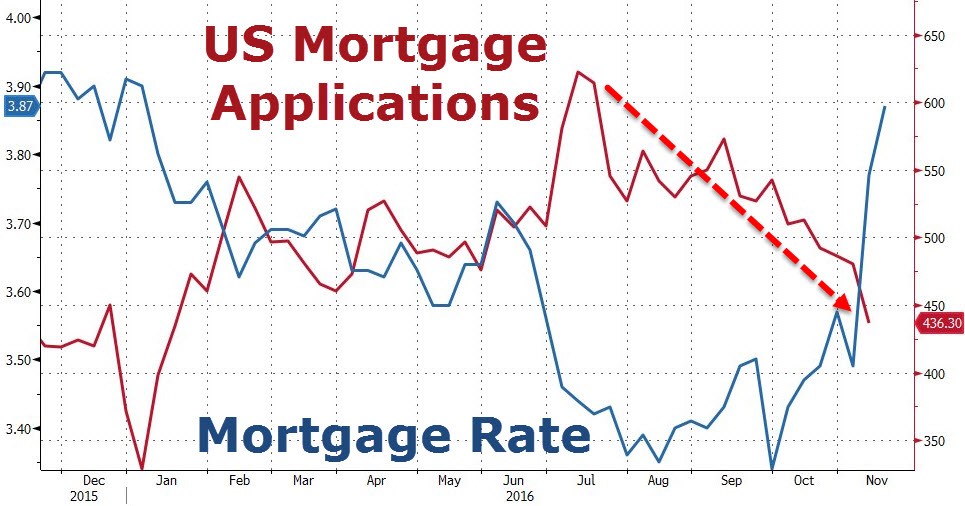
The second scenario is stagflation. This would happen if Trump’s spending increases do more to increase inflation and less to increase growth. This possibility could be caused by Trump’s stimulus not working like how Obama’s stimulus didn’t work or it can be caused by the unwinding of the equity and real estate market bubble. So far, rising interest rates have not hurt stock prices, but they have hurt mortgage applications. Mortgage applications have fallen by 30% to a 10 month low. They have fallen 9% in the past week. This deflating of asset bubbles would hurt growth, while money printing would create inflation in commodities as the dollar loses value, thus stagflation emerges.
Conclusion
There are many mistakes the market is making since Trump has been elected President. While the repeal of regulations is great for the banks, the flattening yield curve isn’t. Trump needs a clear policy of advocating for capitalism to get out the mess we are in. However, his message is disjointed because of his positive viewpoint towards spending to create economic growth. The Fed will play a part in this through gingerly raising rates and starting QE 4. The two possible outcomes I see are economic growth with the Fed showing its cards as a clear debt monetization machine and stagflation with the collapse of asset bubbles putting a lid on growth while the Fed destroys the dollar through QE 4. When I say the Fed is ‘showing its cards’ I am saying that we will see an accelerated selling of treasuries by foreign governments as they realize the Fed is defaulting on the debt through money printing.