

We’ve long documented the sad if sometimes comical demise of Deutsche Bank, the German behemoth that’s become synonymous with, how shall we say, “unscrupulous” business practices.
The company replaced its co-CEOs last year including Anshu Jain, a man who a BaFin (that’s the German financial watchdog) once outed in a report as being a cheerleader for one of the most notorious rate riggers of them all, Christian Bittar. He even allegedly made changes to the structure of the trading floor to allow for LIBOR shenanigans. These aren’t our findings mind you, they are BaFin’s (although the agency would later decide to forgive and forget). Here’s an amusing excerpt from their report:
“Mr. Jain created an environment by the physical and functional restructuring of the business GFFX division in the year 2005, involving also a change in the seating order of the trading floor in London which he initiated in which conflicts of interest between traders and submitters arose or were strengthened.”
And then there was the sad story of Eric Ben-Artzi. By all accounts a genius with a PhD from NYU’s Courant, Ben-Artzi found himself embroiled in a scandal involving the alleged mismarking of some $12 billion in exposure to leveraged super senior CDO trades with Canadian special purpose vehicles. If recognized, that loss could have forced Deutsche to take a government bailout in 2009. In the end, Ben-Artzi was vindicated, but he refused his portion of an SEC whistleblower award, telling FT, quote “this goes beyond the typical revolving-door story. In this case, top SEC lawyers had held senior posts at the bank, moving in and out of top positions at the SEC even as the investigations into malfeasance at Deutsche Bank were ongoing.”
Last year, Deutsche paid $2.5 billion to settle the LIBOR rigging suit but the proverbial chickens came home to roost in earnest when the bank, earlier this year, reported its first annual loss since the crisis (nearly $7 billion).
Well the latest body blow came on Friday as the Department of Justice demanded $14 billion from the bank to settle claims it peddled shoddy mortgage backed securities. Deutsche ain’t buyin’ it ...errr.. payin’ it. Here’s what the bank said in a statement:
"Deutsche Bank has no intent to settle these potential civil claims anywhere near the number cited. The negotiations are only just beginning. The bank expects that they will lead to an outcome similar to those of peer banks which have settled at materially lower amounts."
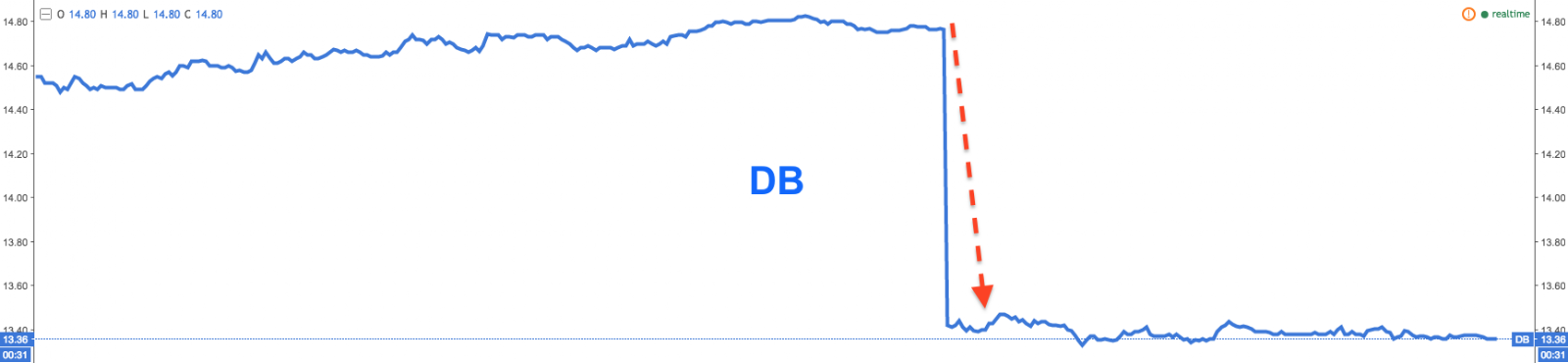
Ok, sure. And with Ben-Artzi’s “revolving door” still vigorously “revolving,” we don’t necessarily doubt it. But analysts aren’t taking this lightly. And neither is the stock:
Here’s a rundown from Bloomberg:
KEPLER CHEUVREUX (buy)
-
Removes Deutsche Bank (buy) from Most Preferred Stocks list, replacing it with Natixis, after the announcement of an opening position by DOJ for a settlement of $14b with regards to RMBS litigation process
-
Notes amount “vastly superior” to market estimates of $2.4b and the brokerage’s estimate of EU2.35b
GOLDMAN SACHS (neutral)
-
Deutsche Bank’s end settlement figure remains unclear, doesn’t take a view on final outcome
-
Shares of European investment banks that have yet to settle RMBS issues with the U.S. DOJ -- Credit Suisse, UBS, Barclays and RBS -- could be affected by the developments from Deutsche Bank overnight
RBC (sector perform)
-
None of European banks has settled with the DOJ on RMBS yet so Deutsche Bank is the first to enter negotiations, with Barclays, UBS, Credit Suisse and RBS also facing this issue
-
Would expect Deutsche Bank’s final settlement to be significantly below the starting negotiation amount as seen at other banks although it remains uncertain where final settlement will end up and what final impact on capital ratios will be
-
Resolving this issue remains key for Deutsche Bank
-
Mentions a number of other moving parts – namely Russian equities investigation and Postbank IPO
KBW (underperform)
-
Runs analysis on litigation risks for Deutsche Bank, Credit Suisse, UBS; concludes that once RMBS case is settled, internal capital generation should be sufficient to cover any further charges, grow capital and sustain dividends
-
New cases continue to appear, which means that risks will remain beyond 2020
-
On base case, by 2018, expects litigation to consume 284bps of capital, with 143bps thereafter
-
Deutsche Bank the most sensitive to litigation settlements, due to weaker capital levels vs peers today
-
UBS most exposed in future, Credit Suisse’s risks reasonably contained
And here’s what Credit Suisse had to say:
“Deutsche Bank (Underperform, €13 target price): The low valuation of under 0.4x current TBV is anchored by a low ROTE. We think the slow filling of the €7bn capital shortfall will lower dividend expectations and keep the shares under pressure, with limited upside potential from further restructuring and risk from litigation settlements.”
“Litigation is where DBK faces perhaps the greatest near-term risk to earnings and capital generation. While considerable uncertainty exists with litigation matters, in total we anticipate the key cases including US RMBS and Russian mirror trades could cost more than EUR8bn to settle against which DBK has EUR5.5bn in existing reserves.”
Have a look at the the bank’s “grey skies, baseline, and blue skies” scenarios:
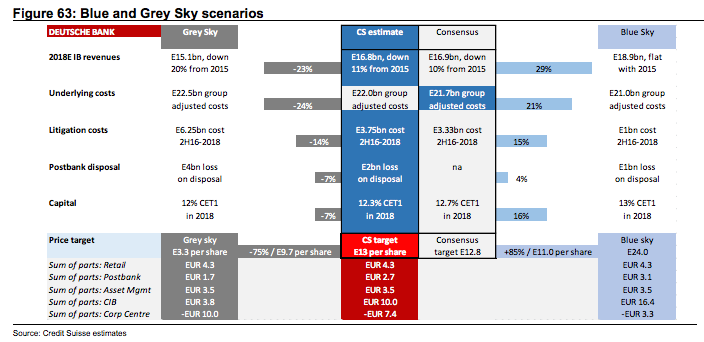
(Chart: Credit Suisse)
This is from The Journal:
“Based on its roughly $18.9 billion market value, Deutsche Bank would be coughing up more than one-fifth of its current market cap if it were to pay a $4 billion Justice Department settlement.”
“Deutsche Bank held $6.2 billion in litigation reserves as of June 30. Analysts had been estimating a Justice Department settlement somewhere between $2 billion and $5 billion, while acknowledging that they don’t have much transparency into the process. Previous deals that banks have struck in parallel mortgage-backed securities probes aren’t necessarily a reliable indicator, lawyers say.”
“RBC Capital Markets banking analyst Fiona Swaffield had estimated a $4 billion settlement for Deutsche Bank. Should it end up being higher, she wrote Friday, Deutsche Bank’s capital targets would appear increasingly unrealistic.”
Allow us to summarize this for you: The. Writing. Is. On. The. Wall.