

There is perhaps no more dangerous word in the financial lexicon than “contained.”
As a general rule, anytime someone tells you something is “contained,” it’s probably not. After all, they wouldn’t be talking about it in the first place if it were.
Nothing can be truly “contained” anymore. It’s not possible in a globalized world where markets are inextricably linked and information moves as quickly as it does. The post-crisis effort to create an organized policy response to what was very nearly financial armageddon only made the situation worse. The butterfly effect is more relevant today than ever.
That’s why you have to be concerned with rising global defaults (there have been 116 to date, up sharply from the same period last year). The standard line seems to be that in the US, it’s confined to energy (it’s thus “contained”). As for China, the line is that it’s confined to SOEs and overcapacity sectors (again, “contained”).
We don’t buy that. Companies don’t just default en masse without creating a ripple effect on lenders and on supply chains. This is self-evident, but an apparent effort to mask the extent of the problem predominates. Take this, from Goldman (and we’ve used this quote before):
“Defaults: Limited spillover from Energy and Metals & Mining. We raised our forecast for the 12-month trailing default rate to the 5.75%-6.25% range by year-end 2016 from the 4.5%-5.0% range. This revision accounts for the lag effect of higher defaults among Energy and Metals and Mining issuers, but our central thesis remains in-tact “what happens in commodities, stays mostly in commodities. We continue to expect little spillover from the Energy and Metals & Mining sector, reflecting the strong “business cycle” component in the behavior of HY defaults. And given that US recession risk remains low, the risk of spillover from Energy and Metals and Mining to the broader market is still limited.”
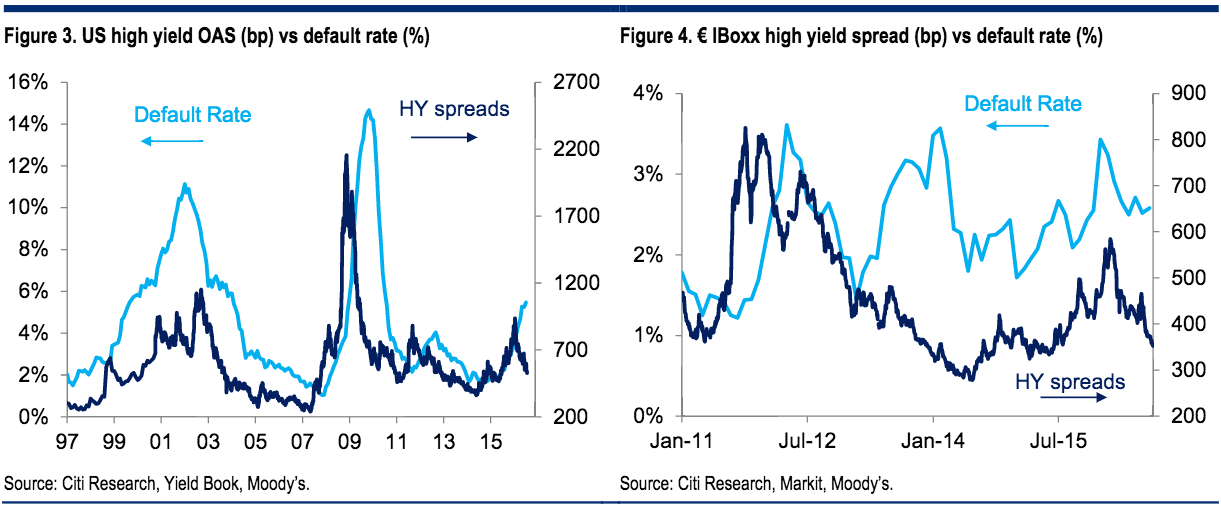
Sorry, but that’s ridiculous. Now have a look at this from Citi:
(Charts: Citi)
How can default rates rise while high yield credit spreads tighten? That’s oxymoronic and it is of course a function of central banks herding investors into riskier and riskier assets to find yield.
On Monday, Goldman is out suggesting that defaults in China will also be “contained.” Here are some excerpts:
“Although the pace of China corporate bond defaults has slowed since the first half of this year, defaults have continued to trickle through. We recently saw the first default in the Dim Sum bond market, the first default in onshore Asset Backed Securities, and a default on a commercial paper by a shipbuilding firm. These recent defaults have not resulted in any meaningful market dislocations, and we believe there are two supporting reasons. First, there have been instances of forbearance. Based on our estimates, there have been 19 notable defaults (we exclude defaults in small sized privately placed bonds) in the China onshore corporate bond market and of those, eight defaults have seen investors receive par recovery. Second, the majority of defaults have occurred in overcapacity sectors such as steel, coal mining, solar and shipbuilding, and correspond with the findings from our Chinese listed company leverage analysis, which noted that stressed debts among listed companies are concentrated in the overcapacity sectors.”
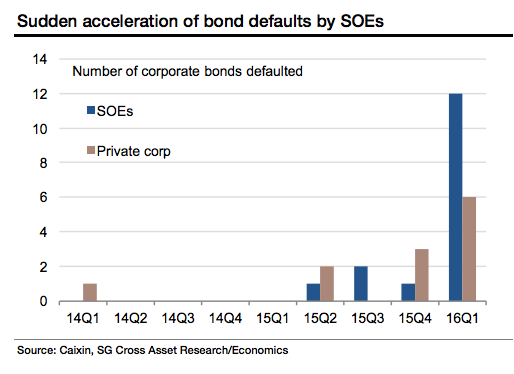
As we’ve said before, default cycles have to start somewhere. But the contagion then invariably spreads. Have a look at how quickly this is accelerating in China:
(Chart: SocGen)
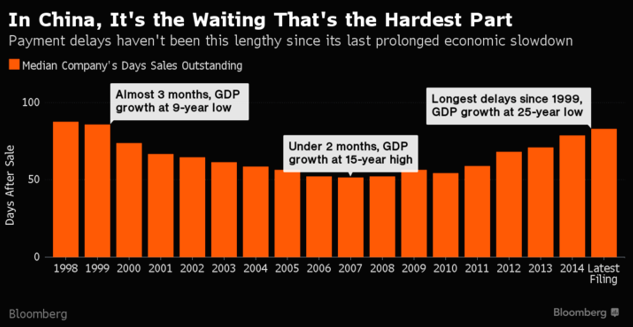
And if you think that doesn’t have a knock-on effect, take a look at this:
(Chart: Bloomberg)
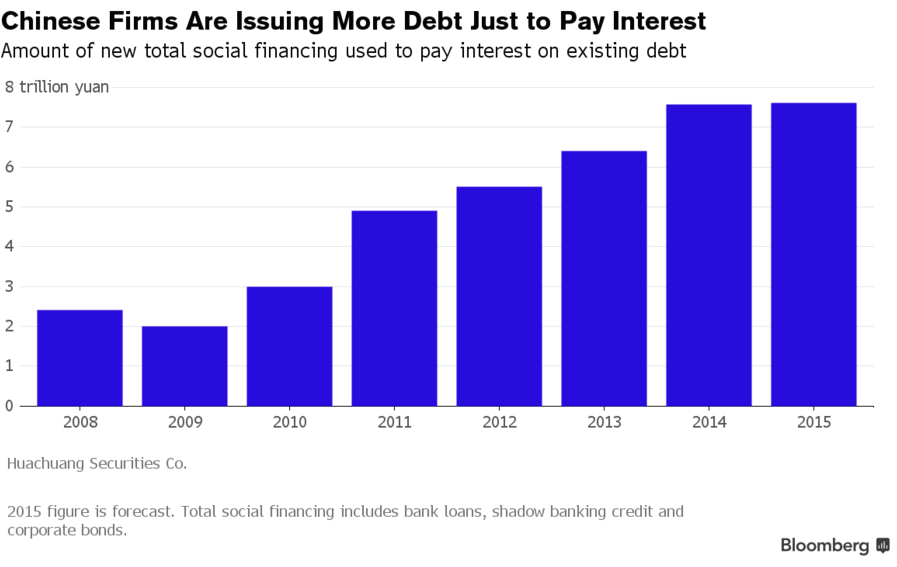
So that’s median days sales outstanding for Chinese corporates and as you can see, it’s the highest it’s ever been in the 21st century. That’s what we mean when we talk about knock-on effects. Just look at the amount of debt companies are taking on just to pay interest on their existing obligations:
(Chart: Bloomberg)
Getting back to the US, the writing is on the wall. The market is practically screaming “default cycle”:
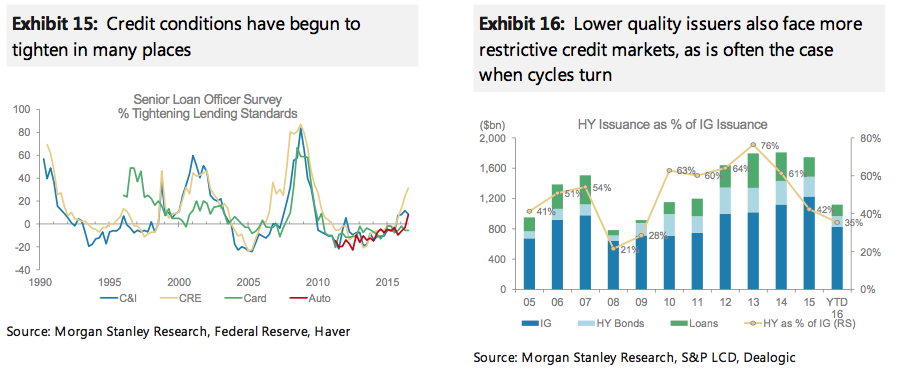
(Charts: Morgan Stanley)
So when we think about the Fed and the timing of a hike, this is one more reason to believe that they’ve waited so long to normalize policy that they’ve actually waited out an entire cycle, which means to hike now would be to hike into a downturn.
What say you, Janet?