Redbook Sales Growth Bumps Up
Redbook spending growth in the week of December 19th rose from 2.5% to 6.5%. That’s actually a good reading. It had been in the low single digits for a while. If it can stay in the mid-single digits, it will be a positive sign. As for now, it’s just 1 week of data which is meaningless. The stimulus had no effect on spending in that week because it wasn’t signed by then. The money still hasn’t gone out. It would only help spending this week if people borrow in anticipation of the money coming.
That’s not how people act though. They are usually conservative with money from the government because they don’t know when the next check is coming. It’s not like a job where people know they will get paid because they did work. One thing to keep in mind, which we don’t know is a factor here, is that people need to buy gifts online in advance of when they can buy them in stores.
Usually, if you want to get a last minute gift, you can literally wait until the last minute. With online shopping, you need to allow for shipping, so the peak in spending should be around now. Sure, some offer 1 day shipping, but that’s not universal. It would be bad if that’s why Redbook sales growth increased since that’s not sustainable.
Consumer Confidence Falls
Consumer confidence plummeted in December similar to consumer sentiment and most of the other data on the consumer like Chase card spending. The Redbook result is one of the few positives, but it’s the most updated, so it’s worth following.
The consumer confidence index’s cutoff date is December 14th. The consumer confidence index fell from 92.9 to 88.6 as you can see from the chart below. It fell near its cycle lows because of the present conditions index. This suggests consumer spending this holiday shopping season was weak.
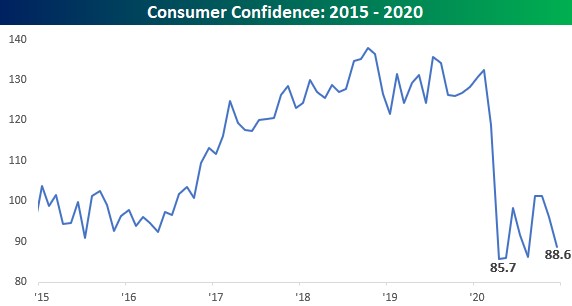
Present conditions were crushed from 105.9 to 90.3. Consumers were staring at the spike in COVID-19 cases and not seeing any sign of a stimulus being signed. That will change in January as the stimulus passed. If we are lucky, the recent peak in COVID-19 cases will be maintained and lead to a decline in hospitalizations. There is a chance if all the vaccines go to the elderly, which they will, there will immediately be a sharp decline in deaths.
Imagine if almost all people over the age of 80 get the vaccine by January. That would shrink the death rate quickly and allow life to start to go back to normal. The good news in this report is the expectations index rose from 84.3 to 87.5. That’s because consumers see the vaccine going out. Since the end of this survey, Moderna’s vaccine was approved.
The net percentage claiming business conditions are good fell from -16.1% to -23.5%. Conditions weren’t good last month, but a few percent of people changed their mind and saw them worsen this month. They are probably correct. The Richmond Fed manufacturing index actually went up from 15 to 19 which beat estimates for 12 and the highest estimate for 14. The manufacturing part of the economy is definitely the most resilient at this point in the cycle.
The net percentage of consumers saying jobs were plentiful fell from 6.9% to 0.2%. That’s a perfect assessment of the labor market based on initial claims as they fell in November and started to rise in December. Some analysts are looking for negative job creation in December, following positive creation in November.
The data on expectations improved modestly. For example, the net percentage expecting business conditions to improve in the next 6 months rose from 4% to 7.1%. Consumers are too negative. Conditions are very likely to be better by June. We all wonder how much the stock market impacted their answer. It doesn’t seem to have played a big role because stocks have done so well. Obviously, the market has recently been led by the secular growth tech stocks, but they don’t know that.
Goldman Current Activity Index Goes Negative
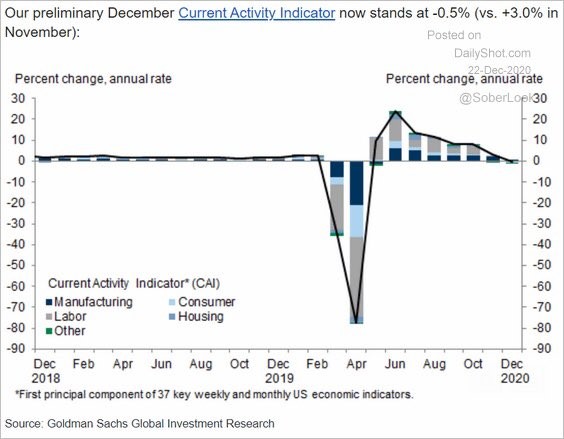
The expansion isn’t over and this is not a double dip recession. We are discussing this because the chart below shows the preliminary December current activity index went from 3% growth in November to -0.5% growth. The annualized growth rate is negative for the first time since April. This makes sense because there was an increase in initial claims and weakness in consumer confidence.
If the consumer is in worse shape than last month, we can only imagine how bad the retail sales report will be. We'are all assuming the stimulus will have a tiny factor on spending this month. If the money goes out on Monday, that gives consumers 3 days to spend it this month.
Don’t worry about this weakness. The vaccines are going out quickly. I expect weak data in January and then a sharp improvement starting in the spring. Interestingly, the last two Georgia Senate polls have the Dems up 5% and 7% which is much different from the last 3 sets of polls. That makes this race more of a tossup. The polls are wildly different. We are 2 weeks from the election. If the Dems win, another stimulus could be passed.
High Frequency Data Showing Issues
There's some credibility in calling for a recovery next year because there may likely be a slowdown from the 2nd half of November through January. If the data stays very weak in March, you can call that wrong. It’s not that much of a prediction because obviously when the virus goes away, activity will recover. That’s why stocks haven’t reacted much to the weakness seen in the chart below.
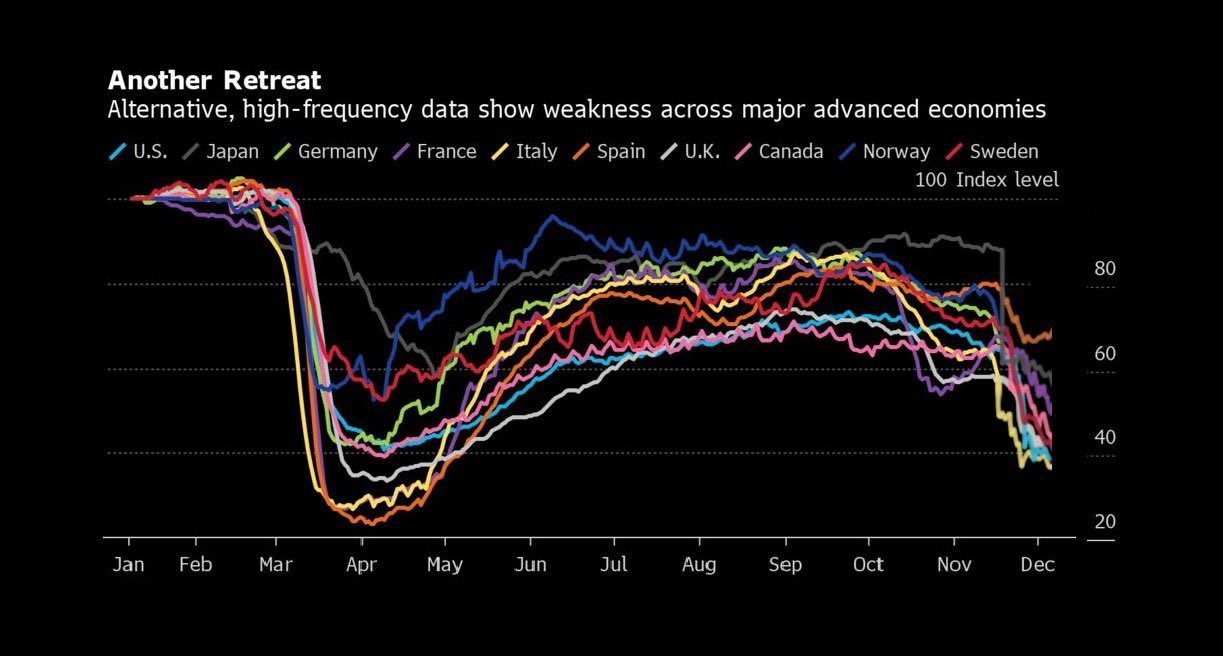
For example, Zoom stock is still down 28% from its recent peak. It would be down more if the high frequency data didn’t show mobility is cratering, but it’s not close to its high. Don’t trade this economic and COVID-19 data like you did in the spring and summer. It’s being viewed as temporary, which most would agree with.