Vaccine Predicted To Stop COVID-19
We are all waiting to see if the economy rolls over or if it continues on its path towards improvement, albeit at a slower pace than earlier in the recovery. Most of the current data shows the economy still on solid footing in November, but things could go awry as the virus seemingly spreads. Furthermore, at the end of the year pandemic unemployment benefits expire. There are currently about 13.5 million people on them.
Over 10 million people will lose their benefits. If nothing is done by the end of the year, we may need to wait until inauguration day which is January 20th. Being without benefits in the heart of the crisis will be a problem. We don’t have much clarity as to whether the vaccines will broadly be given out by the winter.
Good news is Moderna’s vaccine results will come out next week. If there are good results, we will have 2 major companies working on producing vaccines which makes it more likely the virus will be done with next year. CEO of BioNTech, which is working on the vaccine with Pfizer, stated, “If the question is whether we can stop this pandemic with this vaccine, then my answer is: yes, because I believe that even protection only from symptomatic infections will have a dramatic effect.”
Chase Card Spending Growth Starts To Roll Over
The stock market is completely fine with pricing in a better future if we are sure the vaccine gets the economy going again sometime in 2021. It doesn’t really matter if the economy reopens in March or July. What matters is that uncertainty is gone.
For actual consumers, every week matters. Getting from now until the vaccine is widespread will be a huge struggle. Cases are exploding and benefits are dwindling. So far, the labor market is fine, but it can easily stop improving for a couple months.
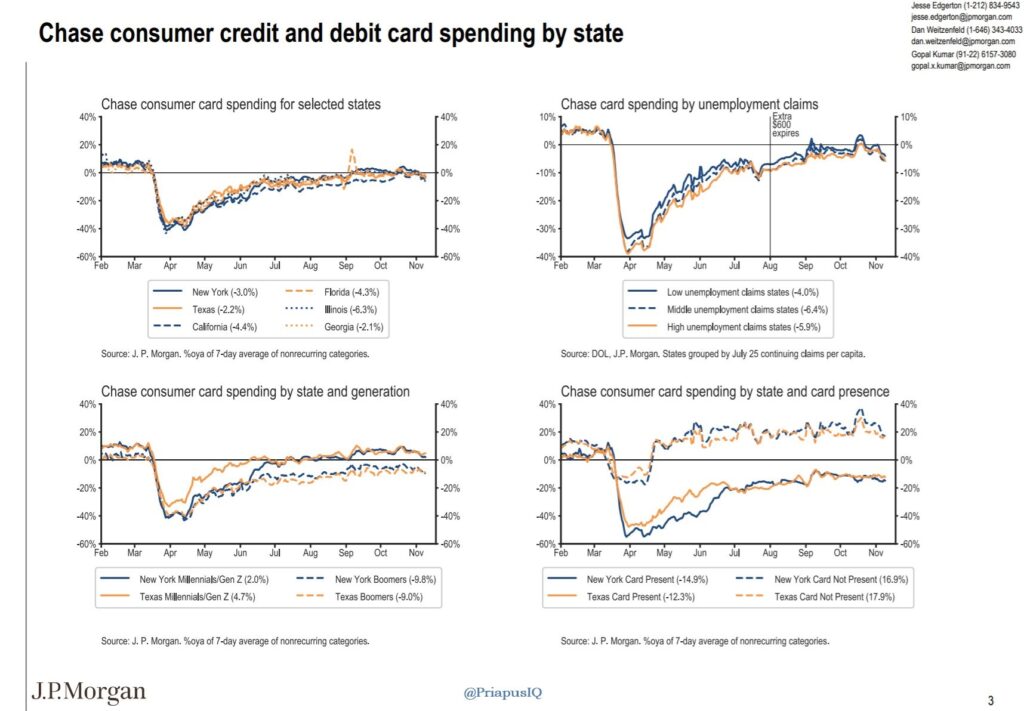
With that being said, we have the charts above which show consumer spending is starting to weaken. We’ve had a couple of weak points in this recovery. But people are willing to extrapolate this as a trend because of the rise of COVID-19. If you have a small move without a catalyst, you ignore the data point until it is confirmed. Chase spending growth nearly got to flat in the 2nd half of October; now it has fallen to -7.4% (week of November 9th).
If this trend continues, it spells bad news for the holiday shopping season. As you can see, spending at restaurants was down 16% while spending at wholesale and discount stores was up 24.2%. Spending at gas stations was down 25.3%, meaning the supply oil glut will be maintained for a little while longer. Spending at airlines was down 77.8%.
Even still Boeing is up 29.6% since October 30th. The stock market thinks the economic data is irrelevant. Therefore, we can’t expect a weak holiday shopping season to bother it. However, it’s still worth keeping close eye on the economic results. Maybe some of the stocks you follow will fall when their weak earnings come out.
Looking at some individual states, the chart on the top right shows Illinois had a 6.3% decline in spending, while Texas and Georgia had declines of 2.2% and 2.1%. It makes sense a Midwestern state is underperforming because that’s where COVID-19 is the worst. Millennials/Gen Z are spending much more than Boomers. Spending among Millennials/Gen Z in Texas is up 4.7% and it’s down 9.8% among Boomers in New York.
States with low unemployment claims had a 4% decline and states with high claims had a 5.9% decline. People are pulling back on spending more out of fear than actually losing their jobs. It makes sense to save money in such a tumultuous time.
Consumer Sentiment Falls
After a few months of waiting for weakness in consumer sentiment, we finally got it in the November preliminary report. Some thought it might appear in August when the extra jobless benefits expired. Instead, we got in November. You would think the weakness came from the spread of COVID-19, but it was mostly because of the election.
University of Michigan index fell from 81.8 to 77 which missed estimates for 82 and the lowest estimate which was 80. As you can see from the chart below, Republicans became much less confident and Democrats became slightly less confident.
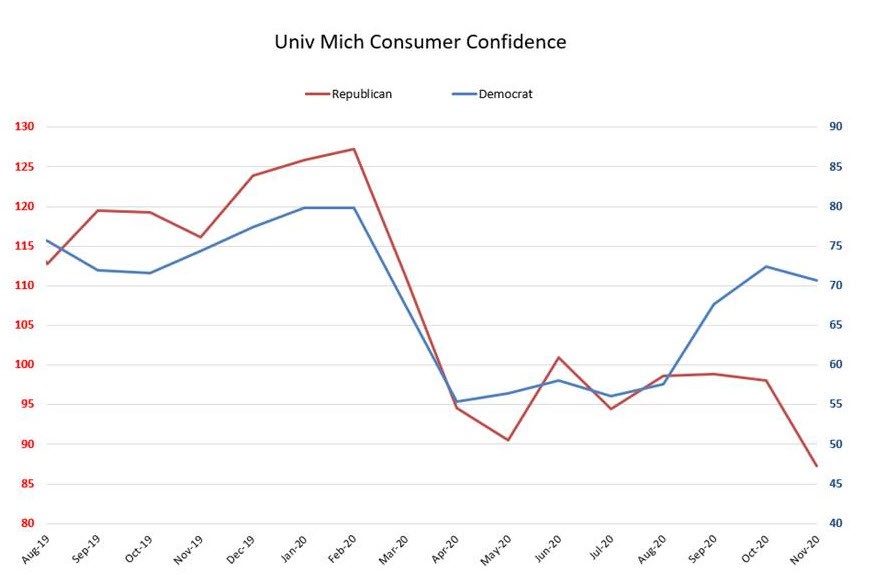
Current index fell 0.1 to 85.8. If COVID-19 was hurting confidence, it would hurt the current index because people would be feeling the effects of the virus. Expectations index fell from 79.2 to 71.3 because Republicans are less optimistic about the future. Democrats didn’t have a gain though because of worries about the virus.
59% of Dems said their normal life changed because of COVID-19 and 34% of Republicans said it did. There would have been less of a decline in confidence if it wasn’t for the virus, but the election definitely played a bigger role in the weakness.
COVID-19 Still A Major Issue
COVID-19 seems to be getting worse everyday as we eagerly await widespread vaccine distribution, more testing, and better therapeutics. We don’t know if everyone will get the vaccine. But if we get it combined with more testing and better therapeutics, the virus will be gone and life will go back to normal.
As of Friday, the 7 day average of tests hit 1.429 million. We are still 1/10th of where we need to be. There were 170,333 new cases on Friday which was by far a record high. We might even hit 250,000 in a day by the end of the month at this rate of increase. There are now 68,616 people in the hospital which is about 8,000 above the peak in the summer.
We are fast approaching the peak in the spring. The 7 day average of deaths is 1,068 which is still a few below the summer high. Unfortunately, it will surpass the summer high very shortly.