Same Store Sales Growth Falls
Every common consumer sentiment indicator shows weakness in July. Therefore, it’s no surprise that Redbook same store sales growth in the week of July 18th was -7.5% which fell from last week’s -5.5%. Some consumers likely are pulling back spending in anticipation of their $600 weekly unemployment checks going away. Congress is currently debating a new stimulus.
One won’t be done by July 25th. It will take until early August to get something passed. Consumers can’t spend money they don’t have. They will probably pull back substantially in the 2nd half of July.
However, if we get a stimulus and a decline in COVID-19 cases in August, it can set the economy up for a great autumn. The stock market is very confused by all this as some days the cyclical stocks outperform and some days they crash. There seems to be no rationale for each move.
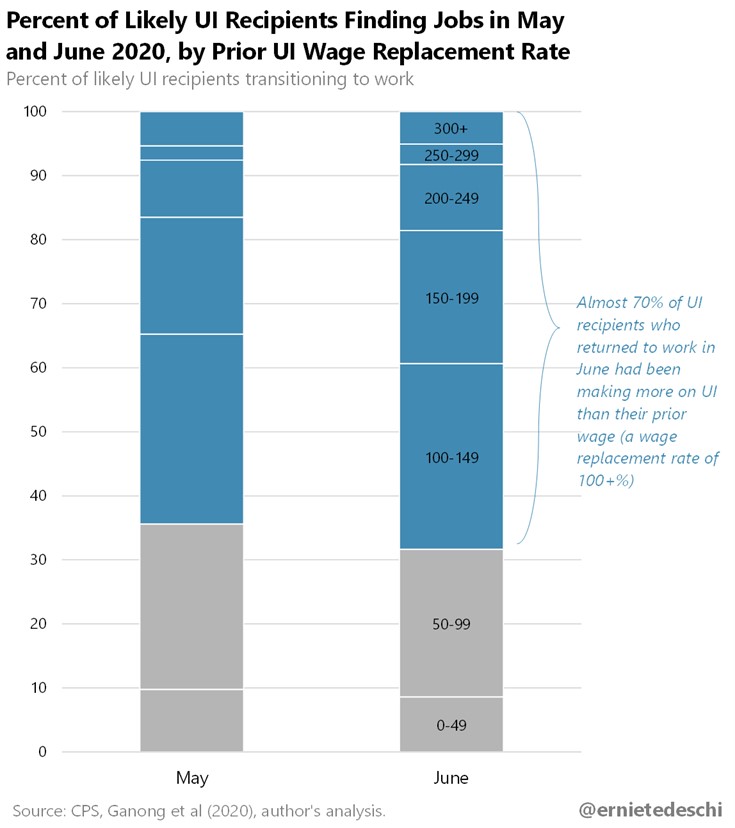
As you can see from the chart above, most consumers made more money on unemployment insurance than they did at their job. 68% made more on unemployment insurance with almost 20% making double or more of their normal income. If you have about 20% of unemployment recipients about to lose out on making double their income, you know they won’t be spending much money. They either need to get their jobs back or they need more stimulus. And they need to get the money in their hands before spending it.
Luckily, some probably have the money saved from the last stimulus and the unemployment benefits. Congress knows the economy won’t immediately fall off a cliff once the checks stop getting sent out, but it also knows every day that goes by without new legislation passed, the situation gets more precarious. Congress loves to use all the time it has and only makes deals when it’s forced to.
COVID-19: More Green Shoots
COVID-19 situation is stabilizing in terms of national cases and is getting worse in terms of deaths. Arizona has peaked which signals the other hotspot states will see a peak within the next couple weeks. However, it’s possible deaths per day will get above 1,000.
Either the 7 day average of new national cases per day has peaked or we are really close to a peak. A main question is how fast the decline will be. Remember, from mid-April to mid-June, cases only fell gradually. However, in that period there were more tests. This situation definitely improved in that period as you can see from the chart below (the positive rate fell).
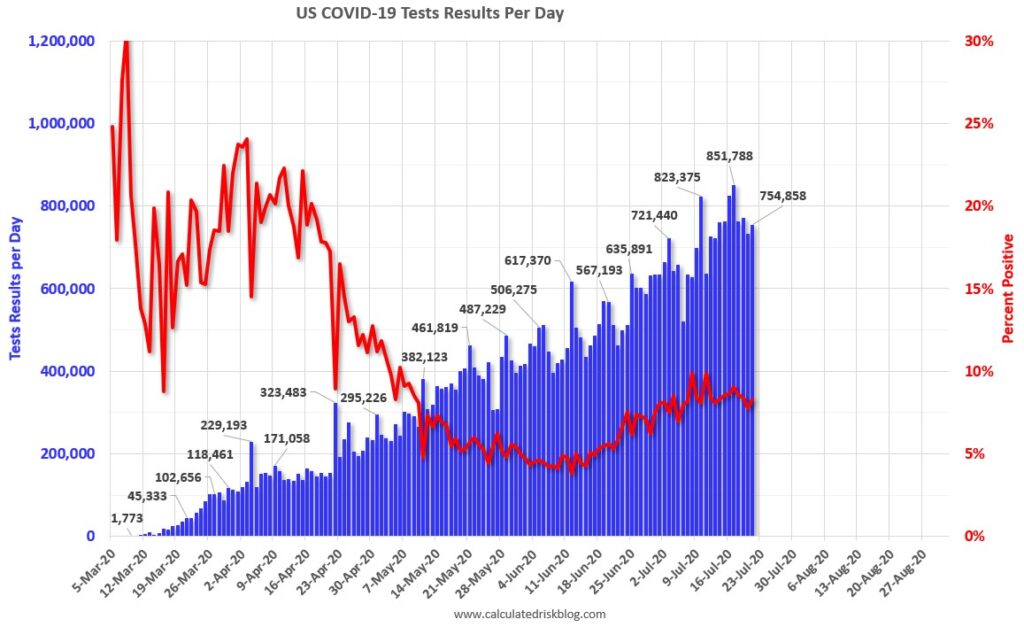
Cases will fall more now than in the spring because they have more room to fall and there isn’t a new area that’s going to see a spike. Each region has now dealt with COVID-19 fully. The next potential catalyst for new cases is schools opening, but even if they open the situation won’t get as bad as it is now. More people are wearing masks.
In the next few weeks, the number of tests per day will increase which means the positive rate will need to fall solidly to lower the number of cases. There was no need to focus on the positive rate in this recent spike because it increased along with tests. In other words, cases were up because the virus spread and because there were more tests. However, if the positive rate falls in the next couple weeks while the number of cases stays the same.
Tuesday’s COVID-19 Details
A major headline on COVID-19 that is scaring people is there were over 1,000 deaths on Tuesday. That’s a scary number for sure. Specifically, there were 1,122 new deaths which is the highest number since June 2nd. Obviously, if we have a couple more days like this, we will get the 7 day average above 1,000.
Worst case scenario would be for over 1,000 deaths consistently and record new cases per day. That would send value stocks lower. There were 67.140 new cases on Tuesday which was the highest since July 17th. Furthermore, this was up from last Tuesday which had 66,048.
Arizona had 134 new deaths which is horrible. It had 3,500 new cases which is down a lot from last Tuesday which had 4,273. That sent the 7 day average down further. Numbers are volatile when you look at each state individually. But the trend is lower.
Arizona has an insignificant impact on the national total. Texas and Florida have shown some small signs of peaking, while California hasn’t. California made many precautions in April and reinstated them quickly in June (meaning it still issues even with the proper precautions taken). California has the biggest economy in the country, so it can’t be left behind.
COVID-19 Home Buying
Everyone has been wondering what COVID-19 means for the housing market. Obviously, it has been strong recently because of pent up demand and low rates, but this is referring to where people move. Will they move to the suburbs because it’s safer from viruses?
Millennials had been moving to cities for a few years. This would be a reversal. To be fair, regardless of COVID-19 as millennials age and have families, they will want to move to the suburbs.
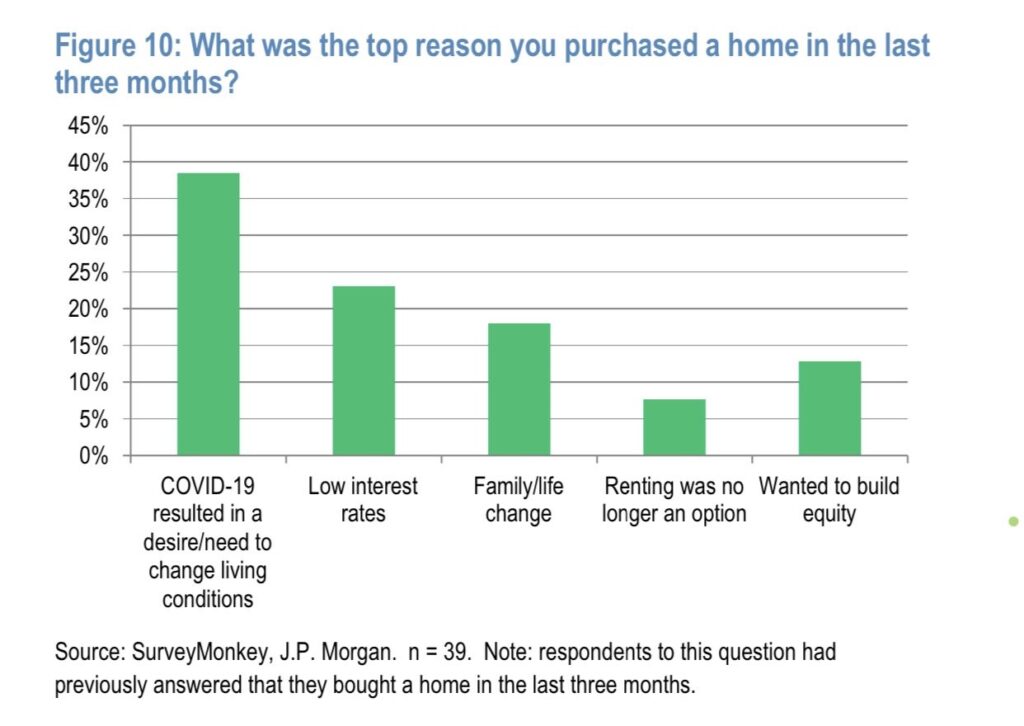
As you can see from the chart above, almost 40% of people who bought a house in the past 3 months said COVID-19 was the top reason they did so. COVID-19 resulted in the desire or need to change living conditions. Almost a quarter said low rates caused them to buy.
This virus is on everyone’s mind. It’s no surprise it is motivating activity. It’s easier to live in the suburbs if you don’t need to commute to the city for work. Personally, I believe the housing market in cities will settle down. Change won’t be drastic. Severity of the long term impact will depend on how long COVID-19 lasts. People might move back to cities if a vaccine comes out next year and cases fall to near zero.