Kansas City Fed Index Falls Slightly
We’ve seen a whirlwind of different manufacturing reports. Some reports were even shocking. The July Markit flash reading shows manufacturing output is falling at a 1% quarterly rate, while the June durable goods orders report showed core orders were up 2% yearly. The Philly Fed index rebounded sharply and the Richmond Fed index was terrible. Even within the Richmond Fed index, there was disagreement as the current index was terrible and the expectations subcategories were solid.
The Kansas City Fed manufacturing index didn’t clear things up, but that’s a tall order. The picture will only be clear when the July industrial production report comes out. The Kansas City Fed index was down the middle as it was weak, but not terrible. The composite index fell just 1 point to -1. Estimates were for 2. One of the special questions was what level of confidence firms have in their local economy. The most common answer was “moderate confidence” as it received almost 50% of the votes. This gives you context for this report. It was ok, not terrible or great.
The details of the current monthly index were mostly weak as the production index fell 3 points to -6, the shipments index was up 7 points to 0, and the new orders index was down 7 points to -2. Just like the Richmond Fed report, the backlog index was weak as it fell 6 points to -13. On yearly basis, results weren’t as bad as the composite index was up 7 points to 11. Unlike the Richmond Fed index, the expectations index was in line with the monthly reading as it fell 2 points to 9. The production index and the new orders indexes were up 1 point to 23 and 17. The capex index was up 3 points to 14.
This report is the first of the regional Fed indexes to show quotes. Obviously, this report is the last I’d choose to see quotes from because its composite was so close to the consensus. However, it’s still interesting to see what firms have to say as we await the ISM manufacturing report which comes out on August 1st which is this Thursday. The quotes are interesting because only 1 of 10 mentioned tariffs. The one that mentioned tariffs stated, “Tariffs continue to have negative impacts on our bottom line. Business is trending down in the industries we serve. We are aggressively quoting new business.” Maybe tariffs are a big issue, but they aren’t new so no other company mentioned them.
Setting Up The GDP Report
Before I detail the Q2 GDP report, let’s look at expectations. The St. Louis Nowcast was at 2.9%. That wasn’t as far from reality as I thought it would be. The Atlanta Fed and NY Fed were too bearish as they saw growth of 1.3% and 1.5%. If you’re curious, the Q3 NY Fed Nowcast took a huge leap mostly because of the durable goods orders report as it went from 1.88% to 2.21%. I stated consumer spending growth would be great and drive GDP growth, but that inventory investment and net exports would drive growth below Q1’s rate. I said growth could even be below 1.5%. I expected growth to be from the mid 1% range to the low 2% range.
Nice Upside Surprise In Q2 GDP Growth
The advanced reading for the Q2 GDP report was solid as it showed quarterly growth of 2.1% which beat estimates for 1.9% and was near the high end of the estimate range which was 2.2%. It was slightly higher than I expected and higher than 2 of 3 GDP Nowcasts. GDP growth was driven by real consumer spending growth was it was 4.3% which beat estimates for 3.9%. That also beat the high end of the estimate range which was 4.1%. The consumer came through which makes sense because real wage growth has been great. Q1’s consumption growth rate was revised higher from 0.9% to 1.1%. That’s still very weak.
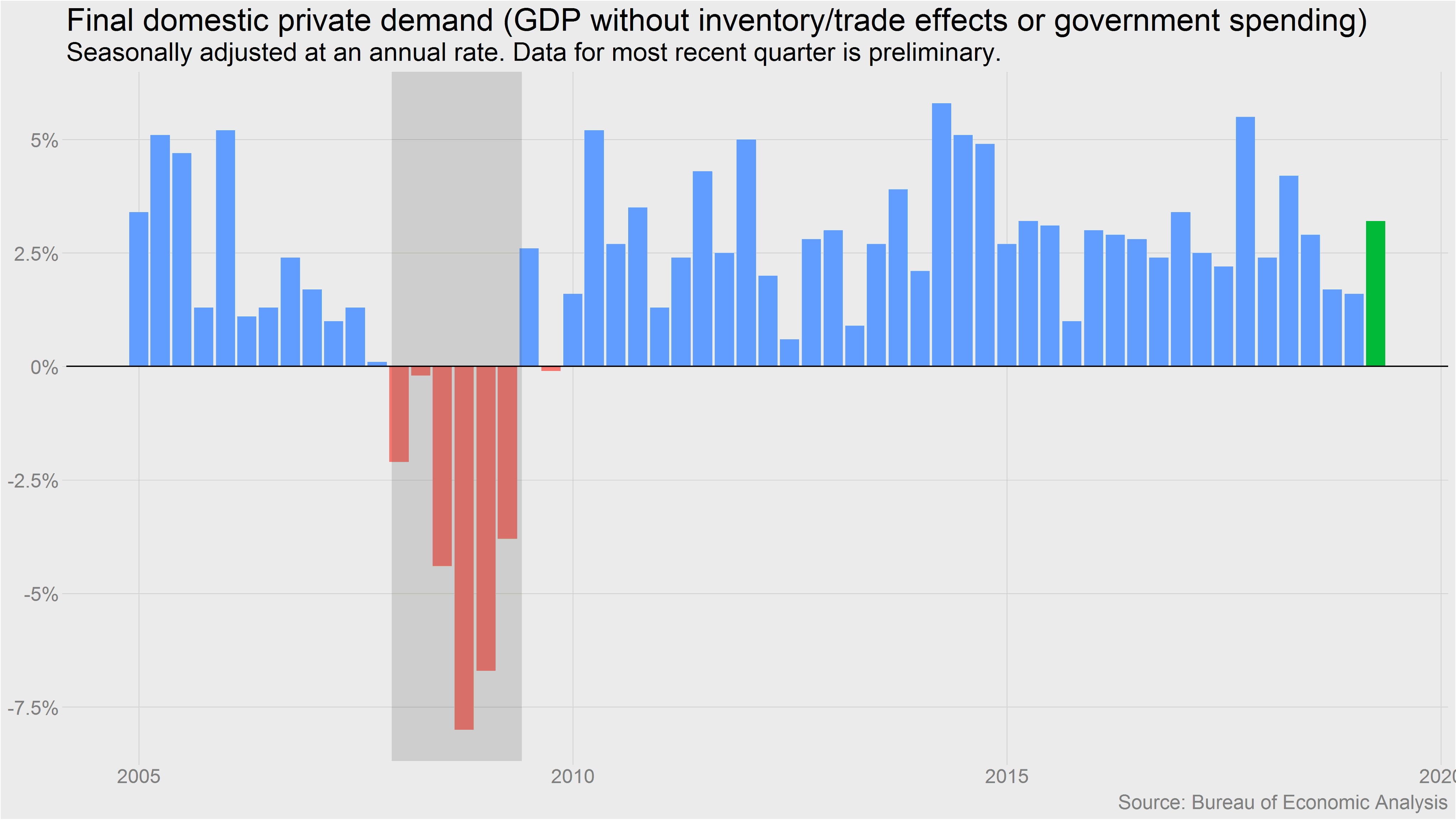
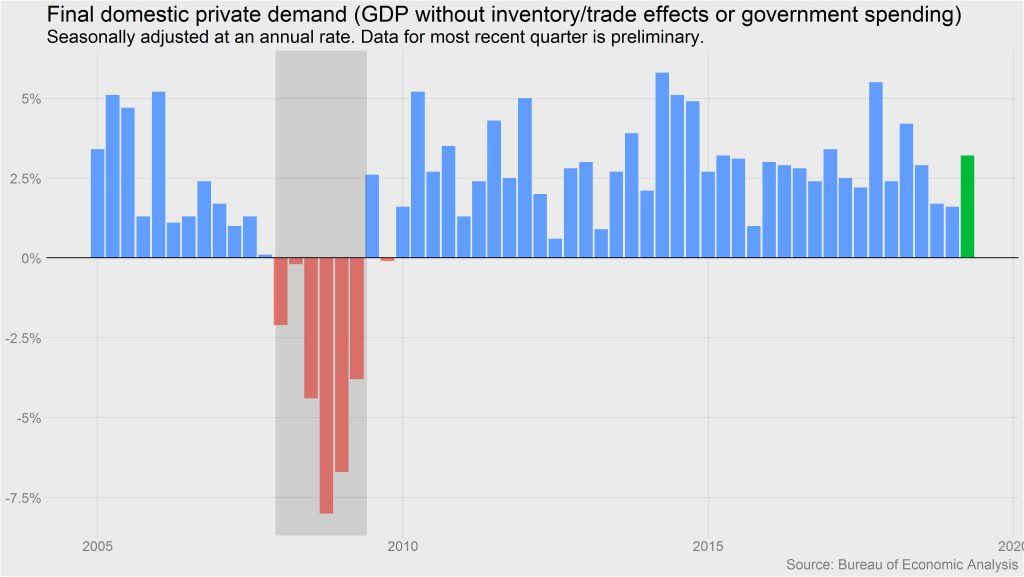
As you can see from the chart below, there was a major rebound in real final sales to domestic purchasers which excludes net exports, inventory investments, and government spending. Quarter over quarter growth improved from 1.6% to 3.2%. That’s the best reading since Q2 2018. It’s within the recent range and doesn’t indicate the economy is even in a slowdown. Essentially, there were 2 weak readings in this slowdown (Q4 2018 & Q1 2019) and one weak reading in the 2015-2016 slowdown (Q4 2015).
Both the GDP price index and the core price index were up 2.4% quarter over quarter. The headline index’s growth rate improved from 1.1% and beat estimates for 2%. The core index’s growth rate improved from 1.4% and beat estimates for 1.9%. Of the 2.1% GDP growth rate, consumer spending growth contributed 2.85% and government spending, which grew 5%, contributed 0.85%. Inventory investment hurt growth by 0.86%. As I mentioned before this report came out, this means headline growth might be strong in the 2nd half. If domestic demand stays strong, inventory investment will need to catch up.
Non-residential fixed investment growth was -0.6% which brought growth down by 8 basis points. I was wrong to suggest real residential fixed investment growth would be positive as its growth was -1.5% which was its 6th straight negative reading. It brought down growth by 6 basis points. Net exports hurt GDP growth by 0.65% as I forecasted would happen.
Conclusion
Most of the categories that don’t matter were weak and most of the categories that matter were strong. The exceptions were strong government spending growth and the declines in non-residential and residential investment. Just as I expected, consumer spending growth was strong, net exports were weak, and inventory investments were weak. Make sure to review real final sales growth instead of headline GDP growth because you want to measure the strength of private sector demand. Finally, we are seeing consumption growth match up with the strong real wage growth. Q1 was a blip possibly made worse by the government shutdown.