Getting Coal For Christmas
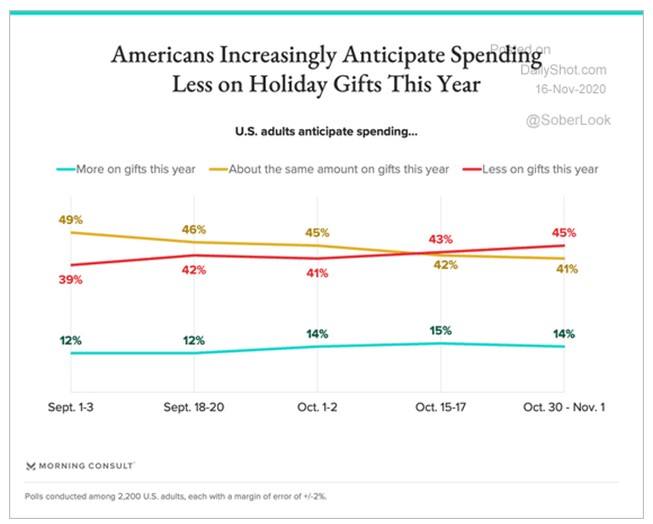
While people won’t actually be getting coal for Christmas, almost half will be getting less expensive gifts than last year. As you can see from the chart below, as of the start of November, 45% of Americans said they would be spending less on presents. 41% said they would be spending the same on gifts and just 14% said they would be spending more.
There was a 6% increase in people saying they would spend less as compared to the start of September. This suggests retail sales growth might not be positive. Rich are doing quite well as evidenced by the percentage saying they will spend more on presents staying the same.
As cases explode, the likelihood of a decline in spending goes up. It seems like COVID-19 is will test the peak in the spring. Vaccine pilots are starting in a few states, but that won’t be enough to help consumer spending in the next few weeks. Redbook same store sales growth in the week of November 14th rose slightly from 1.1% to 1.7%. That’s quite weak.
Labor market recovery is slowing, but it’s not reversing. We don’t know the delta between where the economy is now and where it will be in a few weeks. There isn’t much time for the economy to weaken before the vaccine arrives, but the pandemic doesn’t need much time to spread and potentially cause more shutdowns.
Across The Board Retail Sales Miss
October retail sales report wasn’t a disaster, but it was an across the board miss which is never good. Furthermore, it was an across the board negative revision. Headline monthly sales growth was 0.3% which missed estimates for 0.4%. Last month’s reading was revised down from 1.9% to 1.6%. Comp was easier, yet growth still missed.
Excluding vehicles, monthly sales growth was 0.2% which missed estimates for 0.5% growth. September’s growth was revised down from 1.5% to 1.2%. Control group sales growth was 0.2% which missed estimates for 0.4%. Last month’s growth went from 1.5% to 1%. We thought control group growth was amazing last month, but it was only ok.
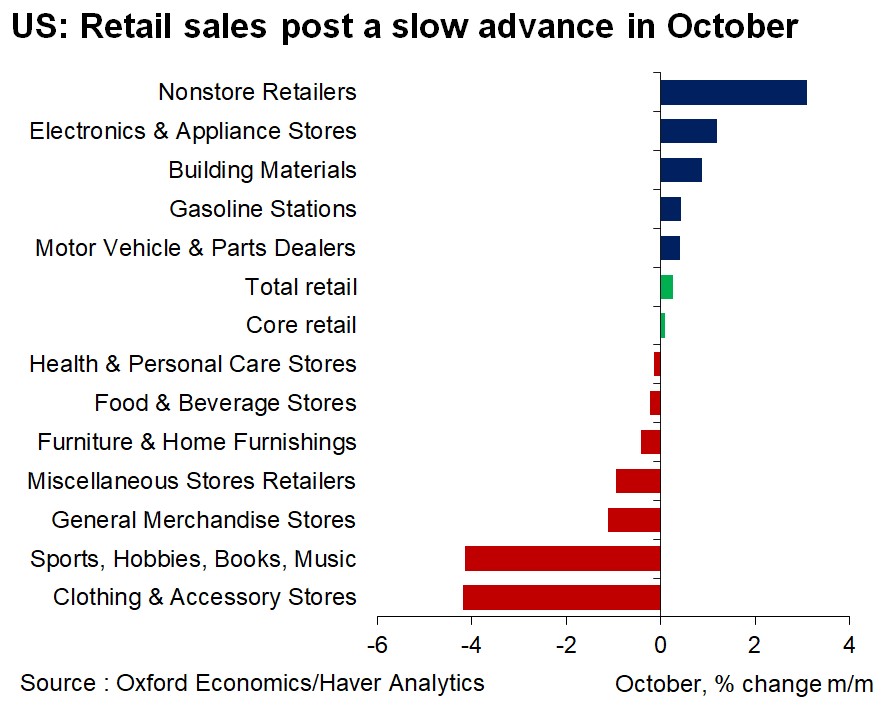
As you can see from the chart above, non-store spending growth was the strongest as it was 3.1%. The economy has not gone back to normal as the virus is exploding. It was growing rapidly in the Midwest in October. On the opposite side, clothing and accessories growth was -4.2% as people aren’t gathering so they don’t need new clothes.
Following the end of summer, spending on sports, hobbies, books and music fell over 4% as many outdoor activities ceased due to the colder weather.
Total retail sales are up 4.9% from before the pandemic. Online sales are up 27.9% and restaurant/bar sales are down 14.9%. That will likely get worse in November and December. Indoor dining restrictions increase and outdoor dining isn’t feasible due to cold weather.
Yearly retail sales growth excluding food services fell from 8.8% to 8.5%. Total retail sales growth fell from 5.9% to 5.7%. Adding in food services drives results lower. Yearly control group sales growth fell slightly to 10.8% which is the 2nd best reading ever.
Yearly food services and drinking sales growth was -14.2% as it improved just 4 basis points. Monthly growth was -0.13%. If the results were weaker in October, imagine how bad they will be in November as there are more restrictions along with lower temperatures.
Sporting goods sales growth was -4.15%. The all important, motor vehicles and parts category showed 40 basis points of monthly growth and 10.7% yearly growth which was down 21 basis points sequentially.
Government Money Doesn’t Solve All
Just giving small businesses loans doesn’t assure they will survive which is why we need vaccines to reopen the economy as soon as possible. As you can see from the chart below, about 280 firms have received PPP loans and have gone bankrupt.
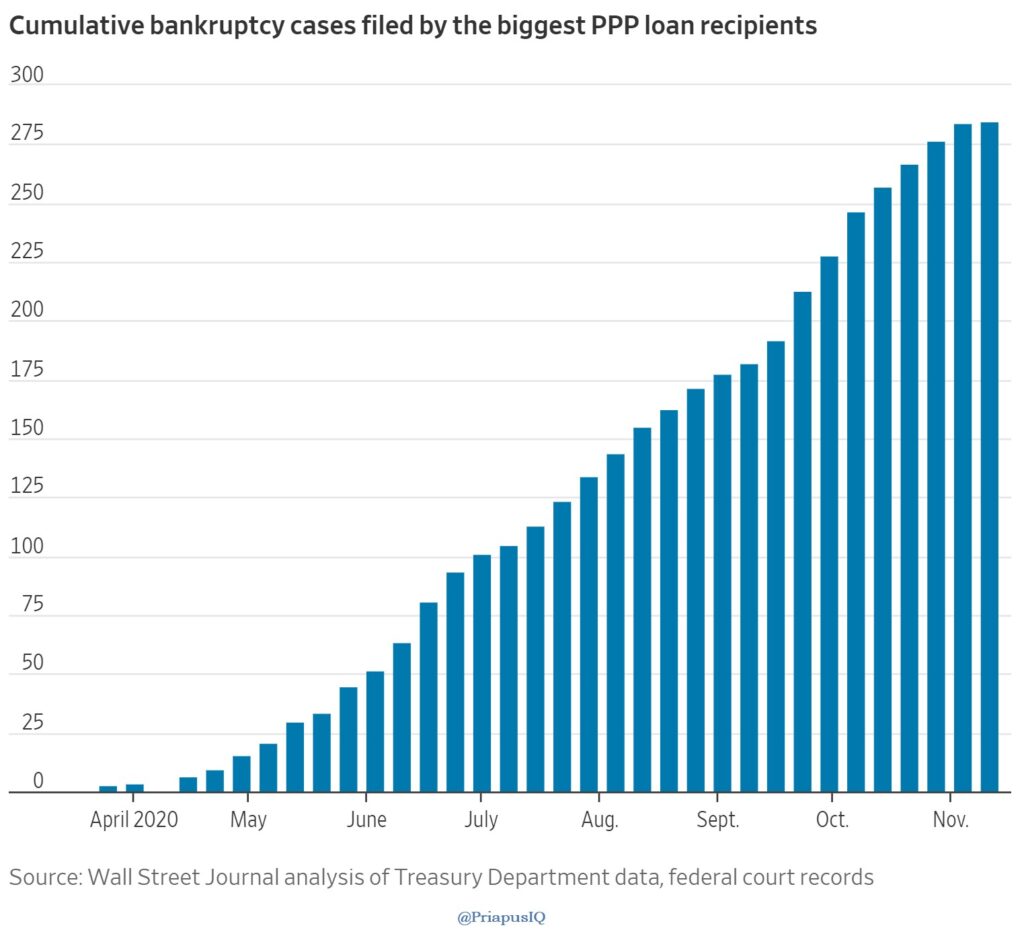
A most popular loan group to go bust is the smallest category which is those getting $150,000 to $350,000. That makes sense because the smallest companies are the most vulnerable. 125 of them went bust. Each category with more money in loans had fewer firms default. Obviously, there are fewer big firms than small ones.
Less than 25 firms getting loans from $5 million to $25 million went bankrupt. It’s no surprise, the biggest states had the most PPP recipients that went bankrupt. Over 40 PPP loans were given to Californian businesses that went bust. Over 35 were in Texas and Florida each.
Better Than Expected Industrial Production
In September, retail sales beat estimates and industrial production missed estimates. In October, it was the reverse. September’s data was revised higher and October’s growth beat estimates. Monthly industrial production growth was revised up from -0.6% to -0.4%. October’s growth was 1.1% which beat estimates by a tick.
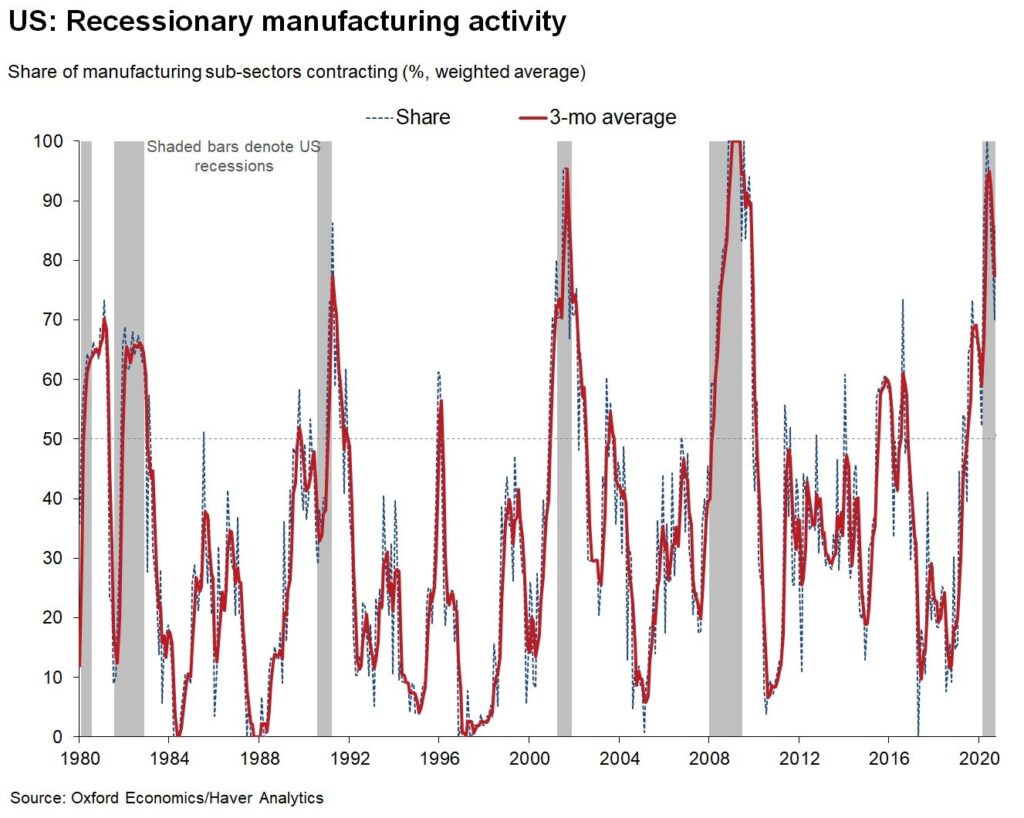
Manufacturing growth was revised up from -0.3% to 0.1%. October’s growth beat estimates by a tick as it was 1%. As you can see from the chart below, the percentage of manufacturing industries in recession is off the peak, but is still high. It’s at 86%; the 3 month average is 78%. Capacity to utilization rate rose from 72% to 72.8%. Last month’s reading was revised up 0.5% and this month’s reading beat estimates by 6 tenths.
Yearly manufacturing growth rose from -5.1% to -3.6%. Yearly industrial production growth rose from -6.7% to -5.3%. Manufacturing was led by aerospace, metals, printing, and paper. Aerospace should improve as the economy reopens and flying recovers. Mining was down 0.6% because of oil and gas. Yearly mining production growth fell from -18.8% to -19.3%. That will recover strongly next year when oil rises to $60.
Utilities production was up 3.9% because of electricity demand. Industrial production is 5.6% off its pre-recession high and manufacturing is 5% off its pre-recession high. We still have a few quarters left of this cyclical global recovery. We are at least 6 months away from even thinking about a cyclical peak. Stay bullish!